(The novel, E Unum Pluribus, is narrated by Jack Shirley, an office intern whose gender behavior doesn’t always fit the expectations common in contemporary Amero-European culture. Anticipating that Jack’s character may arouse comment, this is one in a series of posts to share the author’s thoughts around those expectations. Caution: this one gets a bit long…)
A previous post* suggested, given that the vast majority of social interactions do not afford us the opportunity to know what reproductive cells any individual’s organs produce (the recent Presidential definition of ‘sex’), nor whether they have a penis or a vagina (the more common and time-tested way of differentiating the sexes) nor (in deference to current anti-trans sentiments) what their genitals may have looked like at the time of their birth (a particularly difficult standard to meet, in any normal social situation!), it is very rare that we actually and definitively know the sex of any person we may meet.
That post went on to comment that the common practice of calling some persons men and some women (as opposed to male and female) is really based not on sex but on gender, the wide range of visual, audible, or other cues that we presume to be consistent with the sex we cannot actually identify.
Herewith, a (very) abbreviated list of some of the cues which are available in social contexts and so may be incorporated as we make our presumptions of sex (starting, for no critical reason, from top and running towards bottom):
Length of the hair on one’s head – and its style of cut, neatness/carelessness
Whether that hair is obviously bleached or colored
Whether it interferes with range of vision, or is artificially held in position (clips, spray…)
Pattern of visible hair loss (if any; though this can be obscured by corrective measures)
Earrings (none, one or two or more; fixed in place or changeable; size, shape, color, material…)
Size and shape of head
Ditto, of face
Ditto, of eyes
Ditto, of eyebrows and whether they appear to have been plucked, waxed or otherwise altered
Ditto, of nose
Ditto, of lips, and their color (whether natural, or artificial)
Wearing of cosmetics/make-up – how much, how ‘natural,’ dramatic – or plausibly deniable.
Presence, extent and appearance of body hair on face, legs, chest, arms, armpits, nostrils, ears, groin…and whether that is flaunted, hidden, styled, removed or simply never spoken about
Presence of tattoos – size, location, extent, content – as well as piercings or other body modifications
Noticeability of laryngeal prominence (‘Adam’s Apple’)
Pitch, tone, softness etc. of voice, not to mention word choice, emotional content of speech…
Width of shoulders (relative to chest, hips etc.)
Thickness of arms (is the person ‘pumped,’ ‘skinny,’ ‘flabby,’ or ‘undeveloped’…)
Size and/or slenderness of hands and fingers, visible veins on back of hands
How carefully fingernails are trimmed, filed and cleaned (or not!) and to what curvature
Presence of paint or polish on said fingernails
Convexity of the chest (flat, not flat, prominent; in near-infinite variations and degrees)
Color, fabric, pattern of whatever clothes cover the upper body (shirt, blouse, tunic, crop, tank…)
Size and location of fasteners on such clothes
Tailoring of such clothes (sleeve length and cuff style, collar style, cut full or fitted, cut short to expose midriff, or tailored long to cover hips; tucked or untucked….)
Types, amount, styles and weightiness of jewelry
Slenderness of waist, relative to other body parts
Location of waist (high, thanks to long legs and a short torso, or low due to short legs and long torso) though this is often disguised or manipulated high- or low-waisted clothes
Prominence, or not, of ‘belly’
Location and proportions of belly or abdominal bulk
Width of hips/butt relative to waist and shoulders.
Shape and ‘fullness’ of derriere (butt)
Wearing clothes that cover each leg separately (pants) or together (skirt, dress, robe, gown, toga, sarong, thobe, kilt, gho, dhoti, kimono, boubou, djellaba, shalwar kameez, etc.).
Whether footwear is traditionally functional, or whimsically decorative and ‘impractical’
Height of shoe heels (cowboy boots being an exception to the usual interpretation of this)
Paint or polish on toe nails
And, abandoning the head-to-toe geography, a few more generalized gender distinguishers:
Dressed in clothes that look practical/durable/rugged, or obviously decorative (‘frivolous’)
Wearing an ‘outfit’ (meaning multiple items of the same fabric and color, or items carefully and obviously selected to create a nameable ‘look’)
(Other than a man’s business suit, which is very carefully regimented and strategized and certainly intended to convey a certain ‘look’ and image, but would never be called ‘an outfit’ by the sort of men who habitually don it)
Posture (shoulders or hips forward? head high or neck bent? spine straight or curved?)
Gait (long or short strides, quick or leisurely, bowlegged, pigeon-toed, bounding, ‘mincing,’ marching…)
How one sits or crosses one’s legs – a man-spread vs. an aspirin between the knees look
Default facial expression – open and welcoming, serious, wary, challenging, belligerent…
Engaged in an activity or occupation commonly thought of as manly or feminine, serious or frivolous, rowdy or refined, graceful or violent, ‘productive’ or ‘women’s work.’
Smelling sweetly of perfume/cologne
Or, less sweetly, of sweat, waste, food or beverage, poor hygiene or simple lack of the economic means to avoid odors
Exposing the flesh of one’s legs, arms, shoulders or more in any but an athletic situation (acceptable and even encouraged for females even in very formal settings, but highly unacceptable for males in those very same settings)
So? (you may well ask).
Clearly, that list can go on almost without end, but the above examples seem sufficient to illustrate that, as much as we regularly employ such cues to classify individuals as ‘a man’ or ‘a woman’ and also, very importantly, to critique individuals for not behaving ‘like a man’ or ‘like a woman,’ none of these cues are actually direct consequences of the form (or function) of a person’s reproductive organs.
And, given the number of such cues, it is virtually impossible that any two individuals will exhibit exactly the same variation on every cue (except perhaps, identical twins dressing identically and acting identically as a prank; an exception which actually helps illustrate the validity of the rule in every other case). Even uniformed personnel and incarcerated persons – or performers in a chorus line – who are required to dress uniformly and follow uniform rules for hair, jewelry, cosmetics, etc., are readily distinguished from one another by various gender cues.
Oh, and:
Many of these cues are exhibited and/or interpreted differently by individuals of different racial or ethnic heritage
Many of these cues are exhibited and/or interpreted differently by persons from different cultures, locales, native languages and even political leanings
Many of these cues are, or have been, interpreted differently by persons of different generations, or historical periods
Those statements are true despite the relatively slow pace of natural biological evolution giving assurance that the form and function of male and female sexual organs do not differ significantly from one heritage, culture or time period to another, so those differences of expression and interpretation cannot be dictated by what we say governs one’s sex. Though expressions of gender cues may very well be chosen in conscious or subconscious effort to appear as one sex or the other; such choices would be entirely unnecessary if one’s actual sex was as apparent and binary as we are conditioned to presume.
Further, for each such cue, there exists a wide range of variance among males, and also a wide range of variance among females and one can readily identify persons who otherwise appear to be men, but whose expression of a particular cue falls within the range of variance exhibited by females for same. Conversely, one could readily identify persons who otherwise appear to be women, but whose expression of a particular cue falls within the range of variance exhibited by males.
For those reasons and more, identifying any number of ‘masculine’ or ‘feminine’ cues given out by any individual can, at best, influence one’s perception of the likelihood that that individual is male or female but none of these cues, by themselves or in combination, are actually reliable proof of any individual’s biological sex
To the extent any publicly available cues reveal anything at all about an individual, it is their gender, not their sex and given the number of possible cues and the variations in how each individual exhibits or interprets each of those cues over time, the reality is that there are not two genders – one exclusively manly and the other exclusively womanly and each fixed at birth and separate from the other – but as many genders as there are individuals.
(If not more, since one’s expressions of many such cues naturally varies from day to day and over a lifetime!)
Thus, ‘non-binary’ is far more than a woke label for some newly-invented identity group of persons who intentionally violate gender norms.
In the most basic sense, ‘non-binary’ is what all humans are. It is part and parcel of being an individual. Every one of us embodies, consciously or not, our own unique blend of gender cues and characteristics. Acknowledging that, and allowing for it in our language, laws, polices and behaviors towards one another is a prerequisite to allowing life, liberty and the pursuit of happiness to all.
It’s time to slay the gender binary!
*Previous post: Humans Got Gender! 7/27/2026, https://nobodysays2025.substack.com/publish/post/203904286
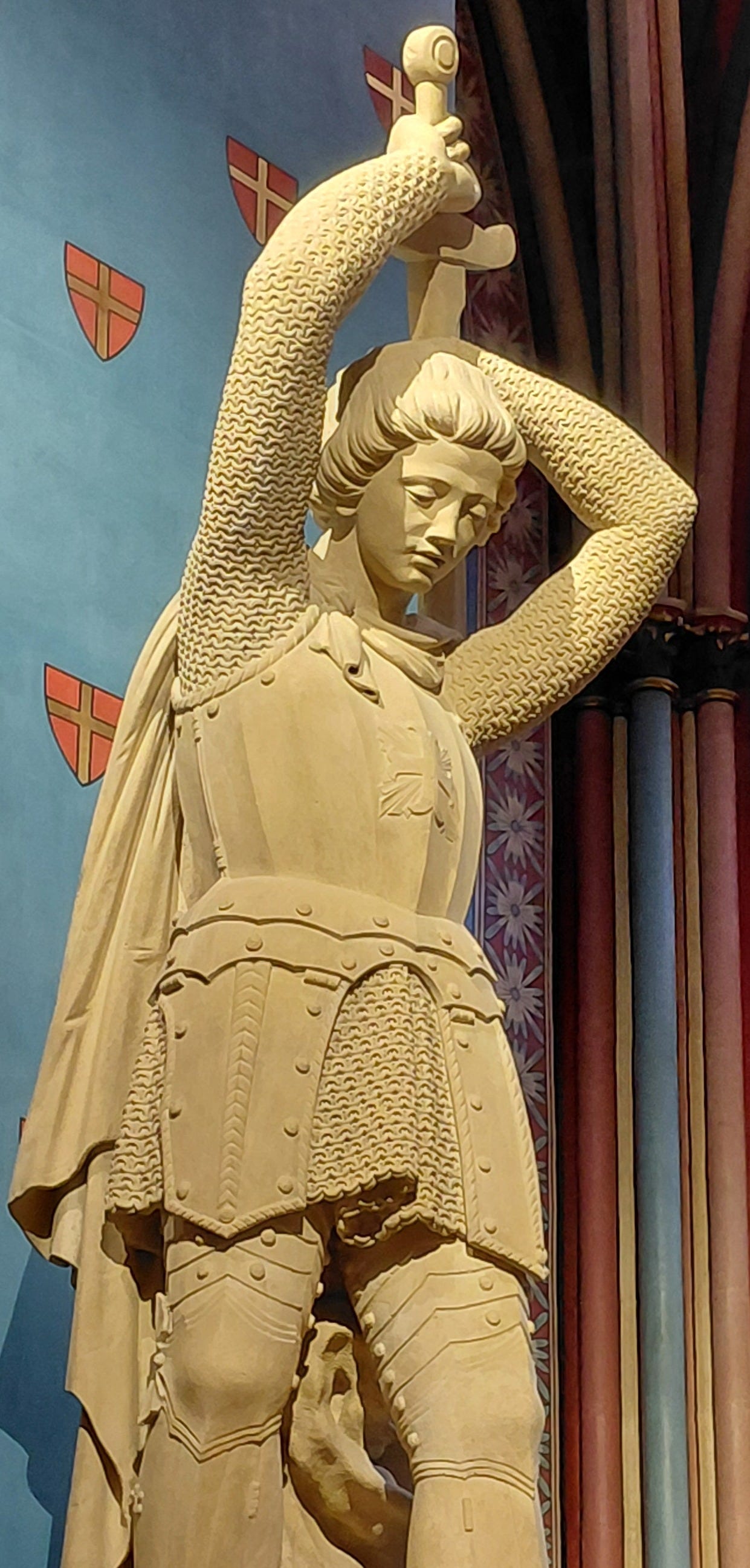
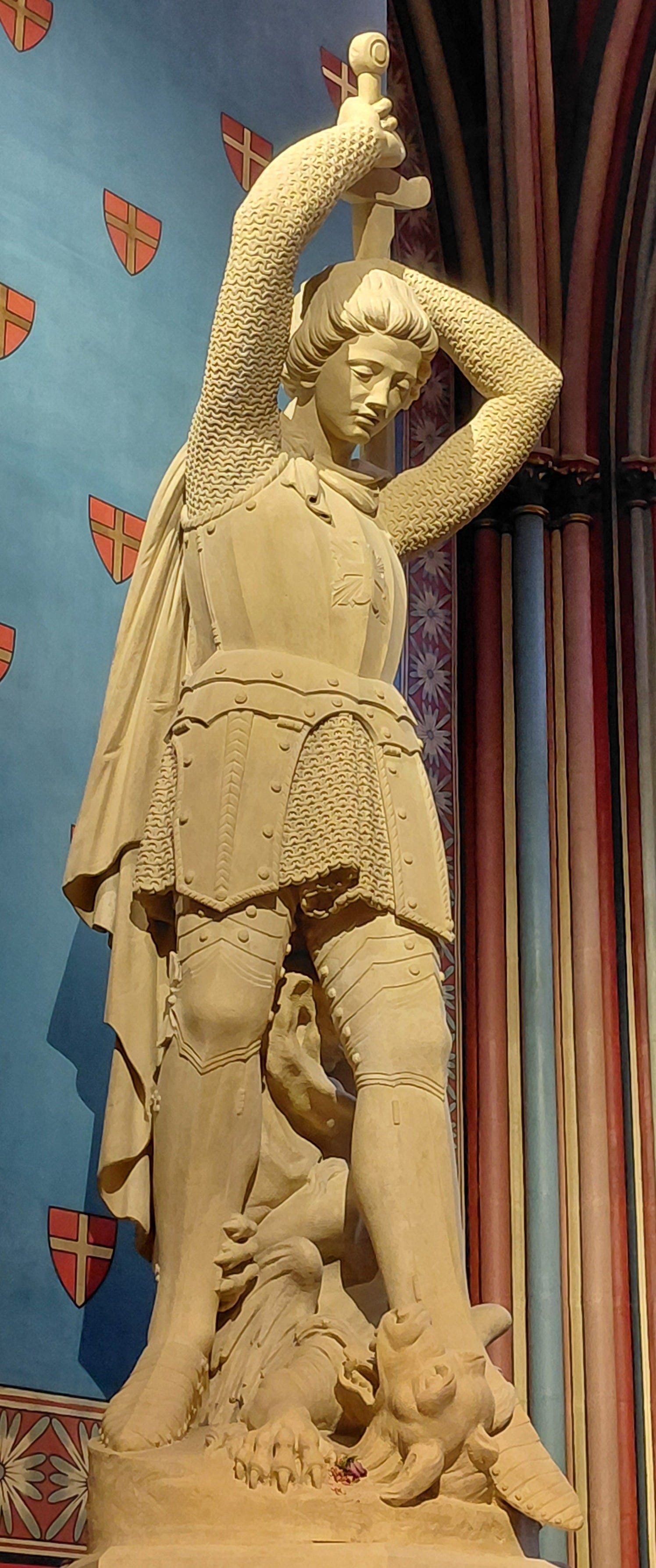
Image: author photograph of a statue of St. George, The Dragon Slayer, taken in the Cathedral of Notre Dame, Paris, France.
P. S. – E Unum Pluribus is a speculative fiction exploring one way in which our current ‘culture wars’ may bring an end to the U. S. A., and what might come in its wake. With a thrilling plot driven by politics and economics (as well as gender, class, language and even the origins of faith) the novel is currently being serialized online and anyone can read it, at no cost, by navigating to home page of this website E Unum Pluribus from the top menu, or via this link: https://robinandrew.net/2026/01/01/e-unum-pluribus/