Tag Archives: Freedom

‘They’ want to turn us all into transexuals!

♀…♂…⚥…?!

Among the many slings and arrows tossed by counter-progressive voices these days are allegations that some amorphous ‘they’ of radical-liberal social engineers is “trying to make us all trans.”  A particularly twisted component of those alarms are accusations that gender-care supporters and medical professionals are coercing young persons into irreversible medical interventions – defenseless young persons who supposedly would never have chosen such treatment on their own and will regret it for the rest of their lives.   Without in any way accepting those arguments, one can still imagine that earlier posts suggesting use of gender-free pronouns run the risk of being classed as part of that same imagined conspiracy, so some response seems worthwhile.

Starting with: Literature, memoir, anthropological scholarship and legal references demonstrate there have long been individuals in many cultures who chose not to conform to the general consensus on how a woman or a man must look and behave.  The fact that conservative religious commentators can find admonitions around gender ‘rules’ in a document as ancient as the Old Testament’s book of Deuteronomy makes clear that modern gender diversity does not need to be drummed up by any elitist cabal or progressive conspiracy; it is part of human nature. 

As to whether there are more such nonconformers in the USA today than at any other time or in any other place, the truth is: no one knows!  What can be reliably said is that, given the high price persons tend to pay for being open about such things, there are certainly more hidden figures today than the few who are brave enough to let themselves be known. And, given that the consequences of nonconformance have been even higher in many other times and places, there probably have been more such silent examples in those as well.  With no way to document either half of the equation, then, it is pointless to argue what the trend has been, or even whether there is any trend.

If, despite that understanding, gender nonconformity seems more visible in twenty-first century America than elsewhere or when, that visibility is better taken as reflecting the high value our era places on variety, creativity, honesty and freedom of expression – characteristics widely recognized as crucial to the nation’s success in economics, justice, scholarship, technological innovation and other realms wherein it has consistently outperformed more orthodox and fundamentalist cultures.   Nonconformity is, in other words, a positive, not a negative phenomenon.

All that said, it would certainly be undesirable for any person, young or old, to feel pressured into changing their appearance, activities or physiology, especially not through costly or invasive and occasionally dangerous medical interventions.  To determine whether or not that is happening, we don’t need to search medical records or point accusing fingers at those who’ve made different choices than any of us might make.  Not when, right in front of our eyes and ears is a language and a grammar that requires every person be repeatedly and continuously categorized in one (and only one) of two (and only two) distinct and mutually exclusive genders: be a woman or be a man, no alternatives considered.  If there’s anything coercing young persons who are at all uncomfortable with the gendered behaviors to which their physiology is said to direct them, a prime suspect should be that language.

Of course, the fear of ridicule, intimidation, prosecution or bodily harm if ever their gender curiosity is detected are also powerful discouragements of experimentation. Even in this though binary language is not helping, as those fortunate enough to have a potential for passing as ‘the other’ gender may find it safer to change their identity completely from that of a woman to that of a man – or vice versa – than to risk inhabiting any unnamed and unrecognized region in between, even if that would be the highest expression of their true preferences.  This is perhaps one way in which invasive measures may truly be the result of coercion – not by the medical establishment but by narrow minds insisting that gender is an either/or thing, that all aspects of one’s life should conform to one gender. By voices, in other words, who believe they have a right to police the personal expressions of others.

So, to those worried about gender affirming treatments: if you want to reduce the number of young people choosing to call themselves trans and maybe even seeking surgical treatment, please consider whether your gender assumptions get in the way of your acting respectfully toward all young persons, however they choose to look or live in the world.  Maybe try imagining a world in which young males can be whatever variety of person each of them want to be (not whatever kind you happen to think is ‘a ‘real man’) and young females can each grow up to be whatever sort of person they wish to be (not necessarily the kind who end up on magazine covers or cooking three meals a day three hundred and sixty five days a year).

Is that belligerent? Defensive? Maybe; but the truth is that a world in which anyone can safely and openly inhabit whatever combination of ‘feminine’ or ‘masculine’ attributes best suit their inner nature is a world in which fewer persons will feel any pressure to totally switch from Column A to Column B.  And a world in which gender-free pronouns provide a respectful way to communicate about persons who mix their own recipes is more conducive to individual freedom and to the common good than one in which every consideration must start by classifying every individual into one or the other of two rigid and unchangeable gender templates that very well may impede them from living happily and productively as the unique individual they truly are.

Which is why, if trans-wary observers truly wish to minimize pressure on young persons to make what they consider poor choices about their gender or biology, they should be right on board with use of gender-free pronouns as one small step to encourage variation with moderation, expression without extremism and exploration without irreversible commitment.

P. S. – E Unum Pluribus is a speculative fiction exploring one way in which our current ‘culture wars’ may bring an end to the U. S. A., and what might come in its place. With a thrilling plot driven by politics and economics (as well as gender, class, language, magic and even the origins of faith) the novel is currently being serialized online and anyone can read it, at no cost, by navigating to the home page of this website and selecting E Unum Pluribus from the top menu, or via this link: https://robinandrew.net/2026/01/01/e-unum-pluribus/

Please feel free to share this post however you wish!

And, if you like what you read here at robinandrew.net, please subscribe – it’s absolutely free!
If Gender Ain’t Sex, What is it?

(The novel, E Unum Pluribus, is narrated by Jack Shirley, an office intern whose gender behavior doesn’t always fit the expectations common in contemporary Amero-European culture.  Anticipating that Jack’s character may arouse comment, this is one in a series of posts to share the author’s thoughts around those expectations. Caution: this one gets a bit long…)

A previous post* suggested, given that the vast majority of social interactions do not afford us the opportunity to know what reproductive cells any individual’s organs produce (the recent Presidential definition of ‘sex’), nor whether they have a penis or a vagina (the more common and time-tested way of differentiating the sexes) nor (in deference to current anti-trans sentiments) what their genitals may have looked like at the time of their birth (a particularly difficult standard to meet, in any normal social situation!), it is very rare that we actually and definitively know the sex of any person we may meet.

That post went on to comment that the common practice of calling some persons men and some women (as opposed to male and female) is really based not on sex but on gender, the wide range of visual, audible, or other cues that we presume to be consistent with the sex we cannot actually identify. 

Herewith, a (very) abbreviated list of some of the cues which are available in social contexts and so may be incorporated as we make our presumptions of sex (starting, for no critical reason, from top and running towards bottom):

Length of the hair on one’s head – and its style of cut, neatness/carelessness

Whether that hair is obviously bleached or colored

Whether it interferes with range of vision, or is artificially held in position (clips, spray…)

Pattern of visible hair loss (if any; though this can be obscured by corrective measures)

Earrings (none, one or two or more; fixed in place or changeable; size, shape, color, material…)

Size and shape of head

Ditto, of face

Ditto, of eyes

Ditto, of eyebrows and whether they appear to have been plucked, waxed or otherwise altered

Ditto, of nose

Ditto, of lips, and their color (whether natural, or artificial)

Wearing of cosmetics/make-up – how much, how ‘natural,’ dramatic – or plausibly deniable.

Presence, extent and appearance of body hair on face, legs, chest, arms, armpits, nostrils, ears, groin…and whether that is flaunted, hidden, styled, removed or simply never spoken about

Presence of tattoos – size, location, extent, content – as well as piercings or other body modifications

Noticeability of laryngeal prominence (‘Adam’s Apple’)

Pitch, tone, softness etc. of voice, not to mention word choice, emotional content of speech…

Width of shoulders (relative to chest, hips etc.)

Thickness of arms (is the person ‘pumped,’ ‘skinny,’ ‘flabby,’ or ‘undeveloped’…)

Size and/or slenderness of hands and fingers, visible veins on back of hands

How carefully fingernails are trimmed, filed and cleaned (or not!) and to what curvature

Presence of paint or polish on said fingernails

Convexity of the chest (flat, not flat, prominent; in near-infinite variations and degrees)

Color, fabric, pattern of whatever clothes cover the upper body (shirt, blouse, tunic, crop, tank…)

Size and location of fasteners on such clothes

Tailoring of such clothes (sleeve length and cuff style, collar style, cut full or fitted, cut short to expose midriff, or tailored long to cover hips; tucked or untucked….)

Types, amount, styles and weightiness of jewelry

Slenderness of waist, relative to other body parts

Location of waist (high, thanks to long legs and a short torso, or low due to short legs and long torso) though this is often disguised or manipulated high- or low-waisted clothes

Prominence, or not, of ‘belly’

Location and proportions of belly or abdominal bulk

Width of hips/butt relative to waist and shoulders.

Shape and ‘fullness’ of derriere (butt)

Wearing clothes that cover each leg separately (pants) or together (skirt, dress, robe, gown, toga, sarong, thobe, kilt, gho, dhoti, kimono, boubou, djellaba, shalwar kameez, etc.).

Whether footwear is traditionally functional, or whimsically decorative and ‘impractical’

Height of shoe heels (cowboy boots being an exception to the usual  interpretation of this)

Paint or polish on toe nails

And, abandoning the head-to-toe geography, a few more generalized gender distinguishers:

Dressed in clothes that look practical/durable/rugged, or obviously decorative (‘frivolous’)

Wearing an ‘outfit’ (meaning multiple items of the same fabric and color, or items carefully and obviously selected to create a nameable ‘look’)

(Other than a man’s business suit, which is very carefully regimented and strategized and certainly intended to convey a certain ‘look’ and image, but would never be called ‘an outfit’ by the sort of men who habitually don it)

Posture (shoulders or hips forward? head high or neck bent? spine straight or curved?)

Gait (long or short strides, quick or leisurely, bowlegged, pigeon-toed, bounding, ‘mincing,’ marching…)

How one sits or crosses one’s legs – a man-spread vs. an aspirin between the knees look

Default facial expression – open and welcoming, serious, wary, challenging, belligerent…

Engaged in an activity or occupation commonly thought of as manly or feminine, serious or frivolous, rowdy or refined, graceful or violent, ‘productive’ or ‘women’s work.’

Smelling sweetly of perfume/cologne

Or, less sweetly, of sweat, waste, food or beverage, poor hygiene or simple lack of the economic means to avoid odors

Exposing the flesh of one’s legs, arms, shoulders or more in any but an athletic situation (acceptable and even encouraged for females even in very formal settings, but highly unacceptable for males in those very same settings)

So? (you may well ask).

Clearly, that list can go on almost without end, but the above examples seem sufficient to illustrate that, as much as we regularly employ such cues to classify individuals as ‘a man’ or ‘a woman’ and also, very importantly, to critique individuals for not behaving ‘like a man’ or ‘like a woman,’ none of these cues are actually direct consequences of the form (or function) of a person’s reproductive organs. 

And, given the number of such cues, it is virtually impossible that any two individuals will exhibit exactly the same variation on every cue (except perhaps, identical twins dressing identically and acting identically as a prank; an exception which actually helps illustrate the validity of the rule in every other case).  Even uniformed personnel and incarcerated persons – or performers in a chorus line – who are required to dress uniformly and follow uniform rules for hair, jewelry, cosmetics, etc., are readily distinguished from one another by various gender cues.

Oh, and:

Many of these cues are exhibited and/or interpreted differently by individuals of different racial or ethnic heritage

Many of these cues are exhibited and/or interpreted differently by persons from different cultures, locales, native languages and even political leanings

Many of these cues are, or have been, interpreted differently by persons of different generations, or historical periods

Those statements are true despite the relatively slow pace of natural biological evolution giving assurance that the form and function of male and female sexual organs do not differ significantly from one heritage, culture or time period to another, so those differences of expression and interpretation cannot be dictated by what we say governs one’s sex.  Though expressions of gender cues may very well be chosen in conscious or subconscious effort to appear as one sex or the other; such choices would be entirely unnecessary if one’s actual sex was as apparent and binary as we are conditioned to presume.

Further, for each such cue, there exists a wide range of variance among males, and also a wide range of variance among females and one can readily identify persons who otherwise appear to be men, but whose expression of a particular cue falls within the range of variance exhibited by females for same. Conversely, one could readily identify persons who otherwise appear to be women, but whose expression of a particular cue falls within the range of variance exhibited by males.

For those reasons and more, identifying any number of ‘masculine’ or ‘feminine’ cues given out by any individual can, at best, influence one’s perception of the likelihood that that individual is male or female but none of these cues, by themselves or in combination, are actually reliable proof of any individual’s biological sex

To the extent any publicly available cues reveal anything at all about an individual, it is their gender, not their sex and given the number of possible cues and the variations in how each individual exhibits or interprets each of those cues over time, the reality is that there are not two genders – one exclusively manly and the other exclusively womanly and each fixed at birth and separate from the other – but as many genders as there are individuals.

(If not more, since one’s expressions of many such cues naturally varies from day to day and over a lifetime!)

Thus, ‘non-binary’ is far more than a woke label for some newly-invented identity group of persons who intentionally violate gender norms.

In the most basic sense, ‘non-binary’ is what all humans are.  It is part and parcel of being an individual.  Every one of us embodies, consciously or not, our own unique blend of gender cues and characteristics.  Acknowledging that, and allowing for it in our language, laws, polices and behaviors towards one another is a prerequisite to allowing life, liberty and the pursuit of happiness to all.

It’s time to slay the gender binary!

*Previous post: Humans Got Gender!  7/27/2026, https://nobodysays2025.substack.com/publish/post/203904286

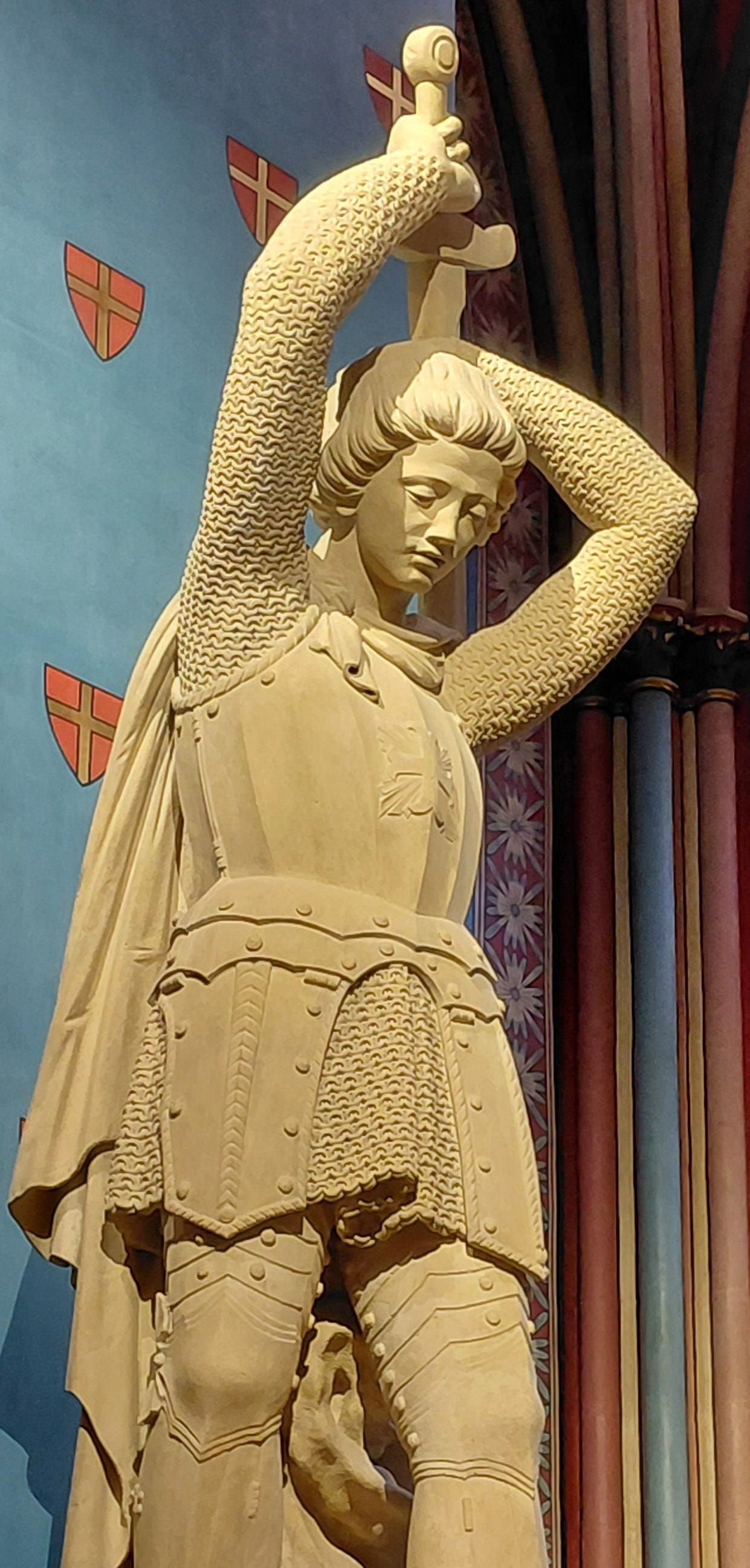
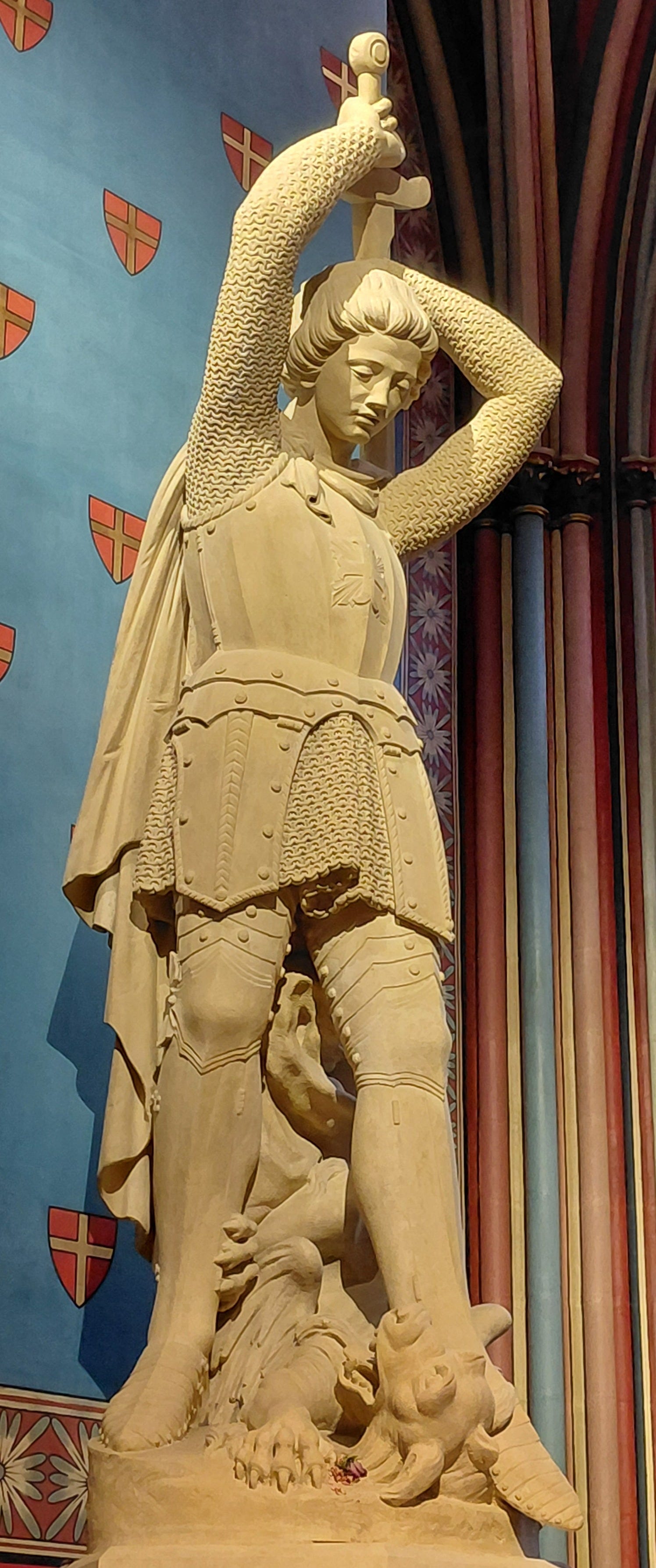
Image: author photograph of a statue of St. George, The Dragon Slayer, taken in the Cathedral of Notre Dame, Paris, France.

P. S. – E Unum Pluribus is a speculative fiction exploring one way in which our current ‘culture wars’ may bring an end to the U. S. A., and what might come in its wake. With a thrilling plot driven by politics and economics (as well as gender, class, language and even the origins of faith) the novel is currently being serialized online and anyone can read it, at no cost, by navigating to home page of this website E Unum Pluribus from the top menu, or via this link: https://robinandrew.net/2026/01/01/e-unum-pluribus/

Images of The Prophet?

In the aftermath of Paris, we’re hearing a lot of talk about whether or not Islam truly prohibits images of the Prophet, but that is an entirely wrong-headed question for the broad public debate. 

Sure, that particular question is important to practitioners of Islam, and if they believe it is so, they should be (and so far as I know, are) free to not create such images, not display such images in their homes, their mosques, etc., and to not purchase materials which contain such images.

But their freedom to practice their religion cannot be allowed to create a constraint on the equal religious freedom of others.  I am not a Muslim, and I do not accept that their religious teachings have any bearing on whether I wish to draw, sell or view images of the man they call The Prophet.  To accept or legislate that would be an abridgement of my freedom of religion.

If you are offended by Charlie Hebdo, don’t buy it!  If you are offended by even seeing it for sale,  stay away from places that sell it – or better yet, take control of your emotions, and walk on by.  Any human being can be (and probably is) exposed on a daily basis to appearances or behaviors they do not like, or by which they feel offended, but your feeling offended is not sufficient reason to curtail anyone else’s freedom.

Which exposes the true breadth of the issue at hand; that if criminality or prohibition of any behavior is determined on the basis of whether or not someone is offended or their feelings hurt by it, then all semblance of rationality, consistency or proportionality is lost, because persons can choose to be offended by anything.  That is neither freedom nor justice.