
(The novel, E Unum Pluribus, is narrated by Jack Shirley, an office intern whose gender behavior doesn’t always fit the expectations common in contemporary Amero-European culture. Anticipating that Jack’s character may arouse comment, this is one in a series of posts sharing the author’s thoughts around those expectations.)
The previous post on this website* – If Gender Ain’t Sex, What is it? – made the case that every individual human presents a unique array of gender cues in varying degrees, that those cues do not result directly from the specific anatomical features which are considered to determine the sex of each human, and that it is very common – and entirely ‘normal’ – that some individuals’ expression of some gender cues falls within a range casually regarded as indicating ‘the opposite sex.’
Why, then, do so many institutions and practices (at least in the English-speaking world) continue to observe the convention that every human belongs to one or the other of only two human genders, fixed at birth and mutually exclusive?
One (generous) reason: framing any issue as a binary choice between opposites simplifies the viewer’s life, reduces a possibly baffling array of choices and generally avoids the work of treating unique instances differently to suit their differences.
It would be quite possible, for example, to frame all discussion of daily timing purely in terms of the dark time and the light time. I’ll meet you in the light, or I’ll meet you when its dark. I woke up in the light or, or if it was earlier, I woke up in the dark. Perfectly true, but not very useful. Even without resorting to clocks and timekeeping, it would be a whole lot more useful to refine things a little by adding words like sunrise, sunset, dawn and dusk. Still, there would be instances where dark and light are not as consistent as all that. A moonless night is clearly part of the dark time, but I’ve been out at 3 AM under a full moon and once my eyes adjusted, it was definitely more light than dark. A great opportunity, in fact, for performing some ‘daytime’ activities before the sun gets too hot.
Speaking of a hot sun, how about the rainbow world of color? Despite the ability of the human eye to distinguish between at least a million colors, artists and designers sometimes simplify them all and speak of just the ‘warm’ colors and the ‘cool’ ones. Thousands of shades of red, yellow, orange and such are ‘warm,’ blues and greens and all the rest are ‘cool.’ No need to mess with scores of pesky names like carmine, maroon, egplant, ultramarine, cobalt, cadmium, peach, chartreuse and American Flag blue. So much more efficient, so much potential wasted.
Or age: one could define all persons up to and including some arbitrary age as ‘young’ (I’d pick 74, but you might choose another number…) and everyone over that as ‘old.’ Simple, convenient, with no gradations, no ‘sort of,’ but not very useful or true, given how differently individuals age and perform. Intelligence? Anyone with an IQ of 134 or higher is a ‘genius,’ anyone with a lower score is ‘dumb.’ Politics? “Anyone to the ‘left’ of me is a communist, anyone not to the left of me is right” – in both senses…
The point is: you can turn any observable phenomenon into a binary by ignoring or defining-away all the things that make it more complex. Any such simplification though, reduces options, misses possible benefits of more complete understanding and works against the inherent variability (freedom) of whatever or whoever is being binaried. Except in the very few cases where such brutal efficiency is truly required (separating the many species of wild mushrooms into ‘deadly’ and ‘non-deadly’ ones, for example), it leads mostly to WFA (waste, fraud and abuse).
Which is the case with our traditional binary gender system. Its survival depends upon us all ignoring the many differences between individual men and between individual women as well as the many characteristics which some or all men have in common with some or all women (and vice versa) in return for the simplicity of treating every person as a member of one or the other blunt and arbitrary category. Aside from the mental labor of constantly deciding what to see and what to pretend not to see, this process causes confusion and pain and reduces the achievement potential of all those individuals who do not closely conform to other persons’ ideas of what is ‘normal’ for a man or a woman.
Another (and less-generous) reason:
As the examples in the third paragraph above suggest, whenever humans posit a binary distinction, it eventually results in one binary being considered the default; superior, preferable or, in any of a thousand other ways, the better of the two.
Day is preferable to night, to the extent that most of us choose to sleep through much of the latter. Being young is widely preferred over being old, intelligence over its lack, and being right about anything is way better than being wrong (once one defines away the possibility of both sides being partly correct and partly mistaken). As to the human genders, libraries have been written and voices driven hoarse pointing out the many ways in which gender stereotypes and practices premiate ‘men’s’ activities and achievements over those of ‘women.’
Separate but equal is no more attainable an outcome in human gender than it ever was (or is) in relations between those considered to be of different races.
So…what’s your solution?
It is not at all difficult to imagine a language which recognizes the complexity of human gender. A person born with a penis but who exhibits sufficient characteristics considered suitable for a woman might choose to be called a ‘male woman.’ A person born with a vagina but who exhibits characteristics considered to be inconsistent with womanhood might choose to be called a ‘feman.’ An intellectual who expends little energy on personal appearance, the search for a romantic partner or popular spectator sport culture in order to focus on their own scientific interests (think the character Sheldon, on TV’s the Big Bang Theory, for example, or the character of Amy from the same show), might self-identify first as a ‘geek’ or ‘nerd’ and let others worry about the man or woman part. I’ve heard individuals of either gonadotype refer to themselves as ‘queer’ in apparent rejection of gender-box-ification.
Easy as that may seem, such typing is too often imposed by others in order to ridicule or discriminate against gender offenders. It also runs the risk of multiplying genders endlessly or encouraging ‘identity group’ politics, a no-no in today’s culture-war environment. Better to allow any such alternative gender identities to grow slowly and organically from the desires of their members and so facilitate pride in their alternative identification. Much as the use of ‘gay’ grew from that community’s coalescence, or as I’ve read some non-hetero female writers use ‘fem’ and ‘butch’ in non-derisive reference to particular members of their community.
Another approach – encouraging users of the English language to utilize non-gendered pronouns (E, em, eir, or similar) whenever an individual’s gender preference is not definitively known – can be a big step toward acknowledging and freeing up the infinite variety of human nature and gender expression – a good start on getting away from the binary.
P. S. – E Unum Pluribus is a speculative fiction exploring one way in which our current ‘culture wars’ may bring an end to the U. S. A., and what might come in its wake. With a thrilling plot driven by politics and economics (as well as gender, class, language and even the origins of faith) the novel is currently being serialized online and anyone can read it, at no cost, by navigating to home page of this website and selecting E Unum Pluribus from the top menu, or via this link: https://robinandrew.net/2026/01/01/e-unum-pluribus/
Please feel free to share this post as widely as you like
If you like what you read here at robinandrew.net, please subscribe. It’s Free!
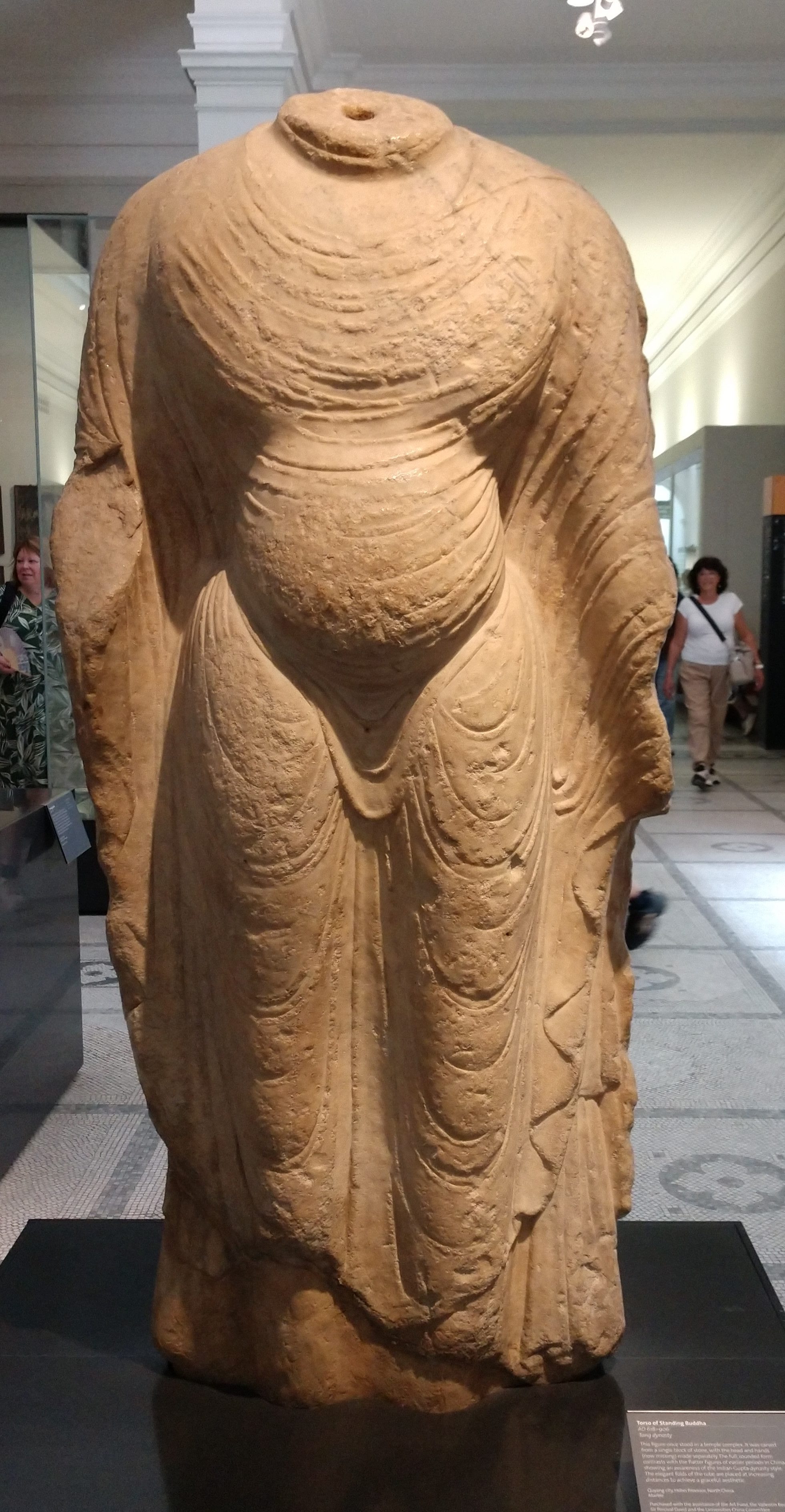
Opening Image: author photograph of Torso of Standing Buddha, AD 618-906, Tang Dynasty, Victoria and Albert Museum, London, UK
*Previous post: https://robinandrew.net/2026/08/28/if-gender-aint-sex-what-is-it/

