
Tag Archives: books

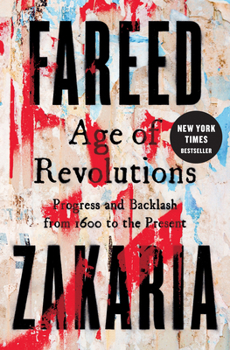
Age of Revolutions – Progress and Backlash from 1600 to the Present

In the historical/political realm, the word ‘revolution’ is commonly applied to a singular event of momentous change. In the realms of physics and mechanics, as Fareed Zakaria reminds us early in this very timely political history, ‘revolution’ means movement of an object or a system around its center, in which any point other than that exact center moves in a circle, initially getting farther away from where it once was but eventually returning to that same point before repeating the cycle.    

With that in mind, the author cogently and persuasively recounts several significant revolutions of the past 500 years, considering each as a cycle driven by some changed circumstances (new knowledge, new inventions, ravaging disease, etc.) and shaped by human choices (often with crucial contributions by extraordinary individuals).  Most importantly, he points out how in each case, the great upheaval we tend to best remember was followed by counter-revolution, a complimentary (in the geometric sense, that is, not the conversational) effort by those not in favor of that revolution’s effects to roll back the cycle of history.

A second crucial point of Zakaria’s is visible in his choice of ‘revolutions’ on which to focus: not only the political (England’s supposedly ‘Glorious Revolution,’ France’s admittedly horrific one) but also technological, economic and social revolutions.  Innovations in navigation and ship building lead to wider trade which brings different cultures into contact, at the same time it finances urbanization and thus greater education and innovation.  Industrialization creates new occupations and allows leisure for intellectual pursuits while also allowing wealth to be generated with less reliance on slavery, conquest or serfdom.  The printing press disseminates knowledge faster and wider than ever before, fostering ideals of personal choice and expectations that government should be a protector of freedom rather than an instrument of domination.  Paper and print in turn are overtaken by an electronic information revolution leading – well, we’re not yet sure where this one is taking us.

Less bloody than overt political ‘Revolutions’, it is arguably these knowledge revolutions which played the greatest role in enabling most humans today to live healthier, more comfortable and perhaps more satisfying lives than any who came before us, even as they present our greatest challenges for the future.

That’s the bulk of the book as finished in late 2023, and it’s an engrossing and valuable analysis.  Given how long it takes for even a veteran author’s work to navigate the publishing gauntlet, though, Zakaria has added an Afterword composed in the wake of Mr. Trump’s 2025 re-ascent to the highest office in our land. 

This crucial update begins by recounting China’s ‘Cultural Revolution’(1966-1976), a backward-facing assault on what Mao perceived as the threat of modernization and ‘liberal’ thought among his subjects. Tellingly, the excesses and destruction of Mao’s minions soon led to their own counterrevolution; an opening up and partial shift toward capitalism and entrepreneurism resulting in tremendous economic progress for the people of the PRC (though far less on social fronts). This history serves as a lamp under which Zakaria examines the USA’s current leadership and direction, bringing to mind another observation about ‘revolutions’ in classical mechanics: that when a revolving object or system is simultaneously moving along a larger axis – a wheel, say, revolving around its axle as a cart moves along a road, or humankind’s cycle of innovation/reaction/regression/innovation as it moves along the axis of time, for another – what results is not an endless repetition of the same events, but a sine curve of events rising up and then sinking down before beginning to rise up again. At any given moment, in fact, some specific parts of the revolving system are moving ‘forward,’ others rising up or dropping down and some are even, for an equal moment, moving backward, despite the entire system continuing its overall progress along its axis of road or time.

Do not mistake one moment’s regression for permanence, Zakaria’s text reminds.  Humanity throughout known history has been incessantly creative and innovative in seeking betterment.  For all recorded history, despite individual points upon civilization’s wheel moving upward, downward or backward, the overall motion of us all has been forward, in the direction of greater equality, greater freedom and greater physical wellbeing for more and  more of us.  If we can avoid the greatest catastrophe of total self-destruction, there is every reason to believe that future revolutions of time’s wheel will see us our fitful history continuing to move in those directions.

A reassuring conclusion in this very daunting moment…

P. S.: E Unum Pluribus is a new novel that considers where our current divisiveness may lead in the near term, and how even tragic events can spawn possibilities for better futures. It is currently being serialized at robinandrew.net and you can be among the first to read its opening pages there in the post titled ‘E Unum Pluribus.’

If you like what you read here or at robinandrew.net, please share any posts as widely as possible – and consider subscribing: it’s totally free!

Change your party – change the future!

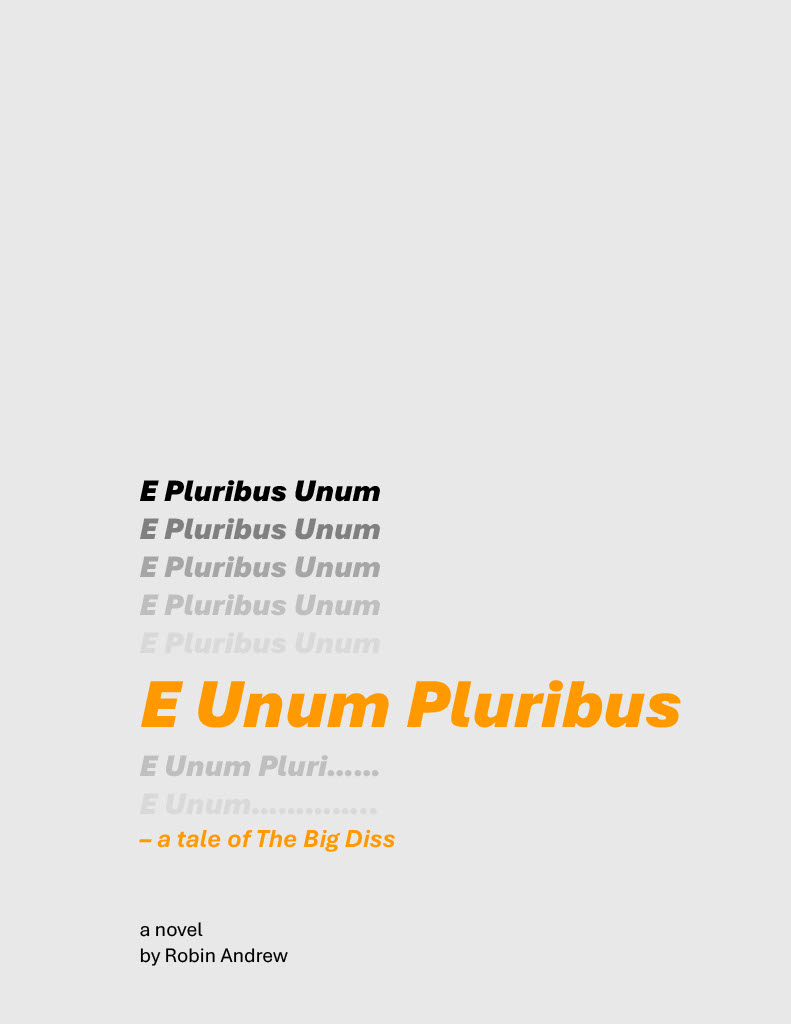
E Unum Pluribus – a tale of The Big Diss, imagines the United States of America dissolving into chaos because its elected representatives ceased to work together for the common good.  While the novel is fiction, its premise is plausible, which begs the question – what can an individual do to avoid such a tragic outcome?

Plenty of folks more knowledgeable than I have commented that we’ve all gotten so isolated into our own bubbles – republicans/democrats, conservatives/liberals, red states/blue states, urban/rural, blue collar/elitist; however one summarizes it – that it’s easy to dismiss everyone on ‘the other side’ as unreasonable, unapproachable, unsalvageable or worse. 

If (like me) you fear there is some truth to that description, and if (like me) you think forever encouraging division is a dead end – if you’ve ever felt the impulse to disagree when you’ve heard someone say the ‘X’ party is corrupt and they’re all a bunch of ‘z#fqt*^k!s,’ – how about switching your voter registration: to the X Party! 

WTF?

First off, once you switch, you will know for certain that there is at least one reasonable person in the X Party – one grain of sand to begin a beachfront of unification.

Second, you may (depending on your state) gain the opportunity to vote in the X party’s primary and improve the chances of their most reasonable candidate.  If enough of us do that, we could all have a better set of candidates to choose between in the actual election, instead of one we  cannot stomach and one we can support if we have to, but only by holding our collective noses.

Third, although there is no need for any else to know about your switch, should you ever hear someone thoughtlessly badmouthing either party, you might choose to respond by pointing out your agreement or disagreement “even though I’m a registered X!”  A single brick pulled out of a wall can improve communication between the two sides.

For whatever it’s worth: I switched to ‘the other party’ over a decade ago.  Since that time, I have found myself much more open to hearing ‘other party’ statements and proposals. I certainly do not dismiss all members of my new party out of hand – I am one of them, after all!  And I still do not always agree with their (our?) positions, but I feel obliged to at least listen, and much less resistance to acknowledging when a representative of my new party has proposed something worthwhile or productive.

Changing your party doesn’t mean voting for candidates you don’t support. It does mean choosing a future where each side is not so committed to smashing and trashing the other side that it’s virtually impossible to accomplish anything constructive. 

Government of the people, by the people and for the people should not be a cage-fight; it should be – and it can be – a mission in which we all share, together.

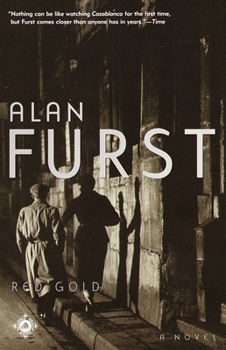
Red Gold, Alan Furst

Through half a dozen novels I’ve read since 2014, Furst has never disappointed.  In a deceptively quiet voice he portrays the complexity of life in situations too often cartooned as ‘dramatic’, ‘heroic,’ or ‘epic.’  Heroes are not sprung from the loins of goddesses, he shows us, but grown from the soil of ordinariness, seeded by terrible circumstances, watered by relationships with other decent human beings and nourished by the force of life itself as they seek the paths which will allow them to go on for another day, a week or if they are very lucky, even longer.

For Red Gold, we travel in the company of one Jean Casson, a Parisian film producer trying to survive under the Nazi occupation.  Having once been picked up by German intelligence and escaped their clutches, he must now hide in plain sight, growing a mustache and dressing poorly as he adopts a false in hopes of not being recognized contacts from his old life.  Learning to watch in every direction at every moment Casson, who is himself no socialist, drifts into contact with Communist resistance fighters, directed and bankrolled by the Soviet Union.  They in turn find his character and connections useful, loosely employing him as liaison to other factions – free French disruptors, conflicted Vichy collaborators and anti-Communist nationalists partially directed and intermittently supported by the Allies’ military for their own ends.  All of these, and also the Nazis, of course, are quite willing to sacrifice any individual at any time, if it serves their particular ‘greater purpose.’

As always, Furst paints a convincing and absorbing picture of life under occupation: the drabness, the cold, shortages and unexpected moments of plenty.  Casson’s inner voice is witty enough to entertain and resourceful enough to keep him and the reader out of the worst trouble, at the same time he manages to find enough minimalist romance to leaven the despair.  These characters have no foreknowledge of how the war will turn out; at any moment this depressing moment in history may take their life and so define it – a tragedy deeper and more painful than the destructive result of any brilliant explosion or dramatic car chase.

Life goes on, even under the heavy hand of war, and as much as some persons may fight for glory or principle, what most really want is simply to keep on living, with perhaps a bit of food, a sip of drink, a smoke or a hint of love to make it worth the effort.

Definitely an author to return to, and with around fifteen novels focused on the war years in Europe (published between 1988 and 2019 and collectively referred to as ‘The Night Soldiers series’) there’s plenty of opportunity to keep Alan Furst on the shelf.

(Note: Furst’s The World at Night (1996) shares a common plot and protagonist with Red Gold, so other readers may benefit from reading that volume first.  His three earliest novels, published in ’76, ’80 and ’81, concern drugs and crime in the U. S.  I’ve not sampled them but hope one day to do so).

My own latest novel is currently being serialized on this site. You can read the first installment in the recent post titled E Unum Pluribus.

If you like what you read here at robinandrew.net, please share any posts as widely as possible, and consider subscribing – it’s totally free!

E Unum Pluribus

Wondering where our nation’s increasingly divisive politics may lead us? E Unum Pluribus is a new novel which explores one very real possibility:

Amid feudal chaos following the USA’s collapse, one city-state seems promising, until an amateur’s murder investigation exposes its weaknesses and the conspiracies threatening to destroy it.

In order to receive community input, I’m serializing a Beta Test draft of E Unum Pluribus free of charge. (So I can track interest, the final installment may be posted only to subscribers, but even that subscription will be totally free of charge or obligation.) A .pdf of Installment One is included below and may also be downloaded for a more comfortable reading experience. Either way, you get to explore this new novel at absolutely no expense!


Succeeding installments are availabe via the top-menu or the right-side ‘Categories’ list on this website’s home page.

In addition to posting the manuscript, I will be sharing thoughts about the novel’s themes and objectives in future posts on both this website and on Substack at nobodysays2025.substack.com

If you find E Unum Pluribus of interest – or if you simply support the concept of authors sharing their work without reliance upon commercial publishing corporations – please share this post as widely as possible.

Have a wonderful 2026!

Robin Andrew

Free Speech on Trial? I. F. Stone’s ‘The Trial of Socrates’

Isidor Feinstein Stone was widely known and read as a liberal/socialist leaning journalist and newsletter writer from the 1930’s to the ‘80’s.  His introduction to the paperback edition of this book suggests it was the product of a late in life desire to move away from investigating current injustices and stake a claim to something timeless. 

In that, Stone acquits himself admirably, analyzing the works of Plato, Aristotle, Euripides, Xenophon and others like a professor of the Classics, along the way citing a wealth of references both primary and secondary, some of which seem quite obscure.  His commentary on specific words of Ancient Greek – their origins and multiple usages and especially the implications of how they’ve been translated (or mistranslated) over the ages – suggests an ability to read the original Greek language sources, which is impressive in one whose Wikipedia entry records only that he dropped out of the University of Pennsylvania

Greatest take away for this unschooled reader is to reframe Socrates from a revered name in the pantheon of Athens’ great philosophers into a rather disreputable rascal; a gadfly and rabble-rouser accused of corrupting the state’s youth by arguing the efficacy of oligarchic tyranny at a moment when such evils had very recently taken advantage of democracy’s natural disorder to seize power for themselves – twice! – and stood eager to do so again at any time.  Also, as Stone puts it, a man who habitually and resolutely argued the negative side of every issue without ever offering a single positive value to which he would actually commit.  This, in Stone’s view, is the real reason Socrates seemed to actively seek and welcome his death sentence (at an age when he could otherwise look forward only to sickness and decline) and turned his own death into a performance calculated to seal his place in posterity.  As likely as it was that a defense on the grounds of free speech might have saved his life (the last chapters of the book analyze this in extravagant detail), Socrates would not demean himself by pleading a principle against which he had previously argued with all his eloquence.  Even more, he seemed purposely to alienate his judges so as to be sure they would not honor their own and their City’s principles by freeing him on those same grounds.

Which last leads into the second lesson of this author’s analysis. An ardent supporter himself of the right to speak freely, Stone reminds the reader that such a right has very rarely been the policy of any government or governing system.  Even among the Golden Age Greeks it was a niche freedom, always tempered by its applicability only to those accredited for a specific body or forum, or only those of wealth and privilege, only those meeting citizenship requirements, only those owning property, only those not owned as slaves or reviled as foreigners or uncivilized – the list goes on.  That freedom of speech was not a universal value even among those greats in that great time and place is a very valuable reminder for those of us living in this one (U.S. A, 2025)

Certainly worthwhile to read and know, Stone’s analytics in The Trial of Socrates feel repetitive and over-argued; one imagines the same points could have been made in an essay rather than a book. But then, an essay about such a scholarly subject would never have achieved the visibility and stickiness this stand-alone book has (much less been deemed a ‘NATIONAL BESTSELLER’ as the paperback jacket proudly proclaims). Pulling Socrates off his pedestal at the same time it raises the U. S. First Amendment’s guarantee of Free Speech up onto one of its own is pretty good work for a small volume (247 pages plus Notes) by the college-dropout son of an immigrant shop owner? Achievements well worthy of a space on the shelf.

Parable of the Sower – Octavia E. Butler’s 1993 Vison for Today’s Tommorrow

Following up recent rereading’s of Orwell’s 1984 and Bradbury’s Fahrenheit 451 I saw this speculative novel recommended for its prescience and found that characterization to be spot on. Writing back in 1993, Butler describes a Southern California that could believably result from just a few more years pursuit of our nation’s current course.  Widespread poverty thanks to an politicians who own power over actual governance, violence and destruction by a populace fragmented and distrustful of one another, worldwide ecological disasters, misuse of new technology for profit and oppression, legal and police powers used not to protect the rights of all but to entrench the power of the few and, overlaying all that, a portion of the populace turning to reactionary religious movements in hope of refuge.  A decidedly dystopian take on our situation, but very convincing and valuable as an eye-opener.  That it is set in our exact time (July 2024 – October 2027) despite having been written over thirty years before is almost spooky to one first reading it today.

Butler (born 1947, died 2006) was a pioneer: at a time when it was striking to find either a Black person or a female making a name writing science fiction she was both, going on to win Hugo, Locus and Nebula awards as well as a MacArthur Fellowship grant.  This first of her works that I have read (there will be more) is partly shaped by her ethnicity, featuring a mixed race band of refugees and touching repeatedly on how race has shaped them, has affected their fortunes and is still affecting them despite the near total collapse of nearly every other social structure. 

Not content to cover that weighty ground, Butler also puts forth a religious theme, with protagonist Lauren Oya Olamina (which surname we learn is from the Yoruba region of Nigeria) the daughter of an Evangelical preacher. Lauren is in the process of devising a faith of her own, which she calls Earthseed in reflection of its vision of destiny – the expansion of Earth’s humanity to live among the stars and spread their ‘ seed’ throughout the universe.  Lauren’s coming to grips with that calling and beginning the process of dissemination is the true theme of the novel, all the others serve to set the conditions and inform the necessity of her doing so.

Butler’s writing is immediate and colorful yet quick and concise, her plotting is complex without falling into the sort of techno traps that affect much Sci-fi.  Resultingly, the Parable of the Sower is a work of literature which uses its genre as vehicle, not a commercial work safely exploiting a comfortable niche. A sequel, Parable of the Talents (1998) presents a further step in Laruen’s and Earthseed’s journey, culminating in departure of their first space craft on a colonizing mission.  That having been Butler’s final published novel, it is sad to consider how she might have continued the tale, had she not struggled with depression and writer’s block before passing away in 2006, at the too-young age of 58.  

Very glad to have encountered both book and author, and highly recommend them to any readers interested in where our politics are leading the USA, exploring the canon of science fiction, alternatives to mainstream religion or just curious about where human society may be headed – in both the near and the far terms.

Fahrenheit 451, Ray Bradbury

Like a 75-year-old car, Bradbury’s most lauded novel feels a bit clunky compared to the sleek and smooth commodity fiction churned out by today’s industrial publishing conglomerates.  As with any mode of transportation though, where a book takes you is more important than the vehicle itself, and Fahrenheit 451 offers a ride through the very territory over which our nation is currently circling. Pretty amazing for a story first anthologized in 1950 and expanded into this short novel in 1953!

Minds colonized by omnipresent ‘entertainment’ media pretending to provide viewers with a ‘reality’ more acceptable than their own; lives lived in bubbles of class and clique; an authoritarian government ginning up perpetual wars as excuse to police every facet of its citizen’s lives; new technologies immediately harnessed to enforce all of the above – Bradbury’s fears for his characters’ ‘future’ are amazingly close to today’s realities. 

In an afterword and coda written later (1982 and 1979, respectively), Bradbury makes clear that he traces all those developments to his fictional culture’s rejection of the written word.  Books there are viewed as corrupting distractions.  Not content with discouraging or banning individual volumes on the basis of specific content, this regime fears all books because they record, preserve and encourage independent thought.  The very possession of any book has been declared a major criminal act and the once laudable community symbol of the Firefighter has been perverted into a new role as government book burner (and incidental executioner of bibliophiles).

So here we are seventy-five years later, with citizens pressuring their libraries and schools to dispose of any books hinting at truths those particular citizens don’t appreciate; a juvenile Secretary of ‘War’ decreeing which slanted versions of history, philosophy and the social sciences may be read or discussed in the military’s colleges and academies as the White House extorts even private universities to teach to the President’s personal prejudices.  Meanwhile, surveys confirm that fewer and fewer and fewer persons are reading any books by choice, preferring instead to have information spoon-fed into their brains via profit-tailored algorithms curating content for their profit-driven mass electronica. In spooky parallel to Bradbury’s Firemen cum Fire-setters, the current administration has given control of many federal agencies to fanatical minions who despise those agencies’ statutory functions, wishing instead to destroy or pervert them by flipping them from protecting the environment or civil rights, for example, to opening the former to plunder by political contributors and restricting the latter’s protections to only those who bow down to the MAGA movement in all its glory and gory ambition (while sporting an appearance that comports to Mr. Trump’s old-Hollywood vision of how true Americans are supposed to look).

Despite some age-appropriate road wear and rust in its wheel-wells, Bradbury’s Fahrenheit 451 is no junker, but a precious classic vehicle for waking up the masses, every bit as timely today as when its rubber first hit the road.  It deserves to be read or reread as widely as possible, so more citizens will see what is happening and do what they can to stop it.

P. S. – Along with Orwell’s 1984, and Animal Farm, Vonnegut’s Slaughterhouse-Five, Huxley’s Brave New World, Anthony Burgess’ A Clockwork Orange and others from the mid-Twentieth, this novel has helped to shape the fears and ideals of multiple generations.  Margaret Atwood’s The Handmaid’s Tale, Cormac McCarthy’s The Road, Emily St. John Mandel’s Station Eleven and Octavia E. Butler’s Parable of the Sower are notable among many other recent and creditable volumes with similar aspirations of enlightenment and warning.  Now more than ever, all such books deserve to be read and shared.

Like this book or this post? Please Share it!

Interested in what you read on this site – please subscribe. It’s free!

Tell Me Everything, Elizabeth Strout

Reliably kind and astute, Strout is a treasure, mining small town Maine for evidence of the human condition; what it takes to survive childhood, adulting, family, romance, loss and the passage of time.

In this installment, we are reunited with aging versions of Lucy Barton, Olive Kitteridge and other characters from earlier Strout novels as they continue the messy business of life. The tale is structured around an unlikely relationship between Lucy, the oddball outsider and Olive, the life-long local and gossip coming to grips with the shrinking world of retired widowhood.

The stories Olive tells to Lucy (and others we glean along the way) eventually coalesce around one theme – they are all about secrets.  Bits of information perhaps insignificant, perhaps life-changing, which characters have kept from spouses, siblings, neighbors and often, sometimes for very long times, from themselves. 

Partway through what seems a familiar journey, Strout drops in a murder mystery, something readers of her earlier novels may find incongruous, even disconcerting.  That sort of drama is not her usual cup of tea. Characteristically though, the mystery develops gently and organically, out of seemingly small bits of character and behavior. For a time, it even seems to have drifted from the author’s attention, then is brought back into focus by other events before being solved well short of the novel’s end. Rather than the book’s raison d’être, then, we understand even murder as one more instance of secrets kept, or not.  More dramatic than most, but the same animal underneath its skin of violence.

Thus the title, Tell Me Everything, is really a misdirection: No healthy happy person actually tells ‘everything.’  And, if one does try to do so, they’d best be prepared for serious consequences. Sometimes, the path most conducive to happiness, the path of love and caring, may actually lead through the difficult decision to not tell everything, but to live with our secrets and let others live without having to confront them.

Simple insight on a complex reality. Sad and humorous, depressing and reassuring, life changing, life affirming, unremarkable and unavoidable and – in the right hands – captivating and moving.

Another gem from the lapidary mind of Elizabeth Strout.  May she live and write forever.

The Children of Men, P. D. James

A Timely Commentary on current events – written nearly thirty-five years ago!

Grabbed this off a neighborhood free-books shelf on basis of the author’s familiar name and work; was surprised to find in place of the expected tea and class-system detective story a speculative political fiction written decades ago yet uncannily timely in its themes.  James* has always been a reliable commentor on the British government and governing class – she spent thirty years in the civil service after all (or rather, before being able to write all her more familiar titles) – but that has previously seemed incidental to the solving of mysteries.  Here, it is the main point.

Though first published in 1992, the novel is set in 2021 with a sci-fi sounding premise – that 25 years earlier it had become unavoidably obvious that all human males in the world had become infertile.  With the birth rate crashing in months to absolute zero, all of humanity was suddenly forced to comprehend the existential doom of universal aging, disability and death without the consolation of watching younger generations grow to replace them.  We are then given to understand how this resulted in apathy and lawlessness, perfect conditions for the rise of a fascistic strongman named ‘Xan’ (reference to Alexander ‘The Great,’ I’d guess).  Our guide through what follows is Dr. Theodore (Theo) Faron, an Oxford historian with a mythologically-tragic reason for retreating from public life but who was also a childhood friend of Xan and, until recently, an advisor to him in his autocratic reign.  When Theo is approached by a band of laughably incompetent would-be revolutionaries, the first half of the novel is set in motion. The second half (spoiler alert) is brought about by the discovery that Julian, a (female, despite the name) member of that conspiracy for whom Theo immediately begins to develop romantic feelings, is pregnant, a monumental event which suggests she and her child have the potential to save humanity from its dire fate.  From that development James builds a compelling thriller addressing moral questions of ends and means, guilt and forgiveness, God or not God and the temptation which even the most honorable person may experience when offered the chance to exercise power over others for what they believe to be good or necessary ends.

Xan’s resemblance to the current U. S. President is striking, and the arguments for his usurpation of total control over English life track almost perfectly with MAGA’s claims of necessity: societal disorder, citizens lost in despair and apathy, crises requiring responses more immediate than any deliberative process could manage, the purportedly inherent weakness and fecklessness of all so-called democratic processes.  The effects too, are symmetrical – arbitrary laws and judgement, scapegoating of immigrants and other ‘others,’ curtailment of individuals’ rights under brutal policing and cruel incarceration and an invasive security state to ensure those who have seized power get to hold it indefinitely.

All of this, James handles with intelligence and generosity (if sometimes overmuch time spent on the exact physiognomy of a face, niceties of vegetation, quality of sunlight or sky and the furnishings of various interiors; the one aspect in which the novel feels rooted in the author’s generation and previous genre).  Theo is a modest and honorable foil for Xan, who is himself allowed sufficient rope to make a moral case for his usurpation.  Their ultimate confrontation is well-scripted if a bit forced and the final decision which results from it is of Sophoclean magnitude and weight.

Among many impressively crafted moments is one where Theo, acting out of necessity to secure resources for the imminent birth of Julian’s child, discovers in himself the potential to enjoy violating norms and forcing others to his will, even to the edge of brutality.  Not only a worthy observation on human nature, this new self-knowledge plants a seed which allows the novel’s final moments and message to ring true.

Schooled by a difficult life, James may have honed her skills in the trenches of genre fiction, but The Children of Men affirms her a true literary artist.  It deserves to be revisited for that reason alone, and especially so in this moment, when its fictional time period has arrived and is turning out strikingly similarly, in some important respects, to what she imagined nearly thirty five years before.

*Officially: Phyllis Dorothy James White, Baroness James of Holland Park!

Note: There is also a somewhat loose film adaption by the same title, credited to five writers and directed by Alfonso Cuaron (Harry Potter and the Prisoner of Azkaban) with Clive Owen portraying Theo.  The film received critical acclaim, numerous award nominations and a few wins, as well as positions on various “Top” lists, but did poorly at the box office).

Feel free to share this post if you like.

If you appreciate what you find on this site, please subscribe – it’s totally free!