Tag Archives: book-review

Parable of the Sower – Octavia E. Butler’s 1993 Vison for Today’s Tommorrow

Following up recent rereading’s of Orwell’s 1984 and Bradbury’s Fahrenheit 451 I saw this speculative novel recommended for its prescience and found that characterization to be spot on. Writing back in 1993, Butler describes a Southern California that could believably result from just a few more years pursuit of our nation’s current course.  Widespread poverty thanks to an politicians who own power over actual governance, violence and destruction by a populace fragmented and distrustful of one another, worldwide ecological disasters, misuse of new technology for profit and oppression, legal and police powers used not to protect the rights of all but to entrench the power of the few and, overlaying all that, a portion of the populace turning to reactionary religious movements in hope of refuge.  A decidedly dystopian take on our situation, but very convincing and valuable as an eye-opener.  That it is set in our exact time (July 2024 – October 2027) despite having been written over thirty years before is almost spooky to one first reading it today.

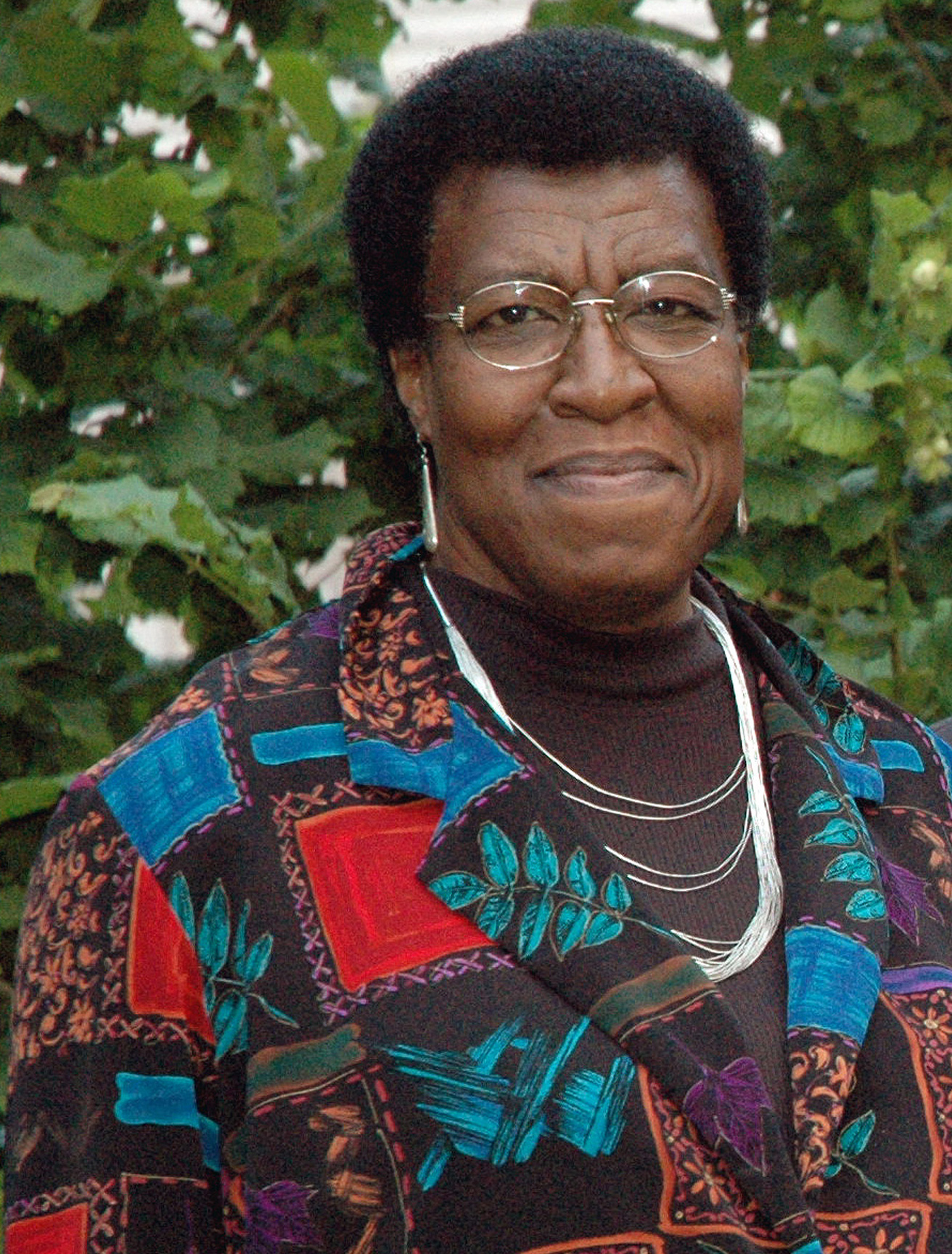
Butler (born 1947, died 2006) was a pioneer: at a time when it was striking to find either a Black person or a female making a name writing science fiction she was both, going on to win Hugo, Locus and Nebula awards as well as a MacArthur Fellowship grant.  This first of her works that I have read (there will be more) is partly shaped by her ethnicity, featuring a mixed race band of refugees and touching repeatedly on how race has shaped them, has affected their fortunes and is still affecting them despite the near total collapse of nearly every other social structure. 

Not content to cover that weighty ground, Butler also puts forth a religious theme, with protagonist Lauren Oya Olamina (which surname we learn is from the Yoruba region of Nigeria) the daughter of an Evangelical preacher. Lauren is in the process of devising a faith of her own, which she calls Earthseed in reflection of its vision of destiny – the expansion of Earth’s humanity to live among the stars and spread their ‘ seed’ throughout the universe.  Lauren’s coming to grips with that calling and beginning the process of dissemination is the true theme of the novel, all the others serve to set the conditions and inform the necessity of her doing so.

Butler’s writing is immediate and colorful yet quick and concise, her plotting is complex without falling into the sort of techno traps that affect much Sci-fi.  Resultingly, the Parable of the Sower is a work of literature which uses its genre as vehicle, not a commercial work safely exploiting a comfortable niche. A sequel, Parable of the Talents (1998) presents a further step in Laruen’s and Earthseed’s journey, culminating in departure of their first space craft on a colonizing mission.  That having been Butler’s final published novel, it is sad to consider how she might have continued the tale, had she not struggled with depression and writer’s block before passing away in 2006, at the too-young age of 58.  

Very glad to have encountered both book and author, and highly recommend them to any readers interested in where our politics are leading the USA, exploring the canon of science fiction, alternatives to mainstream religion or just curious about where human society may be headed – in both the near and the far terms.

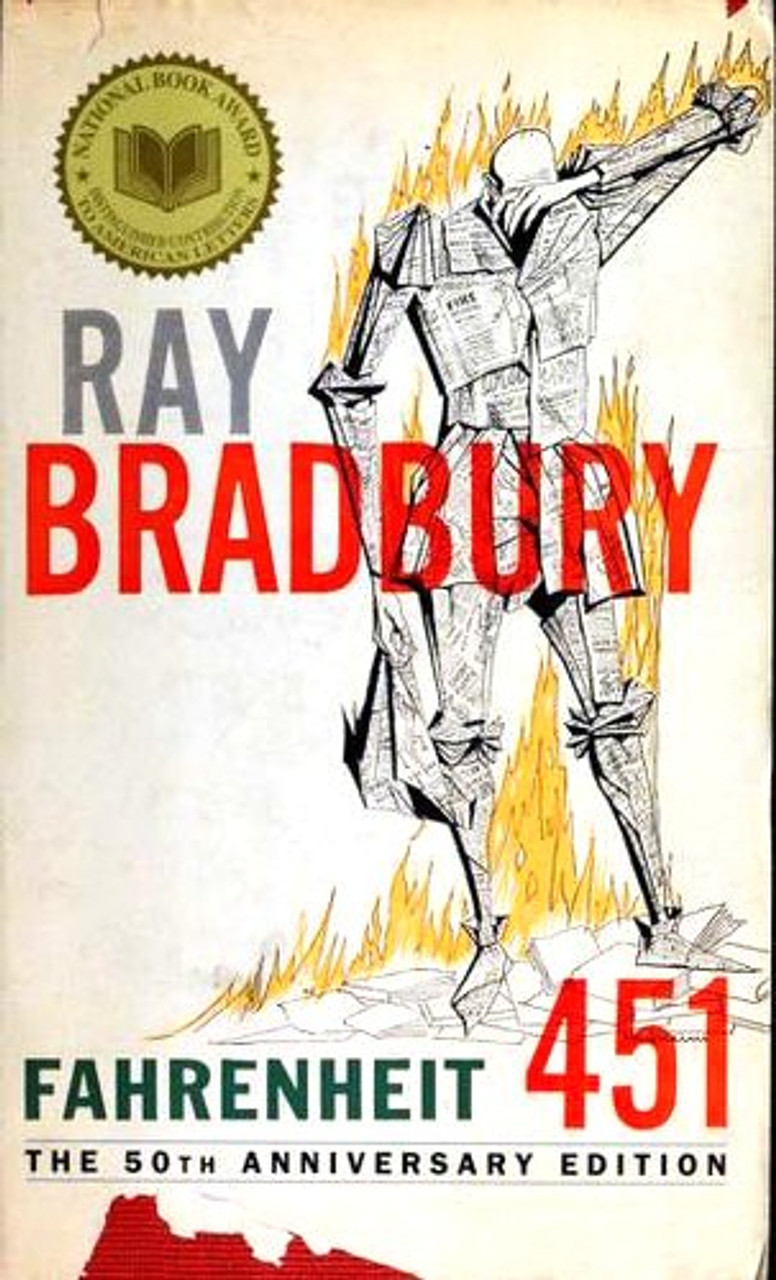
Fahrenheit 451, Ray Bradbury

Like a 75-year-old car, Bradbury’s most lauded novel feels a bit clunky compared to the sleek and smooth commodity fiction churned out by today’s industrial publishing conglomerates.  As with any mode of transportation though, where a book takes you is more important than the vehicle itself, and Fahrenheit 451 offers a ride through the very territory over which our nation is currently circling. Pretty amazing for a story first anthologized in 1950 and expanded into this short novel in 1953!

Minds colonized by omnipresent ‘entertainment’ media pretending to provide viewers with a ‘reality’ more acceptable than their own; lives lived in bubbles of class and clique; an authoritarian government ginning up perpetual wars as excuse to police every facet of its citizen’s lives; new technologies immediately harnessed to enforce all of the above – Bradbury’s fears for his characters’ ‘future’ are amazingly close to today’s realities. 

In an afterword and coda written later (1982 and 1979, respectively), Bradbury makes clear that he traces all those developments to his fictional culture’s rejection of the written word.  Books there are viewed as corrupting distractions.  Not content with discouraging or banning individual volumes on the basis of specific content, this regime fears all books because they record, preserve and encourage independent thought.  The very possession of any book has been declared a major criminal act and the once laudable community symbol of the Firefighter has been perverted into a new role as government book burner (and incidental executioner of bibliophiles).

So here we are seventy-five years later, with citizens pressuring their libraries and schools to dispose of any books hinting at truths those particular citizens don’t appreciate; a juvenile Secretary of ‘War’ decreeing which slanted versions of history, philosophy and the social sciences may be read or discussed in the military’s colleges and academies as the White House extorts even private universities to teach to the President’s personal prejudices.  Meanwhile, surveys confirm that fewer and fewer and fewer persons are reading any books by choice, preferring instead to have information spoon-fed into their brains via profit-tailored algorithms curating content for their profit-driven mass electronica. In spooky parallel to Bradbury’s Firemen cum Fire-setters, the current administration has given control of many federal agencies to fanatical minions who despise those agencies’ statutory functions, wishing instead to destroy or pervert them by flipping them from protecting the environment or civil rights, for example, to opening the former to plunder by political contributors and restricting the latter’s protections to only those who bow down to the MAGA movement in all its glory and gory ambition (while sporting an appearance that comports to Mr. Trump’s old-Hollywood vision of how true Americans are supposed to look).

Despite some age-appropriate road wear and rust in its wheel-wells, Bradbury’s Fahrenheit 451 is no junker, but a precious classic vehicle for waking up the masses, every bit as timely today as when its rubber first hit the road.  It deserves to be read or reread as widely as possible, so more citizens will see what is happening and do what they can to stop it.

P. S. – Along with Orwell’s 1984, and Animal Farm, Vonnegut’s Slaughterhouse-Five, Huxley’s Brave New World, Anthony Burgess’ A Clockwork Orange and others from the mid-Twentieth, this novel has helped to shape the fears and ideals of multiple generations.  Margaret Atwood’s The Handmaid’s Tale, Cormac McCarthy’s The Road, Emily St. John Mandel’s Station Eleven and Octavia E. Butler’s Parable of the Sower are notable among many other recent and creditable volumes with similar aspirations of enlightenment and warning.  Now more than ever, all such books deserve to be read and shared.

Like this book or this post? Please Share it!

Interested in what you read on this site – please subscribe. It’s free!

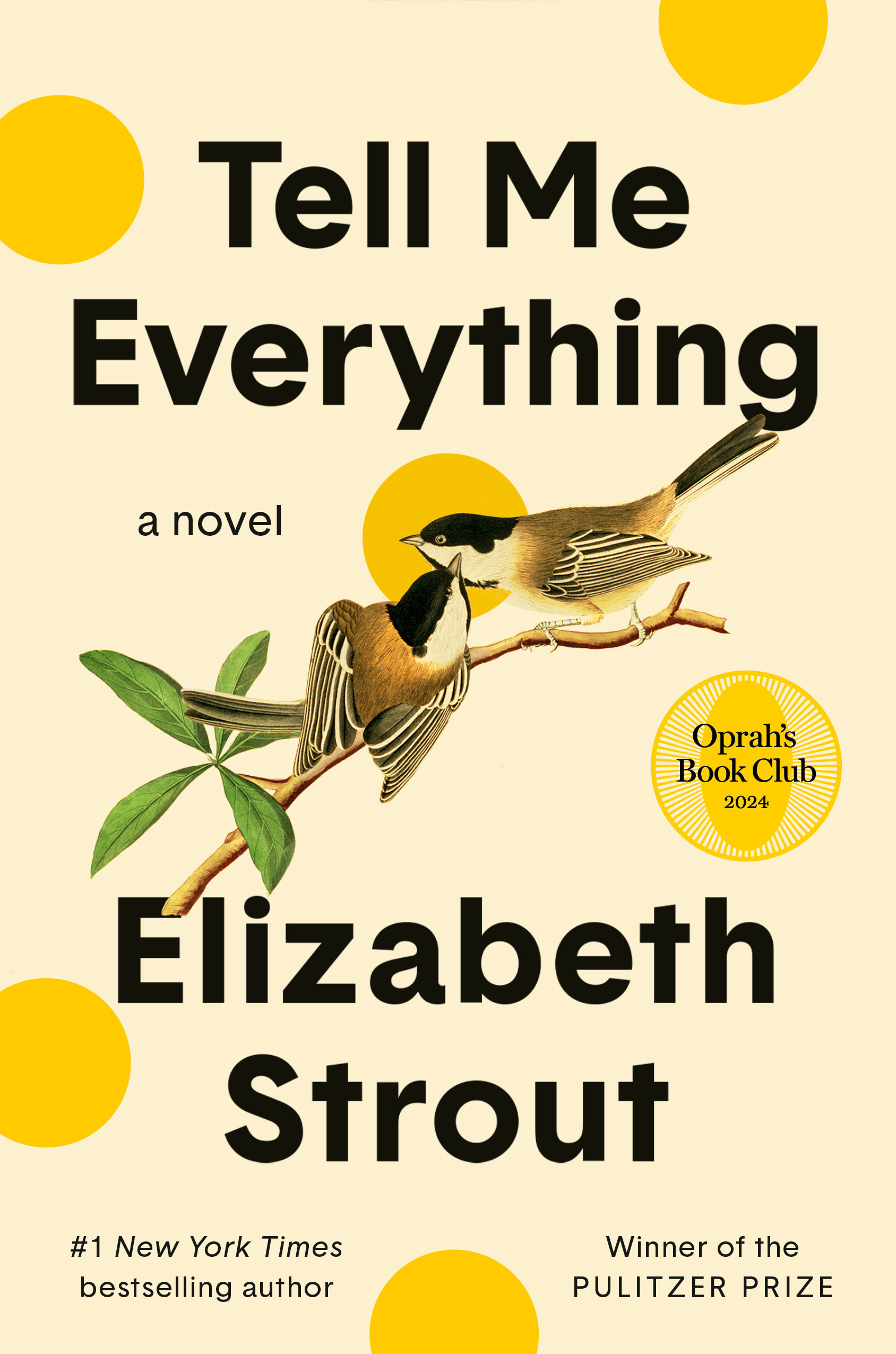
Tell Me Everything, Elizabeth Strout

Reliably kind and astute, Strout is a treasure, mining small town Maine for evidence of the human condition; what it takes to survive childhood, adulting, family, romance, loss and the passage of time.

In this installment, we are reunited with aging versions of Lucy Barton, Olive Kitteridge and other characters from earlier Strout novels as they continue the messy business of life. The tale is structured around an unlikely relationship between Lucy, the oddball outsider and Olive, the life-long local and gossip coming to grips with the shrinking world of retired widowhood.

The stories Olive tells to Lucy (and others we glean along the way) eventually coalesce around one theme – they are all about secrets.  Bits of information perhaps insignificant, perhaps life-changing, which characters have kept from spouses, siblings, neighbors and often, sometimes for very long times, from themselves. 

Partway through what seems a familiar journey, Strout drops in a murder mystery, something readers of her earlier novels may find incongruous, even disconcerting.  That sort of drama is not her usual cup of tea. Characteristically though, the mystery develops gently and organically, out of seemingly small bits of character and behavior. For a time, it even seems to have drifted from the author’s attention, then is brought back into focus by other events before being solved well short of the novel’s end. Rather than the book’s raison d’être, then, we understand even murder as one more instance of secrets kept, or not.  More dramatic than most, but the same animal underneath its skin of violence.

Thus the title, Tell Me Everything, is really a misdirection: No healthy happy person actually tells ‘everything.’  And, if one does try to do so, they’d best be prepared for serious consequences. Sometimes, the path most conducive to happiness, the path of love and caring, may actually lead through the difficult decision to not tell everything, but to live with our secrets and let others live without having to confront them.

Simple insight on a complex reality. Sad and humorous, depressing and reassuring, life changing, life affirming, unremarkable and unavoidable and – in the right hands – captivating and moving.

Another gem from the lapidary mind of Elizabeth Strout.  May she live and write forever.

The Children of Men, P. D. James

A Timely Commentary on current events – written nearly thirty-five years ago!

Grabbed this off a neighborhood free-books shelf on basis of the author’s familiar name and work; was surprised to find in place of the expected tea and class-system detective story a speculative political fiction written decades ago yet uncannily timely in its themes.  James* has always been a reliable commentor on the British government and governing class – she spent thirty years in the civil service after all (or rather, before being able to write all her more familiar titles) – but that has previously seemed incidental to the solving of mysteries.  Here, it is the main point.

Though first published in 1992, the novel is set in 2021 with a sci-fi sounding premise – that 25 years earlier it had become unavoidably obvious that all human males in the world had become infertile.  With the birth rate crashing in months to absolute zero, all of humanity was suddenly forced to comprehend the existential doom of universal aging, disability and death without the consolation of watching younger generations grow to replace them.  We are then given to understand how this resulted in apathy and lawlessness, perfect conditions for the rise of a fascistic strongman named ‘Xan’ (reference to Alexander ‘The Great,’ I’d guess).  Our guide through what follows is Dr. Theodore (Theo) Faron, an Oxford historian with a mythologically-tragic reason for retreating from public life but who was also a childhood friend of Xan and, until recently, an advisor to him in his autocratic reign.  When Theo is approached by a band of laughably incompetent would-be revolutionaries, the first half of the novel is set in motion. The second half (spoiler alert) is brought about by the discovery that Julian, a (female, despite the name) member of that conspiracy for whom Theo immediately begins to develop romantic feelings, is pregnant, a monumental event which suggests she and her child have the potential to save humanity from its dire fate.  From that development James builds a compelling thriller addressing moral questions of ends and means, guilt and forgiveness, God or not God and the temptation which even the most honorable person may experience when offered the chance to exercise power over others for what they believe to be good or necessary ends.

Xan’s resemblance to the current U. S. President is striking, and the arguments for his usurpation of total control over English life track almost perfectly with MAGA’s claims of necessity: societal disorder, citizens lost in despair and apathy, crises requiring responses more immediate than any deliberative process could manage, the purportedly inherent weakness and fecklessness of all so-called democratic processes.  The effects too, are symmetrical – arbitrary laws and judgement, scapegoating of immigrants and other ‘others,’ curtailment of individuals’ rights under brutal policing and cruel incarceration and an invasive security state to ensure those who have seized power get to hold it indefinitely.

All of this, James handles with intelligence and generosity (if sometimes overmuch time spent on the exact physiognomy of a face, niceties of vegetation, quality of sunlight or sky and the furnishings of various interiors; the one aspect in which the novel feels rooted in the author’s generation and previous genre).  Theo is a modest and honorable foil for Xan, who is himself allowed sufficient rope to make a moral case for his usurpation.  Their ultimate confrontation is well-scripted if a bit forced and the final decision which results from it is of Sophoclean magnitude and weight.

Among many impressively crafted moments is one where Theo, acting out of necessity to secure resources for the imminent birth of Julian’s child, discovers in himself the potential to enjoy violating norms and forcing others to his will, even to the edge of brutality.  Not only a worthy observation on human nature, this new self-knowledge plants a seed which allows the novel’s final moments and message to ring true.

Schooled by a difficult life, James may have honed her skills in the trenches of genre fiction, but The Children of Men affirms her a true literary artist.  It deserves to be revisited for that reason alone, and especially so in this moment, when its fictional time period has arrived and is turning out strikingly similarly, in some important respects, to what she imagined nearly thirty five years before.

*Officially: Phyllis Dorothy James White, Baroness James of Holland Park!

Note: There is also a somewhat loose film adaption by the same title, credited to five writers and directed by Alfonso Cuaron (Harry Potter and the Prisoner of Azkaban) with Clive Owen portraying Theo.  The film received critical acclaim, numerous award nominations and a few wins, as well as positions on various “Top” lists, but did poorly at the box office).

Feel free to share this post if you like.

If you appreciate what you find on this site, please subscribe – it’s totally free!

Still Life, Sarah Winman

The romantic novel as still life painting – an unlikely assortment of exquisitely-rendered events (the objects) carefully arranged for maximum effect (starting with Evelyn and Dorothy in 1944, then moving forward in jumps and fits, then returning to Evelyn in 1901), the entire assemblage framed by the city of Florence in all its history and culture and gastronomic variety. 

When I search the text for ‘still life’ I find reference to all the still life paintings Evelyn inherited; thought by some to be no more than decorations, to her they are the grail, which seems perhaps a comment on the genre as a female space. Another instance, also, in which she, having become an art professor, theorizes on the genre’s power as coming from, not in spite of, the seeming triviality of individual objects or domestic situations which actually contain specific phrases of the overall painting’s meaning and purpose.  How it freezes time, raises up the contributions of those who provide for others (as opposed to the ‘movers and shakers’). And a final instance of the two words together in the passage  “…Empty bowls.  Rotting fruit.  Passing time.  But still life in all its beauty and complexity…” thus making clear the author’s multiple intents: still life as a genre of painting, life as a collection of individuals interacting and connecting as do the objects in a still life painting, an account rendered in the manner of a still life painting and, ultimately, that ‘life’ is still ‘life,’ whether one is old, or disappointed, grieving or alone or has serendipitously found what they’ve been looking for all along.

(Worth noting the large number gay characters; more than would be expected solely because of the novel’s interest in art, literature and other creative pursuits.  Clearly the result of many decisions by the author, who herself came out in the 1980s, and a welcome reminder that human variety is not a product of the late twentieth century.  Noted also that not quite all the hetero relationships in the book are constrictive, doomed and/or abusive, but the tally certainly trends in that direction.)

_______

Eight months after reading this novel and recording the notes above, I came across the title again and was not certain whether or not I had read it.  Reading my notes at this remove, I’m struck by how interesting and satisfactory they make the book sound and yet I did not recall it (sincere apologies, M. Winman). Entire reason I started writing notes like these was the hope of no longer doing that… 

Is it time, perhaps, to slow down and not consume so many books but rather to savor the few?  But what other way to find those few, given that recommendations and reviews are so unreliable?  And isn’t that dilemma just what life itself is all about?  One has to experience its entirety – the exciting and the tedious, the success and failure, the love and the rejection, the yin and the yang and the black and the white and the good, the bad and the ugly – in order to learn what is truly astonishing and beautiful and we wish we had done a better job of savoring and holding onto – what will be so difficult to say goodbye to when one finally shuffles off.

Maybe it’s simply time for me to re-read some of those books which a first read confirmed to be worthwhile. 

Like Sarah Winman’s Still Life.

How to Get Filthy Rich in Rising Asia, Mohsin Hamid

Version 1.0.0

Posing as satire of the Western world’s self-help book genre, this clever volume starts out strong (“Look, unless you’re writing one, a self-help book is an oxymoron.  You read a self-help book so someone who isn’t yourself can help you, that someone being the author.”) and finishes even stronger.  There is a stretch about three quarters through its slender 220 pages that treads close to familiar crime and corruption thriller terrain, but happily that is only a dalliance, employed by Hamid to bring his protagonist down to earth and set up the final chapters wherein we realize what sort of wealth is really being promoted here, and in what way this book truly proposes to help its readers help themselves.

Along the way, we get a glimpse of what life is like for many hundreds of millions across the globe.  A lesson given greater impact by being written in the second person, casting the reader as protagonist (“The whites of your eyes are yellow, a consequence of spiking bilirubin levels in your blood.”) This choice is particularly effective at impressing readers from prosperous northwestern-quadrisphere cultures (such as myself) with the realities of life for those who indirectly support our affluence (“The virus affecting you is called hepatitis E. Its typical mode of transmission is fecal-oral.  Yum.”)  Later, when a different range of emotions arise among characters in circumstances superficially different from our (my) own, this second-person setting makes plain the conclusion that we are all the same underneath, no matter how different our economics make us seem at first glance.

Lest this sound like a civics lesson, I want to emphasize that the writing throughout is full of wry insight and humor.  To that, the final chapters add great warmth and sympathy for the human condition and an understanding of love, aging and the grace with which those can be faced – when complex and imperfect beings rise to their best potential.  An unexpected and very welcome reward at the end of a brisk and entertaining trip.

Ultra-impressive work by Hamid, who is fast becoming a favorite author.  Originally from Pakistan, he has dual English citizenship, degrees from Princeton and Harvard Law and experiences in the worlds of corporate law and McKinsey consulting to complement his South Asian frame of reference. Author of five novels so far and at least one work of non-fiction (Discontent and its Civilizations: Despatches from Lahore, New York and London, 2014), his is a voice which deserves to be heard, and widely.

Paris Undercover

Version 1.0.0

Paris Undercover – A Wartime Story of courage, Friendship and Betrayal, Matthew Goodman (2025)

At times inspiring, at others horrific, this is an impressive example of historical scholarship and its value in setting the record straight – as opposed to its all too prevalent effect of skewing history to the writer’s preferences.

In the midst of WWII the Etta Shiber’s purported memoir Paris-Underground is published in New York describing the exploits of herself and Kitty Bonnefous, two female resistance workers in Nazi-occupied France.  How that book came about, how much it was fact and how much fiction, and what were the effects its publication, are this current book’s subjects.

Part One of this volume gives us a factual record of the women’s actual lives and actions, up through Etta’s capture trial and imprisonment by the Nazis, thru her eventual release and arrival in New York. (At least I believe this is the factual version.  Given what follows, I do wish Goodman gave us a more explicit assurance to that effect.  In particular, his choice to open with the moment of Etta’s arrival in New York and then backtrack to their exploits confused me when, in Part Two, he informed us that is the way in which Etta’s book was structured.)

Readers looking for a pleasant and inspiring book could perhaps stop right here, and be somewhat satisfied.

Part Two is Goodman’s account of how Etta’s book came to be, how it was or was not written and by whom (there are differing accounts), and the impacts it had on her life..(This is where Goodman details that book’s departures from fact, and where I became a bit confused as to whether what I’d previously read was the true facts, or a replaying of the wartime book’s fabrications.  Perhaps a more diligent reader would not experience any confusion, but I did). What does seem clear though, is that Paul Winkler, himself a Jewish refugee from France, had the leading role as publisher and assembler and probably came out farther ahead financially than anyone else did.  Certainly the book sold well, and Etta Shriber did not get much for it.  What is also clear is that the book’s publication would certainly cause the Nazis to revisit Kitty’s case with even more sadistic vigor than before, likely with deadly consequences for her and others.

By the end of this section, one is angry with Winkler and others, but mostly on the edge of one’s seat, impatient to learn where Kitty has been imprisoned how she has fared while this profit-oriented sideshow was taking place in the safety of North America.  An excellent demonstration of how even a nonfiction book can be structured to maximize its suspense.

Part Three: Into the Night and Fog is the crux of Goodman’s work, a detailed account of Kitty’s imprisonment and mistreatment, the effect of Etta’s book on her such, the terrible  privations she and other prisoners of the Nazis had to endure to survive and even after being ‘freed’ by Soviet troops and, at long last, Kitty’s eventual return to the land of the living, where she lived to very nearly 80 years of age, at last enjoying some comforts and peaceful pleasures despite the debilitating effects of her ordeal.

(Given the chaos and destruction endemic to wartime, especially the end of a World War, it is amazing that Goodman is able to reconstruct this period in such detail and anecdote.  Since the overall purpose of the current volume is to expose the fabrications of Etta’s earlier book, it would have been worthwhile for him to address head on how he is able to be so comprehensive and how he avoided inserting his own imaginings in it, though the extensive Acknowledgements, Notes and Bibliography do help in this regard.)

As with other accounts of wars and particularly the Nazi Reich, one comes away from Paris Underground near despair at the eagerness of some men (and a few women, too) to inflict unnecessary pain and agony on other humans.  And, at the same time, amazed at the ability of many humans to survive mistreatment and hardships that would seem, if described in the abstract, unendurable.

A compelling and thoroughly worthwhile read, but not pleasant, and not for the faint of heart.

Karla’s Choice, Nick Harkaway

Picked this up less than fully convinced that a John Le Carre novel sans Le Carre was really needed.  Fact it was penned by the master’s son, Nick Harkaway, made it somewhat more promising than the various Ian Fleming-less Bond retreads by unrelated followers (of whom Harkaway is one, the admirable William Boyd another).  Was encouraged before the start by a statement in the Author’s Note that “There were always supposed to be more Smiley books.”  LeCarre’s having graciously left ten years of blank foolscap between The Spy Who Came in From the Cold and Tinker Tailor Soldier Spy also suggested room for this insertion.

From the start, what I found was encouraging, gliding along quite happily to the familiar rhythms and contexts of LeCarre’s world as scored and conducted by Harkaway (who has the benefit of having actually been present and somewhat privy to his father’s creative processes).   A pleasant enough experience, but not eye-opening – until somewhere around 80% of the way through – stop reading here if you don’t want to spoil the experience for yourself…

Just as I’d begun to worry this might be all retread, Susannah, the naive civilian whose cry for help initially set the entire story into motion, despairs at Smiley’s apparent lack of principle and crosses the Iron Curtain into Hungary (at the time a Communist autocracy tightly leashed to the Soviet Union) to commandeer his mission for herself.  Though believable based upon her earlier actions and personal history, this impulsive act nonetheless flips us into another plot entirely, as Smiley and his professionals must improvise in hopes of catching up with her.  Then, just as I’d accepted that and begun to anticipate the excitement it must generate, Harkaway switched form entirely – stopping the clock to preview various character’s future reminiscences on whether Smiley’d had no idea this was coming and was now in totally reactive mode, or had anticipated and accepted Susannah’s action as inevitable and gone with the flow or had, in fact, callously conceived, arranged and ensured such a dangerous act in order to achieve his own ends at the probabl cost of her innocent life.  By dancing a follow-spot rapidly over Smiley’s talent, skill and commitment even as it highlights several canonic characters’ own abilities and relationship to the master, Harkaway makes clear that moral principle, guilt and regret are the true subjects of the novel, assuming LeCarre’s mantle very nicely, thank you. 

Minutes later (in reading time, that is) we’re back into thriller form, watching as George discovers he has been made and is being tailed, and then as this unassuming ‘little man’ deals brilliantly with the challenges (including a car chase with Smiley at the wheel – never thought we’d see that!).  These scenes are virtuosic for both character and author, and from there it is a race to a signature LeCarre finish: bloodshed held off-screen, morality front and center and more than a hint of anticlimax, until Harkaway surgically exposes just what values and choices lay behind the various participants’ actions. Despite the infamous Karla (through-line villain of the entire Smiley oeuvre) having appeared very sparingly and with minimal back story, it turns out that his ‘choice’ is indeed the true point of this novel.  Not to mention a worthy gift to the fans in how it adds color and insight to Le Carre’s own chronologically-later volumes. Very nicely done!

Credit where credit is due:  I read this in e-book form – one of the more benevolent byproducts of our evolving digital hegemony.  An e-book I had borrowed online from a public, i.e. ‘government funded’ (cue the sinister theme music) library – one of those many liberal-culture institutions from which our marginally-elected leaders are currently scrambling to rescue us.  Had downloaded it in moments and for free – another benefit of the ‘mommy state’ imposed upon us by the ‘deep state’ which is now being shredded in favor of absolute free-market fundamentalism. Who knew we had so much to lose?  Anyone with eyes…

Having thus tested the waters and found them delicious, I’ll now be purchasing a hard-copy of Karla’s Choice so as to compensate author and industry for conspiring to make such an entertaining and worthwhile title available.

Kköszönöm mindenkinek – ’Thank you everyone.’