A previous post (‘Novel Words – fictional pronouns for the actual future.’ *) explored the concept of a non-gendered singular pronoun, ‘e’, to supplement our familiar ‘he’ and ‘she.’ Fortuitously, a recent article on the perils of AI suggested another way to frame the case.
With ‘he’ and ‘she’ as our English language’s only widely-accepted singular pronouns (‘they’ carrying the stain of wokeness upon its back in addition to its confusion with the plural and ‘it’ being generally received as an insult whether or not intended as such), alongside the predominant conversational practice of using gender terms (‘man’ and ‘woman’) as if they were synonymous with the bio-sexual (‘male‘ and ‘female’), any inquisitive consideration of gender is pre-emptively shipwrecked on the issue of whether each particular individual carries around a penis or a vagina.
Thus, perhaps the simplest and most cogent reason to encourage the use of a gender free singular pronoun such as ‘e’: it enables us to discuss gender issues without the need to pin-down (ouch!) anyone’s genitalia.
P. S.: E Unum Pluribus is a new speculative fiction with its own take on where the current culture wars may be leading our nation, and how even tragic events can spawn new possibilities for the future. The novel is currently being serialized on this site and you can be among the first to read its opening pages in the post titled ‘E Unum Pluribus.’
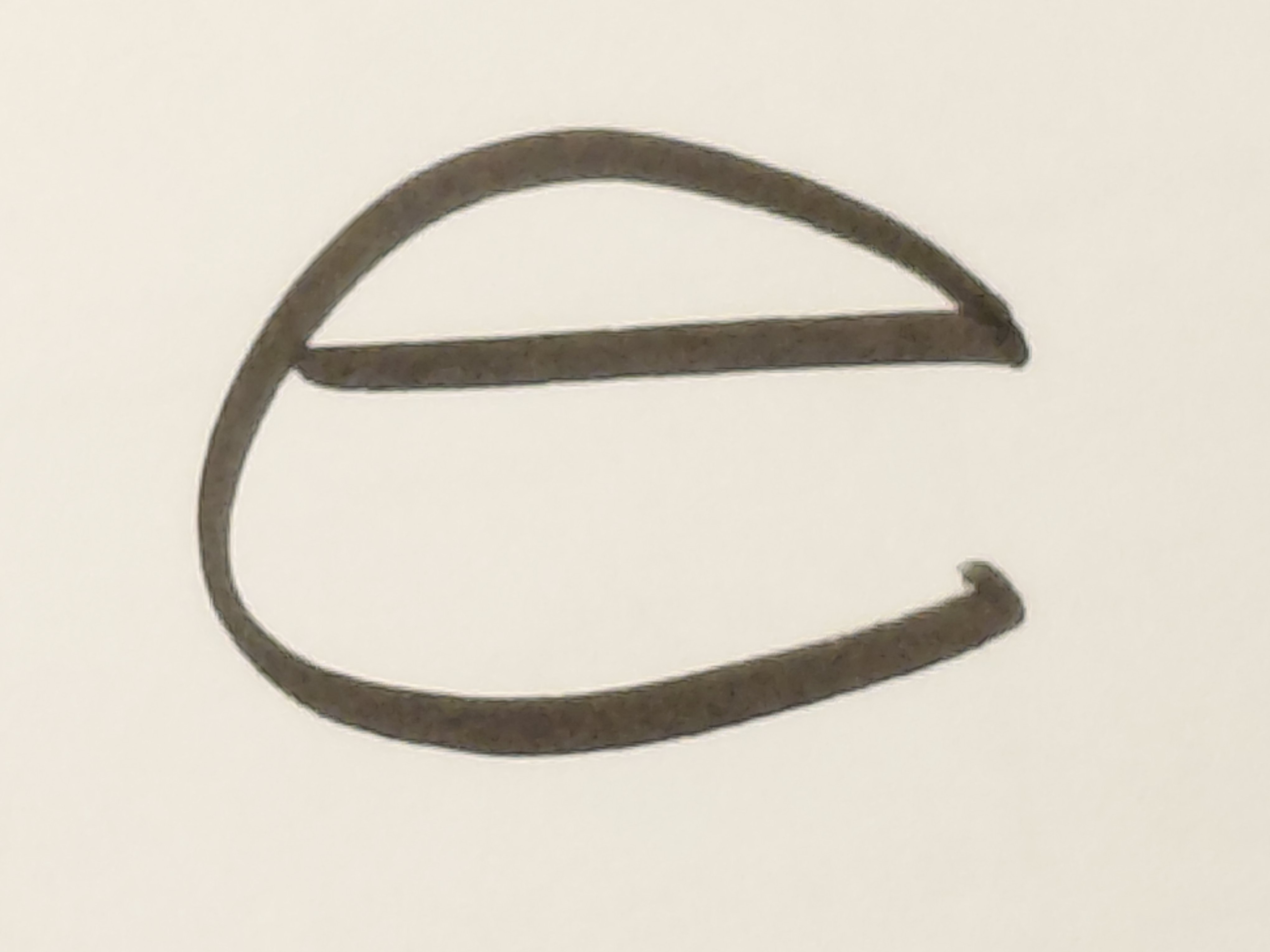
John McWhorter published an Opinion piece recently* about the evolution of pronouns, with particular attention to a new character gaining attention among users of the Mandarin language (X也, shown in image above, combines features of the characters for both he and she, rather as some persons do). Along similar lines, a new novel, E Unum Pluribus, speculates a future American city/state called Confluence in which government edict directs all official communications to employ non-gendered pronouns. The novel’s events make clear that Confluence’s government has plenty of faults and weaknesses, but this one of its policies merits some consideration.
For generations the convention in English was to use ‘he/him/his’ as default and inclusive of all, regardless of their sex/gender. Appropriately, that has now been perceived as favoring male identity over female; simultaneously reflecting historic inequality and perpetuating it. Replacing all those instances with ‘he or she,’ ‘his or her,’ etc. is hardly workable, especially in spoken communications, and still carries a hint of misogyny by placing one gender ahead of the other, whereas ‘she/he’ risks offending insecurities on the other side of the identity coin.
Recent efforts to innovate ‘they’ as a singular pronoun for persons who choose to declare themselves non-binary run aground first on its pre-existing function as plural, generating confusion where they intend clarity. That usage also seems to open the door to a trickle of additional new pronouns as various groups or orientations demand similar recognition; one need only read the snarky online critiques of how LGBT has grown to LBGTQIA2S+ to know that is not a path to tolerance so much as a guarantee of further friction. Worst, in this opinion, ‘they’ singular requires persons who prefer not to be stereotyped as either ‘he’ or ‘she’ to state that publicly, thereby outing themselves and very possibly inviting prejudice, at least at this point in our societal evolution.
The fictional founders of Confluence have taken another approach; directing official communications to use ‘e/em/eir’ for all individuals. This treats everyone with equal respect and does not require the clunky ‘my pronouns are…’ , which can itself incite prejudices. The specific form, ‘e,” ‘em,’ and ‘eir’ are brief and efficient, similar enough to other pronouns that they quickly feel familiar but with sufficient difference to avoid confusion**.
By applying equally to all possible personal preferences ‘e’ equalizes all in one swoop while tacitly expressing the truth that for virtually all public or official interactions there is no proper reason to indicate what genitalia an individual bears or with whom they choose to become intimate. Those are – and should remain – irrelevant.
There’s nothing revolutionary here, by the way, modern English already has gender neutral pronouns – ‘they’ does not presume the gender of a group or any of its individuals. ‘It’ can be used for all objects – unlike French, say in which some nouns require feminine constructions and other nouns masculine, despite the objects having no actual sexual function or accoutrements. Most prominently, ‘I’ is the same for any individual regardless of sex, gender or other characteristic. It is really only in the second person singular that our language’s evolution has codified an unfortunate and outdated discrimination.
In the world of E Unum Pluribus, that governmental edict for official communications also does not mean ‘e’ is used by everyone all the time. Non-official conversations use gendered pronouns wherever a subject’s preference has become clear, sticking to gender-neutral when an individual’ presentation is itself gender neutral. As in real life, casual usage and common courtesy have the final word in how language evolves over time.
(For what it’s worth, future posts on this site may selectively incorporate ‘e/em’eir’ pronouns to explore just how functional they are – or are not.)
*“This Novel Word Speaks Volumes About How an Entire Language Works” N. Y. Times online edition, 2026-01-22
** E Unum Pluribus does not claim to have invented the ‘e/em/eir’ construct. Variations on what are sometimes called ‘Spivak pronouns’ have been noted at least as far back as the late 19th-century.
P. S.: E Unum Pluribus is a tale of murder and conspiracy set a decade or so in our future in one of many small sovereignties sprung up in wake of the USA’s self-destruction. The novel explores multiple themes – language and gender, identity, guilt and even the origins of faith and belief – but speaks loudest in its depiction of how much we all stand to lose if we continue to retreat into factions which each act only for their own needs and interests.
The manuscript is available in six instalments, starting at:
According to reports*, Elon Musk’s new AI-generated online encyclopedia, Grokipedia, begins its entry for gender with: “Gender refers to the binary classification of humans as male or female based on biological sex…”
Wrong! Gender and sex are not the same things!
That Grok thinks they are**, indicates it has been ‘taught’ to parrot the opinions of its human creators. Like a young child, it is not worldly or intelligent enough to think beyond what it has been told by its groomers and so sees the world through their blinders.
For AI as with any other computative system, the value of output is highly dependent upon the quality of input. The first law of computer science – ‘garbage in, garbage out’ – is worth keeping in mind as AI’s very human procreators inject their offspring into as many facets of our lives and world as they can, as quickly as possible, with no oversight and often without our consent or even our awareness.
Knowledge is power, and ignorance posing as intelligence is an abuse of power, not a sign of the glorious and unadulterated progress which AI’s promoters claim to be offering to the world.
CAVEAT UTILITOR!
If you like this post, feel free to share it.
* This post refers to a report by Will Oremus and Faiz Siddiqui in the electronic edition of the Washington Post on 2025-10-27 titled “Elon Musk launches a Wikipedia rival that extols his own ‘vision’”
** In case there’s any question: ‘Male’ and ‘female’ are classifications of sex, which is about biology and can mean, depending on who is speaking, which chromosomes a person’s cells carry, which type of reproductive cells their body produces, which genitalia it exhibits, etc. ‘Man’ and ‘woman’ can refer to various selections from a wide range of public behaviors, perceptions, expectations and putative rules which are loosely and collectively referred to as gender. Sex and gender terms are sometimes congruent, sometimes not, but they are not the same things, as Grok seems to believe.
Most famous perhaps for her new age-y self-help memoir Eat, Pray Love, Gilbert is also and initially a novelist and this, her latest, is no slouch. Substantial at 465 pages, it covers the mid-Twentieth Century through the life of upstate New York ingenue Vivian Morris, who receives an education and much more once she relocates to the city of the same name. Sex and alcohol fuel much of the raucous early going, till the story abruptly shifts locale and tone around page 300. Disconcerting, that; and a serious disappointment to this reader, until a few chapters later when the narrative returns to its previous location and regains some (but only some) of its attitude. From there the tale matures along with its protagonist, moving from girlish dalliances to womanly relationships and thoughts.
Which may be the author’s point. While the title seems for a time to refer to the young women of the early chapters, and later to a play of the same name which becomes prominent for a while, it becomes ultimately a shorthand for all the different relationships between women which sustain these characters and the few social arrangements which care for and value them – the men in Gilbert’s telling being almost universally disappointing to the women, and often just as much so to themselves. Her one male exception is introduced very near the end, a terribly-damaged creature with a heart of gold, who is, tellingly, an even greater disappointment to himself than any of those who preceded.
Another indication: the two wronged women who get tossed out of Vivian’s life are both sorely missed and the reader spends the rest of the novel hoping they will be brought back for some dramatic rapprochement. On the other hand, the one male who drops out is not missed in the least, despite being her close relative and a tragic victim of greater events.
Overall, and thanks almost exclusively to the quirky women Vivian meets in the big city, one comes away with the impression of a life lived off the beaten track and outside the generally accepted definitions of success and happiness, yet more successful and more satisfying at its end than many which better fit the traditional definitions. A theme well in keeping with Gilbert’s other writings and a quite satisfying ending to a charming journey.
(BTW, the above description of Eat Pray Love is not meant to put it down. In addition to being on-trend, it is also deeply felt, thoroughly entertaining and insightful. I read it some 13 years ago with under-liner in hand and closed the book feeling more optimistic about my own life than I had in ages. Which is one reason I picked up City of Girls, though a reading of Gilbert’s 2000 first-novel, Stern Men, during the intervening years was also instrumental. Either way, I am glad I did, and ready to read more of this author any time.)
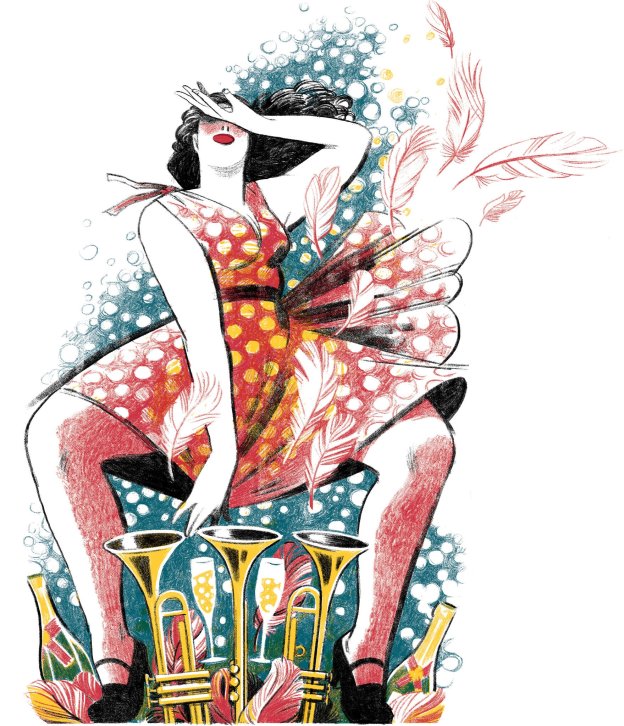
(Illustration by Eleanor Davis for N. Y. Times review)






 RobinAndrew