Tag Archives: Putin

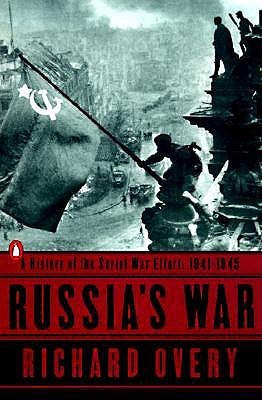
Russia’s War – A History of the Soviet War Effort: 1941 – 1945

Anyone surprised by the tenaciousness with which Ukrainians have been fighting their Russian invaders over the past four and a half years, or by how willing the Russian people have been to suffer sacrifices in service of their autocrat’s imperialistic escapade, could do worse than to read Richard Overy’s engrossing history. Written to accompany a ten-part televised documentary, the book is made compelling by its author’s extraordinary scholarship (an accomplished Professor at King’s College in London, this is his twelfth volume on the Second World War; its 35 pages of reference notes and 17 of bibliography are truly mind-boggling) and also by revelations made possible by the 1991 fall of the Soviet Union and resultant opening of previously-secret archives and previously-silenced voices and memoirs.

Overy rightly begins his tale prior to the actual fighting, recounting the machinations between Stalin and Hitler, two consummate conspirators each committed to securing as much power and protection as possible and both willing to undercut or double-cross anyone, even their closest associates and supporters, for that purpose. Two men also carrying deep hatred and mistrust for the other’s systems (industrialized nationalism versus world-communist socialism) even as they secretly held some common beliefs (racist hatred of Jews and other groups, resentment at not receiving what they considered their due from the European powers and, especially in Russia’s case, cross currents of superiority and inferiority between the urbanized and seafaring European nations and those more landlocked or of ‘questionable’ Asian origins).  Simmering in the aftermath of The Great War and the punitive geography imposed by its victors, these convictions made confrontation nearly inevitable.

Naturally, most of the story takes place during and following Hitler’s ill-advised overreach, Operation Barbarossa, which siphoned the majority of his forces away from Western Europe for what he envisioned as a very brief campaign to conquer a minimally trained and pre-industrial rabble spread sparsely over a primitive landscape.  The subsequent give and take of territory reiterate what America has since learned in places like Vietnam, Iraq and now Iran: that it is very nearly impossible for even a massively asymmetrical military force to defeat a population inured by history to hard work and sacrifice under harsh conditions, who know they will receive no quarter if conquered and so have nothing to lose by fighting to the death for every inch of land, who have for generations believed those lands to be both their home, their heritage and their inheritance, and who are both more familiar with and better adapted to the battleground than their aspiring usurpers.

That Josef Stalin cared not a whit about how many of his subjects died at his discretion is clearly another factor in the ultimate outcome.  The numbers of Soviet dead, wounded, missing, captured, imprisoned by their own countrymen or summarily executed by same are staggering, as are the numbers of combatants: time and again, we read of millions of men marching here and other millions over there, then half a million lost in this skirmish, or a million and a half in that campaign.  One wonders that there could even be that many men of fighting age in either nation; and then we read the extent to which women (already absolutely crucial to Russia’s industrialization), children and the elderly were progressively enlisted into the fighting – first by the Soviets to stop and then push back the Nazis, and later by the Nazis themselves in futile rear-guard actions once their ‘homeland’ came under its own invasion by the Soviet counter-force.

As to reports of the hideous brutality with which Soviet-led forces treated Germans and their sympathizers in the final stages of the war, Overy is neither dismissive nor quick to judge.  He chronicles their cruelties while also relating the earlier brutalities of Nazi forces (who were not all German, btw, but included many thousands impressed from conquered nations as well as others who claimed historic excuses for their treatment of Russians).  There were, in sum, sufficient hatreds, grudges, and unredressed grievances on all sides to ensure that no part of the war was gentlemanly and neither side innocent.  Given such blood-soaked soil in which to take root, the fact that the post war peace blossomed and largely held for 69 years (1945 to Russia’s 2014 invasion of Crimea) is all the more remarkable an achievement, and an indictment of our current leadership that so blithely squanders its benefits.

Having had all this history driven into the minds of both combatants’ descendants from childhood, it should surprise no one that the current Ukraine conflict has gone on as long as it has despite enormous costs.  And no surprise that this administration’s cocky amateur diplomats have been unable to produce their promised quick and easy end to its horrors.

Another issue on which Overy’s observations are particularly noteworthy: that it was not the D-Day invasion and subsequent drives of the Western Allies’ European campaign which caused Hitler’s defeat.  Given their late arrival on the scene, he argues, and the much smaller scale of their combined forces, the actions of American, British and associated troops served largely to distract Hitler and split his resources, hastening but not enabling the Nazi’s defeat, which had already become inevitable once the USSR had fully mobilized and industrialized, almost overnight.  One could, in fact, argue that the USA’s most important contribution to victory was the much earlier sharing of its industrial knowledge, technology, raw materials and factory output with the USSR through Lend/Lease and other programs.  An insight worth applying directly to our nation’s current debate over how and how much to support the Ukrainians in their battle with Stalin’s successor – we do not necessarily need to send our own troops in order to help ensure the success of their long and heroic struggle for freedom and self-determination.

P.S. – speaking of the struggle for self-determination, E Unum Pluribus is a speculative fiction imagining a post USA world. 

Packed with intrigue and fueled by politics, economics and murder (as well as gender, class, language and even the origins of faith), E Unum Pluribus examines how much we stand to lose if we allow our differences to destroy this precious nation, and what might be required to begin repairing the damage if we do.  This thrilling novel is currently available in six online installments, totally for free, simply by navigating to this website’s home page and selecting E Unum Pluribus from the home page’s top menu, or via this link: https://robinandrew.net/2026/01/01/e-unum-pluribus/

Stronger Together

“… you can talk all you want about international niceties and everything else, but we live in a world…that is governed by strength, that is governed by force, that is governed by power. These are the iron laws of the world that have existed since the beginning of time.” 

Where commentator Leighton Woodhouse rightly sees those words of Trump-whisperer Stephen Miller as a retreat from Christian values*, they also suggest a tragic misread of our nation’s history.

As Ken Burns’ recent documentary, The American Revolution vividly reminds, the story of the USA has never been that of the strongest and most powerful singlehandedly dominating those around them.  Rather, the founding generations were wise enough to see that their thirteen colonies must work together- despite very significant differences around religion, economics, politics and, perhaps most profoundly, the pernicious institution of slavery – in order for any among them to have a hope of breaking free from British tyranny.

Once the colonists united – a unity as messy, tenuous and frustrating as any representative system tends to be – even their combined numbers and resources did not assure success; from its start, the colonial coalition actively sought the support of other nations.  Ultimately, after six long years of brutal fighting, it was direct French participation (along with the indirect assistance of other nations and peoples who further taxed the Britain’s resources by opposing it in other parts of the world), that enabled Washington’s forces to triumph at Yorktown, turning the tide of attrition and so winning our independence. 

Power, strength and force, yes, but born of compromise, cooperation and alliance; that is what allowed a band of ragged upstarts to defeat the British Empire, which was, at that time, the greatest exemplar of Mr. Miller’s professed ‘laws’ of existence.

Similarly, the decades which established America as a superpower were never about the U.S. going it alone, even if we were by some measures the most powerful single nation.  Both World Wars were won by alliances in which we participated, sometimes as leaders sometimes not (Russia’s defeat of Nazi forces on the Eastern Front set the stage for Hitler’s eventual defeat which was, until then, far from a certain outcome).  Nor was the Cold War ‘won’ by unilateral American action; we could not have strained the Soviet economy to the point of failure without the economic cooperation and military participation of our allies in Europe and elsewhere – including Japan and Germany, two one-time conquerors whose defeat in war was accomplished through force but whose rehabilitation and future contributions as allies were made possible by reason, cooperation and patient hard work.

Yes, the qualities Miller cites – strength force and power – play a role in life and international relations.  And yes, there are ruthless players in the world today against whom we must defend our nation and civilization.  But coming from a cadre dedicated to belligerent unilateralism, who have employed military force, willful brutality and a single-minded claim of their own superiority against not only other nations but many of their fellow citizens as well, his proclamation smacks not of wisdom but of hubris.   If he and his ilk won’t take the word of American history for that, let them consider how few of history’s most famous strong, forceful and powerful tyrants – Stalin, Mao, Pol Pot, Bismark, Napoleon, Alexander, Julius Caeser, et al – established or continued any institution which lasted nearly as long as the 250 years which our more measured nation celebrates this year.

Perhaps a dog-eat-dog America such as Mr. Miller envisions can temporarily proclaim itself a bigger fish by shrinking its pond to just the western hemisphere and consigning the rest of the world to their own fate.  But the USA is and always has been a part of the world and will eventually be affected by the fate of other nations.  If we wish truly to fulfill the promise of its founding, to honor that era’s sacrifices and to deserve the bounties we all continue to enjoy thanks to them, we must relearn the value of building alliances and collaborating with like-minded forces wherever they reside. 

America First has never been America Alone

(And if, as it sometimes seems, Mr. Miller’s and Mr. Trump’s real goal is to forge an alliance between the USA and Vladimir Putin’s Russia, one need only look at the quality of life, rule of law and economic vitality of Russia today to see where that road leads.)

*Donald Trump, Pagan King, by Leighton Woodhouse, New York Times online, 2026-01-11

P.S. – For another vision of how our current politics may play out, try E Unum Pluribus, currently available free of charge to Beta Test readers. Click the box below to access its first installment: 

I hope you will take a look, and even if you do not, please share this post with anyone who believes the written word can help to bring us together!

Red Notice, Bill Browder

Naïve American-born (but later a British citizen) investment banker stumbles upon vast opportunities in post-Soviet Russia, makes a fortune for himself and his hedge-fund clients, then runs afoul of Putin’s thuggish cronies, with tragic consequences, especially for one of his Russian attorneys, who is imprisoned, tortured and beaten to death.

Coming from a background of self-importance, Browder’s brief youthful rebellion is followed by a dive into the hyper-establishment world of investment banking.  It is from that platform he learns the post-Soviet Russian government has given every citizen a voucher to invest in their newly-privatizing economy – a laudable goal, on its surface. Realizing that most citizens have no idea how to benefit from this historic opportunity, Browder organizes the means necessary for himself and other non-Russian investors to buy up those vouchers and benefits, instead.

Perhaps not surprisingly, there are Russians who resent this.  Not, the ordinary citizens, who have made at least a tiny gain by selling him vouchers they believe to be worthless, but rather the local sharks, who resent not being able to gobble up this bonanza themselves.  When they, with the help of corrupt police and courts, begin stealing from Browder’s organization and, even more tellingly, from their own government (and thus its citizens) Browder, being a good child of American idealism, tries to use the rule of law to stop them.  The majority of the text, and its drama, concern this white-hat intrigue, and the death of Russian attorney Sergei Magnitsky, whose only sin was believing to the end in the myth of his nation’s legal system.

This is a compelling tale, worthy of LeCarre or Green, and Browder tells it pretty well for a first-timer (no other pen is credited…).  While one can almost hear the author swearing not to aggrandize his own role, though, he does come off as…well…a crusader for justice.  A jet-setting lifestyle, financed by taking advantage of the same lax government which cultivated Russia’s oligarchs and oligarchy, is hardly a stable perch from which to condemn others, but the degree of corruption and cruelty he uncovers makes such criticism seem rather a quibble. 

The real hero here, as Browder frequently and forcefully reminds us, is Sergei Magnitsky, attorney, husband and father, who risks all for the truth, and pays the ultimate price, his last weeks recounted here with justified horror and sympathy.  It is to Browder’s credit that he then pursued the only form of justice available; the Magnitsky act by which the USA (and later several other nations) put Russa on the public stage and on record as a criminal conspiracy dressed up in nation’s clothing.  (Browder appears also to have taken financial care of Magnitsky’s family after his death, another stand-up move.)

The events of this book took place in the aughts, the first decade or so of Vladimir Putin’s presidency.   As the autocrat now wreaks his havoc on Ukraine, Red Notice (not to be confused with the movie or another novel of the same title, btw) is more valuable than ever for its glimpse behind the curtain, confirming that his tyranny is no recent development, but the true measure of the man, evil rooted and growing for many years.   All the way back to his KGB days in the old Soviet Union, in fact.  Clearly, there is no hope Putin will ever change his ways, and no wisdom in ever believing anything he spouts about agreements, cooperation, the rule of law or any alternative to simple brute force and self-service.  Fair warning to the next president who believes he has seen the Russian’s soul in his eye (43), or finds in him a friendly bro’ with whom to shoot the breeze – with no witnesses and no notes taken (45).

Pass this one around; people deserve to know.