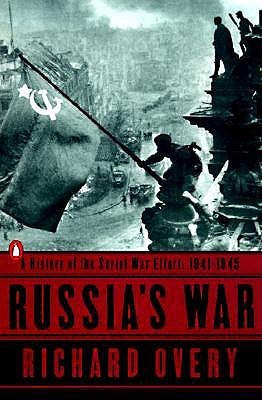
Anyone surprised by the tenaciousness with which Ukrainians have been fighting their Russian invaders over the past four and a half years, or by how willing the Russian people have been to suffer sacrifices in service of their autocrat’s imperialistic escapade, could do worse than to read Richard Overy’s engrossing history. Written to accompany a ten-part televised documentary, the book is made compelling by its author’s extraordinary scholarship (an accomplished Professor at King’s College in London, this is his twelfth volume on the Second World War; its 35 pages of reference notes and 17 of bibliography are truly mind-boggling) and also by revelations made possible by the 1991 fall of the Soviet Union and resultant opening of previously-secret archives and previously-silenced voices and memoirs.
Overy rightly begins his tale prior to the actual fighting, recounting the machinations between Stalin and Hitler, two consummate conspirators each committed to securing as much power and protection as possible and both willing to undercut or double-cross anyone, even their closest associates and supporters, for that purpose. Two men also carrying deep hatred and mistrust for the other’s systems (industrialized nationalism versus world-communist socialism) even as they secretly held some common beliefs (racist hatred of Jews and other groups, resentment at not receiving what they considered their due from the European powers and, especially in Russia’s case, cross currents of superiority and inferiority between the urbanized and seafaring European nations and those more landlocked or of ‘questionable’ Asian origins). Simmering in the aftermath of The Great War and the punitive geography imposed by its victors, these convictions made confrontation nearly inevitable.
Naturally, most of the story takes place during and following Hitler’s ill-advised overreach, Operation Barbarossa, which siphoned the majority of his forces away from Western Europe for what he envisioned as a very brief campaign to conquer a minimally trained and pre-industrial rabble spread sparsely over a primitive landscape. The subsequent give and take of territory reiterate what America has since learned in places like Vietnam, Iraq and now Iran: that it is very nearly impossible for even a massively asymmetrical military force to defeat a population inured by history to hard work and sacrifice under harsh conditions, who know they will receive no quarter if conquered and so have nothing to lose by fighting to the death for every inch of land, who have for generations believed those lands to be both their home, their heritage and their inheritance, and who are both more familiar with and better adapted to the battleground than their aspiring usurpers.
That Josef Stalin cared not a whit about how many of his subjects died at his discretion is clearly another factor in the ultimate outcome. The numbers of Soviet dead, wounded, missing, captured, imprisoned by their own countrymen or summarily executed by same are staggering, as are the numbers of combatants: time and again, we read of millions of men marching here and other millions over there, then half a million lost in this skirmish, or a million and a half in that campaign. One wonders that there could even be that many men of fighting age in either nation; and then we read the extent to which women (already absolutely crucial to Russia’s industrialization), children and the elderly were progressively enlisted into the fighting – first by the Soviets to stop and then push back the Nazis, and later by the Nazis themselves in futile rear-guard actions once their ‘homeland’ came under its own invasion by the Soviet counter-force.
As to reports of the hideous brutality with which Soviet-led forces treated Germans and their sympathizers in the final stages of the war, Overy is neither dismissive nor quick to judge. He chronicles their cruelties while also relating the earlier brutalities of Nazi forces (who were not all German, btw, but included many thousands impressed from conquered nations as well as others who claimed historic excuses for their treatment of Russians). There were, in sum, sufficient hatreds, grudges, and unredressed grievances on all sides to ensure that no part of the war was gentlemanly and neither side innocent. Given such blood-soaked soil in which to take root, the fact that the post war peace blossomed and largely held for 69 years (1945 to Russia’s 2014 invasion of Crimea) is all the more remarkable an achievement, and an indictment of our current leadership that so blithely squanders its benefits.
Having had all this history driven into the minds of both combatants’ descendants from childhood, it should surprise no one that the current Ukraine conflict has gone on as long as it has despite enormous costs. And no surprise that this administration’s cocky amateur diplomats have been unable to produce their promised quick and easy end to its horrors.
Another issue on which Overy’s observations are particularly noteworthy: that it was not the D-Day invasion and subsequent drives of the Western Allies’ European campaign which caused Hitler’s defeat. Given their late arrival on the scene, he argues, and the much smaller scale of their combined forces, the actions of American, British and associated troops served largely to distract Hitler and split his resources, hastening but not enabling the Nazi’s defeat, which had already become inevitable once the USSR had fully mobilized and industrialized, almost overnight. One could, in fact, argue that the USA’s most important contribution to victory was the much earlier sharing of its industrial knowledge, technology, raw materials and factory output with the USSR through Lend/Lease and other programs. An insight worth applying directly to our nation’s current debate over how and how much to support the Ukrainians in their battle with Stalin’s successor – we do not necessarily need to send our own troops in order to help ensure the success of their long and heroic struggle for freedom and self-determination.
P.S. – speaking of the struggle for self-determination, E Unum Pluribus is a speculative fiction imagining a post USA world.
Packed with intrigue and fueled by politics, economics and murder (as well as gender, class, language and even the origins of faith), E Unum Pluribus examines how much we stand to lose if we allow our differences to destroy this precious nation, and what might be required to begin repairing the damage if we do. This thrilling novel is currently available in six online installments, totally for free, simply by navigating to this website’s home page and selecting E Unum Pluribus from the home page’s top menu, or via this link: https://robinandrew.net/2026/01/01/e-unum-pluribus/

