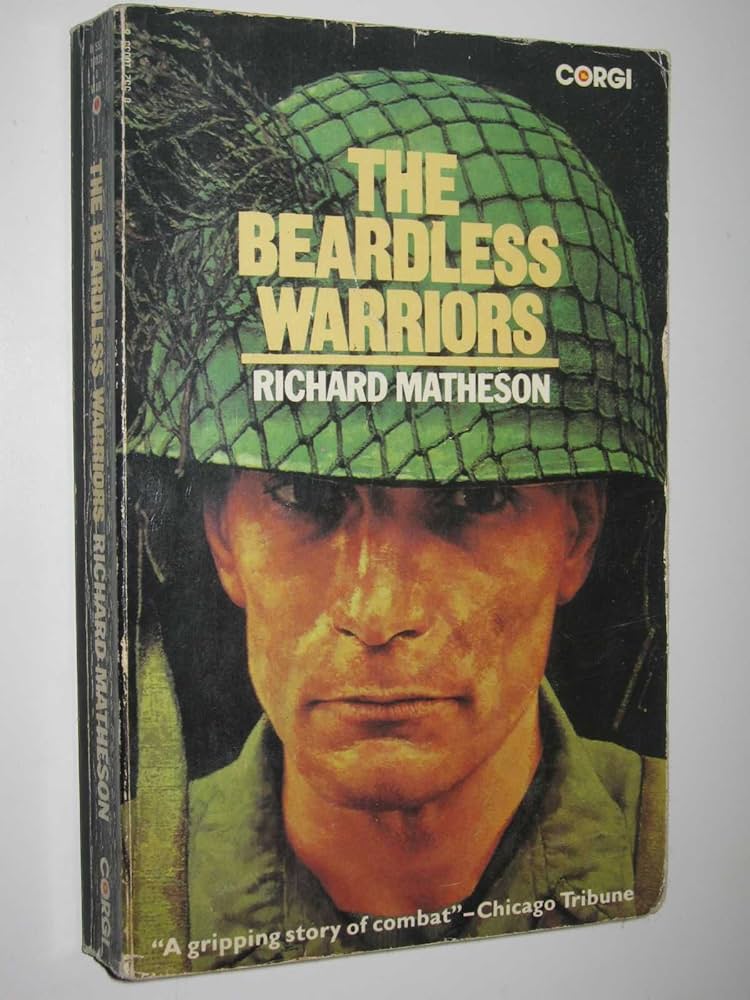
Didn’t recognize the author by name when I saw this paperback on the ‘Free’ shelf, only later learned he was the author of ‘I Am Legend,’ ‘The Incredible Shrinking Man,’ and ‘What Dreams May Come;’ all successful popular novels also turned into movies. No, what drew me in was that Matheson had been among the many eighteen-year-old reinforcement troops sent to join U. S. infantry units as they moved into German territory in December of 1945 – which puts him in spitting distance and time of my father, who was also eighteen when he reported for duty, was trained, shipped over and served in combat until being seriously injured on April 11,1945, less than a month before the end of fighting in Europe. Matheson took fifteen years to get this ‘memoir in the form of a novel’ (my characterization) written and published, so nearly as many years as those reinforcements were granted before being committed to the battlefield, and the time was well spent. Despite my having previously read several other battlefield memoir/history/fictions, this one elevated by an order of magnitude my attempts to imagine what that experience must have felt like.
From the first sentence, Matheson tells his story almost breathlessly, plunging the reader directly into the experiences of one Everett Hackermeyer, a motherless child and nearly fatherless too, with little to live for and few tools to do so. We see the confusion and futility of war from his perspective and feel the importance of his developing relationship with a much older (all of thirty-eight years-old!) Sergeant, a no-nonsense nuts and bolts leader who has learned and accepted the hard truth that no matter how well he performs, many men will die under his command. As is often prominent in memoirs of Vietnam, we see how senseless the orders from on high appear to those who must follow them – war, for an infantryman, is not geopolitical or strategic, it is only struggle. At times it seems the only thing that changes from day to day is the rolling succession of squad members, as one after another are injured or killed, replaced (though not in the same numbers at this late stage) and their replacements in turn are inducted and ground up by the coincidence and accident of chaotic violence.
The novel’s action covers only a couple of weeks, all centered on moving a few short miles to take seemingly one unimportant town, which could have made for monotony, but Matheson is a champ at finding new and creative words to describe similar battle scenes and the dull and dyspeptic interludes between them. Hackermeyer’s evolving knowledge and emotions also give each skirmish the specificity to feel new. Approaching novel’s end the author gives us a skirmish only slightly more significant than the preceding ones, but with personal incidents that make it satisfyingly climactic, even as the reader understands that the hell these men have been living will go on and on until the day that awful war ends, even if they are lucky enough to live to see it.
It has been said that the experience of being in combat cannot be communicated to those who have not lived it, and I don’t doubt that that is true. The Bearded Warriors though, makes more progress in that direction than anything else I’ve encountered, helping me to understand (now that it is years too late) what my father must have experienced and how it probably transformed the bright-eyed young man he had been into the tightly controlled and deeply insulated veteran I knew as I was growing up.
Surviving battle is not the same thing as coming through unscathed.
This novel is a definite keeper and deserves to be read by anyone who claims that fighting for even the most just cause is a path to glory.
P. S. – As America’s leaders seek drama and ‘glory’ in wars of their own creation, the thrilling speculative fiction E Unum Pluribus explores one way in which their winner-take-all governance may bring about the end of the USA – and how very much we stand to lose if we allow that. The novel is currently being serialized online and anyone can read it, for free, starting at https://robinandrew.net/2026/01/01/e-unum-pluribus/
(Those who are wary of unfamiliar links can access it just by going to robinandrew.net and clicking on E Unum Pluribus in the menu at top of the home page.)