Tag Archives: London

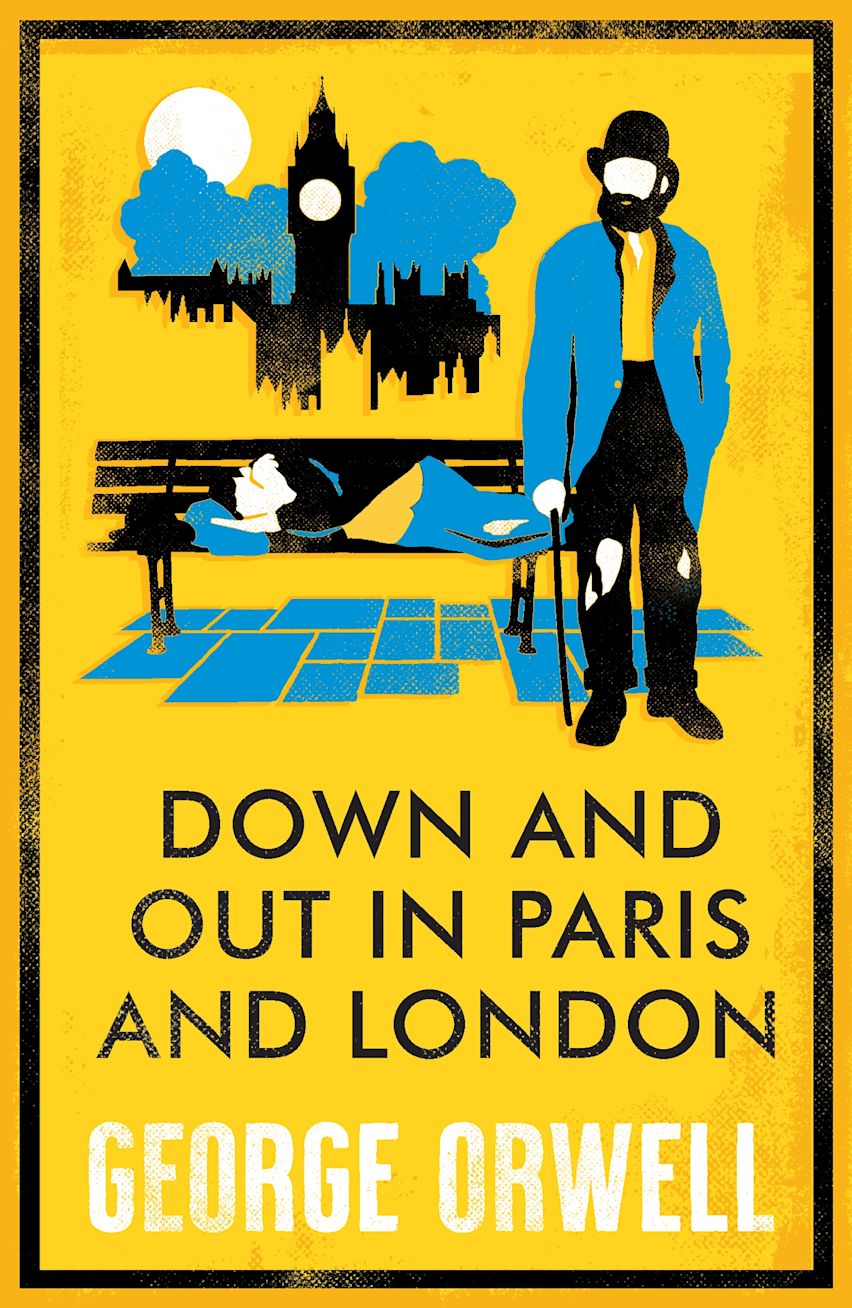
‘Down and Out in Paris and London,’ George Orwell’s 1933 Social Realism

Variously described as a novel and as a memoir presented as a novel, this brief volume certainly has the feel of hard-won experience.  With little preamble Orwell throws the reader into a squalid neighborhood of Paris circa 1930 where we experience the scramble for enough food to avoid starvation and a place to sleep – if one dare drift off while in intimate proximity to any number of strangers, swindlers, thieves, the deranged, the pious and the police. 

Visions of filth, sweat and stink dance in our heads as the narrator (who is in no way distinguished from what we know of the author himself) finds job, loses job, finds room, loses room, earns a few francs and spends all of them on barely enough bread, margarine, tea and tobacco to keep his body upright.  Along the way we are treated to character sketches of many sketchy characters, a few of whom have preserved hearts of something better than lead, another few of whom possess remarkably bright minds despite the grinding effects of their poverty and hopeless circumstances.

Despairing of his ‘opportunities’ in Paris, our guide is thrilled when an old acquaintance in London proffers a job as caretaker to an elderly invalid.  Loaned funds just sufficient for travel and a few days subsistence, he is soon in that great city, only to find the promised position has evaporated as the ‘tame imbecile’ and company have themselves left for the same continent he just abandoned. Now we follow our guide into the bowels of British social services and charities as he learns to navigate ‘the spike’ (a sort of municipal homeless shelter offering prison-like rules and conditions in exchange for horrible food and worse sleep abetted by a tracking system that keeps its customers constantly walking from town to town and so unavailable for any sort of work or betterment), church-run shelters (considered worse than the spike for their insistence on performative piety and the hypocrisy of their tenders), the Embankment (among the few places in London where one is allowed to sleep outdoors, but its benches, noise and Bobbies make sleep next to impossible) and commercial lodging houses (better accommodations, but prices out of reach for the truly destitute).

Given Orwell’s known Socialist leanings, it’s no surprise there’s a certain class consciousness to all this.  His conviction that nearly all the ‘idle’ poor would readily choose to work for their keep if there were jobs available seems a bit broad and naïve ( not to mention the number whose physical, intellectual or/and emotional disabilities and dis-aptitudes might make the unsuitable for hiring).  His modest proposal – group homes where the residents tend gardens which provide a portion of their food, thus requiring a lesser subsidy than the current system wherein they are virtually prohibited from working and earning because the feeble accommodations available will only accept the absolutely penniless – is probably even less likely of enactment today than it would have been in his time.

A painful read, reflecting what the least favored among us must endure simply to survive – but well worth revisiting as the current U. S. administration works to slice open our own social safety net and condemn millions of immigrants and citizens alike to conditions little better than what Orwell describes. (And sometimes worse, incarcerating non-citizens of no significant criminal history without legal process or recourse and even banishing some of them to whatever cutthroat minor state will take our tax money in exchange for receiving and disposing of them). 

P. S. – E Unum Pluribus is a speculative fiction shaped by the economic consequences of the USA’s present partisan divide.  It is currently being serialized online, for free, and you can read its first installment at: 

Neverwhere, Neil Gaiman

Gaiman certainly has a knack for taking fantasy in titillating new directions. Mixing legend with pop culture, bridging generations and phases of life, his is an impressive improvisational-seeming voice; loose and loud and reasonably sound in its coherence and payoff.

Richard Mayhew, protagonist this time around, is a decent mensch, a modern everyman who seems just as lost in his own world as he will become lost in the underworld he discovers as a result of one decent – and so, uncharacteristic – act. Such a mensch, in fact, that his survival and eventual semi-triumph are a bit implausible, though satisfying nonetheless. The characters who surround him are pleasingly off –beat and appealing and their adventures offer enough cliff-hanging to keep one deeply involved.

Underneath it all, there glimmer a few bits of insight into human frailty, relationships and the failings of society. Just enough to ground this fantasy in reality and assuage the guilt of reading such fluff.

Yes, a pleasure all the way. Well done, Mr. Gaiman, well done.

Fingersmith, Sarah Waters

If Charles Dickens had been alive in 2002 – and if Charles Dickens were a woman who loves women, or at least an author who wished to appeal to such – this is the book that Charles Dickens might have written. Sarah Waters gives us the dark alleys and stinking gutters, the unrepentant thieves struggling to make a living off of others’ innocence, the crumbling leaky mansion inhabited by an anti-social misanthrope (this one happens to be a scholar of the era’s pornography, soft-core though it would be to us today) and a cast that would warm the heart of any theatrical agent nursing a deep roster of character actors.

The plot too, is Dickensian in its intricacy, incorporating old family lore, false identities, willful deception and several rapid transitions between the world of wealth and that of poverty – not to mention servitude, orphaning, incarceration and consignment to a madhouse. For the most part it all flows and compels, though there are places that would have benefitted from less conversation and more activity. Given that Waters has had significant success, I’d guess her fans will be more comfortable with the blend than I.   They may also forgive several infuriating passages where characters prolong the drama by refusing to speak the obvious, leading this reader to feel manipulated and the tale prolonged beyond its natural scale.

At the heart of the story is the relationship of Susan and Maud, intricately-tied despite being separated until their teens and unaware until the novel’s very end of what those ties really are. Their interaction is told in alternating first person sections and it is to Waters’ credit that there is never any question which of the two we are inhabiting. As to which of these women is laudable and which detestable, that is always in question, again to the author’s credit. Neither is a saint, yet both have been placed by others into situations that make their conduct, if not excusable, at least defensible in a novelistic context. Their love story is handled very carefully it seems, as if aiming for just enough clarity to satisfy readers who seek that aspect, but obliquely enough not to deter those who are indifferent to it. For anyone who brings along an attitude antagonistic to the image of two women in love with one another, the lack of a single admirable male character in this tale will perhaps suggest a reason to consider it more generously.

Getting back to the women, Mrs. Sucksby, the mother and mother-figure who is in one sense the instigator of all the angst, is in another sense as much a victim. Her final act of love and protectiveness seems modelled on that of Charles Darnay in A Tale of Two Cities, perhaps another nod to the man who wrote that novel, as he might have this.

Thoughtful, empathetic; a rewarding and pleasurable read, though it would have been more so with a few tucks and darts in the right places.

(Fingersmith was adapted into a two part BBC movie, 2005)

Shakespeare’s Pub – A Barstool History of London as Seen Through the Windows of Its Oldest Pub – The George Inn

This amusing blend of history and anecdote traces not just the George, but all the coaching inns of Southwick, down through the centuries. Brown, who has made a career of writing about British beers and the people who brew, serve and consume them, has an obvious love of his subject and that translates into an enjoyable read, even with an iconoclastic glass of wine in one’s hand.

Has a decent eye also, for how individual history reflects that of the surrounding economy and culture. One of his revelations concerns the effects which the invention and rapid spread of railroad trains had on a wide range of industries, from the freight wagon trade, to passenger-carrying stagecoaches, stables and liveries, lodges/hotels, the hop trade, ports and the very patterns of settlement geography. Not gradual change either, but rapid and accelerating, able to wipe out an industry in one lifetime. That some of the trades displaced had done similar violence to other, earlier ones, suggests poetic justice when the trains themselves are later displaced by automobile and truck traffic (on roadways which necessarily evolved almost beyond recognition from the muddy and undisciplined things they had once been – ‘imagine, needing to make actual rules for which side of the road to drive on! Imagine!’).  Which reflects nicely on our current fearless leader’s proposal to preserve the coal trade. Really?

Touching on literature, cuisine, habit and morality, Brown suggests that the history of the George is only tenuously concerned with its physical manifestation, examining the existential question, if you replace only one small piece at a time, but eventually have replaced every piece of any object, is it still the original object? A question he answers in the affirmative – as he must, for the book’s topic to have merit…

My favorite bit though, is when a George-lover asserts that the ghost of Same Weller (of Dickens’ Pickwick Papers), has been seen around the place, allowing Brown a wonderful riff on the mental contortions required first to believe in ghosts, then in the ghost of a fictional character who never lived in the first place, and then that said ghost would haunt not the pub which the author named as his character’s locale but the one which some readers like to think the author may have had in mind when he created his fictional location, despite giving it the not-at-all fictional name of another actual pub down the street!

I like the way this author’s mind works, and will be seeking out his other beery books. Not to mention seeking out The George one again, as soon as we return to London-town.