Tag Archives: books

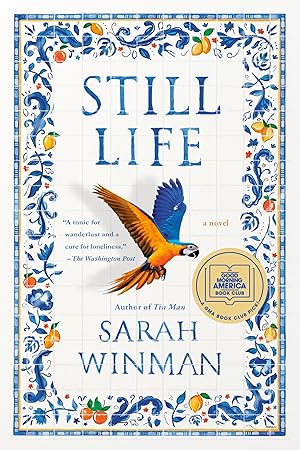
Still Life, Sarah Winman

The romantic novel as still life painting – an unlikely assortment of exquisitely-rendered events (the objects) carefully arranged for maximum effect (starting with Evelyn and Dorothy in 1944, then moving forward in jumps and fits, then returning to Evelyn in 1901), the entire assemblage framed by the city of Florence in all its history and culture and gastronomic variety. 

When I search the text for ‘still life’ I find reference to all the still life paintings Evelyn inherited; thought by some to be no more than decorations, to her they are the grail, which seems perhaps a comment on the genre as a female space. Another instance, also, in which she, having become an art professor, theorizes on the genre’s power as coming from, not in spite of, the seeming triviality of individual objects or domestic situations which actually contain specific phrases of the overall painting’s meaning and purpose.  How it freezes time, raises up the contributions of those who provide for others (as opposed to the ‘movers and shakers’). And a final instance of the two words together in the passage  “…Empty bowls.  Rotting fruit.  Passing time.  But still life in all its beauty and complexity…” thus making clear the author’s multiple intents: still life as a genre of painting, life as a collection of individuals interacting and connecting as do the objects in a still life painting, an account rendered in the manner of a still life painting and, ultimately, that ‘life’ is still ‘life,’ whether one is old, or disappointed, grieving or alone or has serendipitously found what they’ve been looking for all along.

(Worth noting the large number gay characters; more than would be expected solely because of the novel’s interest in art, literature and other creative pursuits.  Clearly the result of many decisions by the author, who herself came out in the 1980s, and a welcome reminder that human variety is not a product of the late twentieth century.  Noted also that not quite all the hetero relationships in the book are constrictive, doomed and/or abusive, but the tally certainly trends in that direction.)

_______

Eight months after reading this novel and recording the notes above, I came across the title again and was not certain whether or not I had read it.  Reading my notes at this remove, I’m struck by how interesting and satisfactory they make the book sound and yet I did not recall it (sincere apologies, M. Winman). Entire reason I started writing notes like these was the hope of no longer doing that… 

Is it time, perhaps, to slow down and not consume so many books but rather to savor the few?  But what other way to find those few, given that recommendations and reviews are so unreliable?  And isn’t that dilemma just what life itself is all about?  One has to experience its entirety – the exciting and the tedious, the success and failure, the love and the rejection, the yin and the yang and the black and the white and the good, the bad and the ugly – in order to learn what is truly astonishing and beautiful and we wish we had done a better job of savoring and holding onto – what will be so difficult to say goodbye to when one finally shuffles off.

Maybe it’s simply time for me to re-read some of those books which a first read confirmed to be worthwhile. 

Like Sarah Winman’s Still Life.

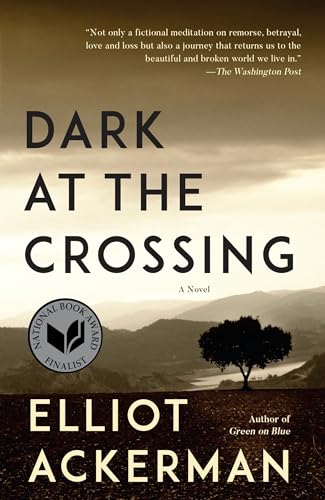
Dark at the Crossing, Elliot Ackerman

Ackerman, takes a risk here, venturing into the mind of an Iraqi-American attempting to join the Syrian resistance to Bashar Al Assad’s brutal regime.   Published in 2017, this may have just predated the current literary judgement that any such attempt at empathetic fiction constitutes an unjustifiable act of appropriation.  For this reader, the complexity he portrays in both the would-be fighter and the rest of his cast – all but one of whom are also of Middle Eastern nationalities and ethnicities – justifies the premise.  No, this is not the novel a native Iraqi or Syrian might have written, but neither is it an opportunistic rip-off spawned in ignorance.  Ackerman’s record as a journalist and as a Marine (decorated for actions during tours of duty in both Iraq and Afghanistan) gives him enough credibility, in my view. Besides, his writing of his book in no way prevents anyone of other background from crafting their own. (That he gets published and someone else might not is more properly a comment on the nature of the publishing industry/market than on the right of any author to spend their days following their own visions.)

Moving past all that, Dark at the Crossing presents a convincing and valuable portrait of the desperation endemic to a wartime refugee movement – boys living on handouts along the side of a highway, families hoping to subsist on what they can grow from a single envelope of seeds, a mother’s love warped beyond repair by the unmanageable violence of urban insurrection, lives casually dispatched by blasé warriors barely out of adolescence and under no close command.

More deeply, this dramatic and eventful story is concerned with the question of why men fight such wars.  Yes, there are individuals or moments in which the desire to topple an illegitimate regime is clear and pure, but often the motives are more muddled. Revenge against previous cruelties and atrocities is a deep strain, the need to be active in one’s fate rather than a passive victim seems another.  Also, and perhaps wrapping around all those, is the need to become part of something which feels simply too large to ignore: when your entire world is burning, is there not a moral obligation to pick up a bucket, no matter how small?  Is that not actually an act of love – for those who might be saved today, tomorrow, next year or next decade?

In that, the novel recalls Chris Hedges’ War is a Force That Gives Us Meaning (though Ackerman does not judge such a search for meaning nearly as harshly), and also John Krakauer’s Where Men Win Glory (despite a perspective which could hardly be more different, its depiction of the personal cost such impulses can exact raises similar issues).

For raising and considering such questions, Dark at the Crossing is more than worthy of the time it takes to read and the fraction of an inch it now occupies on my shelf.

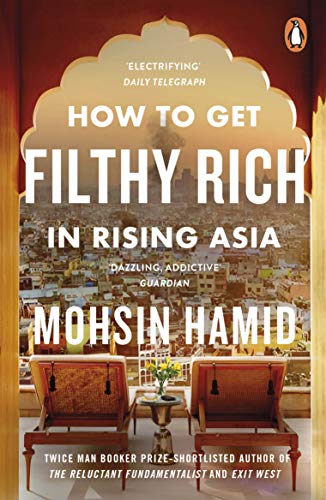
How to Get Filthy Rich in Rising Asia, Mohsin Hamid

Version 1.0.0

Posing as satire of the Western world’s self-help book genre, this clever volume starts out strong (“Look, unless you’re writing one, a self-help book is an oxymoron.  You read a self-help book so someone who isn’t yourself can help you, that someone being the author.”) and finishes even stronger.  There is a stretch about three quarters through its slender 220 pages that treads close to familiar crime and corruption thriller terrain, but happily that is only a dalliance, employed by Hamid to bring his protagonist down to earth and set up the final chapters wherein we realize what sort of wealth is really being promoted here, and in what way this book truly proposes to help its readers help themselves.

Along the way, we get a glimpse of what life is like for many hundreds of millions across the globe.  A lesson given greater impact by being written in the second person, casting the reader as protagonist (“The whites of your eyes are yellow, a consequence of spiking bilirubin levels in your blood.”) This choice is particularly effective at impressing readers from prosperous northwestern-quadrisphere cultures (such as myself) with the realities of life for those who indirectly support our affluence (“The virus affecting you is called hepatitis E. Its typical mode of transmission is fecal-oral.  Yum.”)  Later, when a different range of emotions arise among characters in circumstances superficially different from our (my) own, this second-person setting makes plain the conclusion that we are all the same underneath, no matter how different our economics make us seem at first glance.

Lest this sound like a civics lesson, I want to emphasize that the writing throughout is full of wry insight and humor.  To that, the final chapters add great warmth and sympathy for the human condition and an understanding of love, aging and the grace with which those can be faced – when complex and imperfect beings rise to their best potential.  An unexpected and very welcome reward at the end of a brisk and entertaining trip.

Ultra-impressive work by Hamid, who is fast becoming a favorite author.  Originally from Pakistan, he has dual English citizenship, degrees from Princeton and Harvard Law and experiences in the worlds of corporate law and McKinsey consulting to complement his South Asian frame of reference. Author of five novels so far and at least one work of non-fiction (Discontent and its Civilizations: Despatches from Lahore, New York and London, 2014), his is a voice which deserves to be heard, and widely.

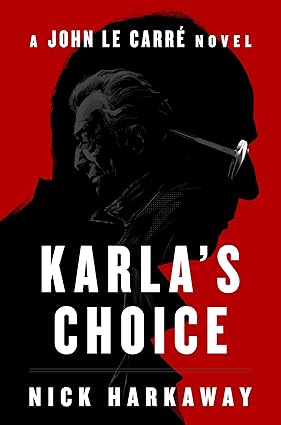
Karla’s Choice, Nick Harkaway

Picked this up less than fully convinced that a John Le Carre novel sans Le Carre was really needed.  Fact it was penned by the master’s son, Nick Harkaway, made it somewhat more promising than the various Ian Fleming-less Bond retreads by unrelated followers (of whom Harkaway is one, the admirable William Boyd another).  Was encouraged before the start by a statement in the Author’s Note that “There were always supposed to be more Smiley books.”  LeCarre’s having graciously left ten years of blank foolscap between The Spy Who Came in From the Cold and Tinker Tailor Soldier Spy also suggested room for this insertion.

From the start, what I found was encouraging, gliding along quite happily to the familiar rhythms and contexts of LeCarre’s world as scored and conducted by Harkaway (who has the benefit of having actually been present and somewhat privy to his father’s creative processes).   A pleasant enough experience, but not eye-opening – until somewhere around 80% of the way through – stop reading here if you don’t want to spoil the experience for yourself…

Just as I’d begun to worry this might be all retread, Susannah, the naive civilian whose cry for help initially set the entire story into motion, despairs at Smiley’s apparent lack of principle and crosses the Iron Curtain into Hungary (at the time a Communist autocracy tightly leashed to the Soviet Union) to commandeer his mission for herself.  Though believable based upon her earlier actions and personal history, this impulsive act nonetheless flips us into another plot entirely, as Smiley and his professionals must improvise in hopes of catching up with her.  Then, just as I’d accepted that and begun to anticipate the excitement it must generate, Harkaway switched form entirely – stopping the clock to preview various character’s future reminiscences on whether Smiley’d had no idea this was coming and was now in totally reactive mode, or had anticipated and accepted Susannah’s action as inevitable and gone with the flow or had, in fact, callously conceived, arranged and ensured such a dangerous act in order to achieve his own ends at the probabl cost of her innocent life.  By dancing a follow-spot rapidly over Smiley’s talent, skill and commitment even as it highlights several canonic characters’ own abilities and relationship to the master, Harkaway makes clear that moral principle, guilt and regret are the true subjects of the novel, assuming LeCarre’s mantle very nicely, thank you. 

Minutes later (in reading time, that is) we’re back into thriller form, watching as George discovers he has been made and is being tailed, and then as this unassuming ‘little man’ deals brilliantly with the challenges (including a car chase with Smiley at the wheel – never thought we’d see that!).  These scenes are virtuosic for both character and author, and from there it is a race to a signature LeCarre finish: bloodshed held off-screen, morality front and center and more than a hint of anticlimax, until Harkaway surgically exposes just what values and choices lay behind the various participants’ actions. Despite the infamous Karla (through-line villain of the entire Smiley oeuvre) having appeared very sparingly and with minimal back story, it turns out that his ‘choice’ is indeed the true point of this novel.  Not to mention a worthy gift to the fans in how it adds color and insight to Le Carre’s own chronologically-later volumes. Very nicely done!

Credit where credit is due:  I read this in e-book form – one of the more benevolent byproducts of our evolving digital hegemony.  An e-book I had borrowed online from a public, i.e. ‘government funded’ (cue the sinister theme music) library – one of those many liberal-culture institutions from which our marginally-elected leaders are currently scrambling to rescue us.  Had downloaded it in moments and for free – another benefit of the ‘mommy state’ imposed upon us by the ‘deep state’ which is now being shredded in favor of absolute free-market fundamentalism. Who knew we had so much to lose?  Anyone with eyes…

Having thus tested the waters and found them delicious, I’ll now be purchasing a hard-copy of Karla’s Choice so as to compensate author and industry for conspiring to make such an entertaining and worthwhile title available.

Kköszönöm mindenkinek – ’Thank you everyone.’