Tag Archives: reading

Parable of the Sower – Octavia E. Butler’s 1993 Vison for Today’s Tommorrow

Following up recent rereading’s of Orwell’s 1984 and Bradbury’s Fahrenheit 451 I saw this speculative novel recommended for its prescience and found that characterization to be spot on. Writing back in 1993, Butler describes a Southern California that could believably result from just a few more years pursuit of our nation’s current course.  Widespread poverty thanks to an politicians who own power over actual governance, violence and destruction by a populace fragmented and distrustful of one another, worldwide ecological disasters, misuse of new technology for profit and oppression, legal and police powers used not to protect the rights of all but to entrench the power of the few and, overlaying all that, a portion of the populace turning to reactionary religious movements in hope of refuge.  A decidedly dystopian take on our situation, but very convincing and valuable as an eye-opener.  That it is set in our exact time (July 2024 – October 2027) despite having been written over thirty years before is almost spooky to one first reading it today.

Butler (born 1947, died 2006) was a pioneer: at a time when it was striking to find either a Black person or a female making a name writing science fiction she was both, going on to win Hugo, Locus and Nebula awards as well as a MacArthur Fellowship grant.  This first of her works that I have read (there will be more) is partly shaped by her ethnicity, featuring a mixed race band of refugees and touching repeatedly on how race has shaped them, has affected their fortunes and is still affecting them despite the near total collapse of nearly every other social structure. 
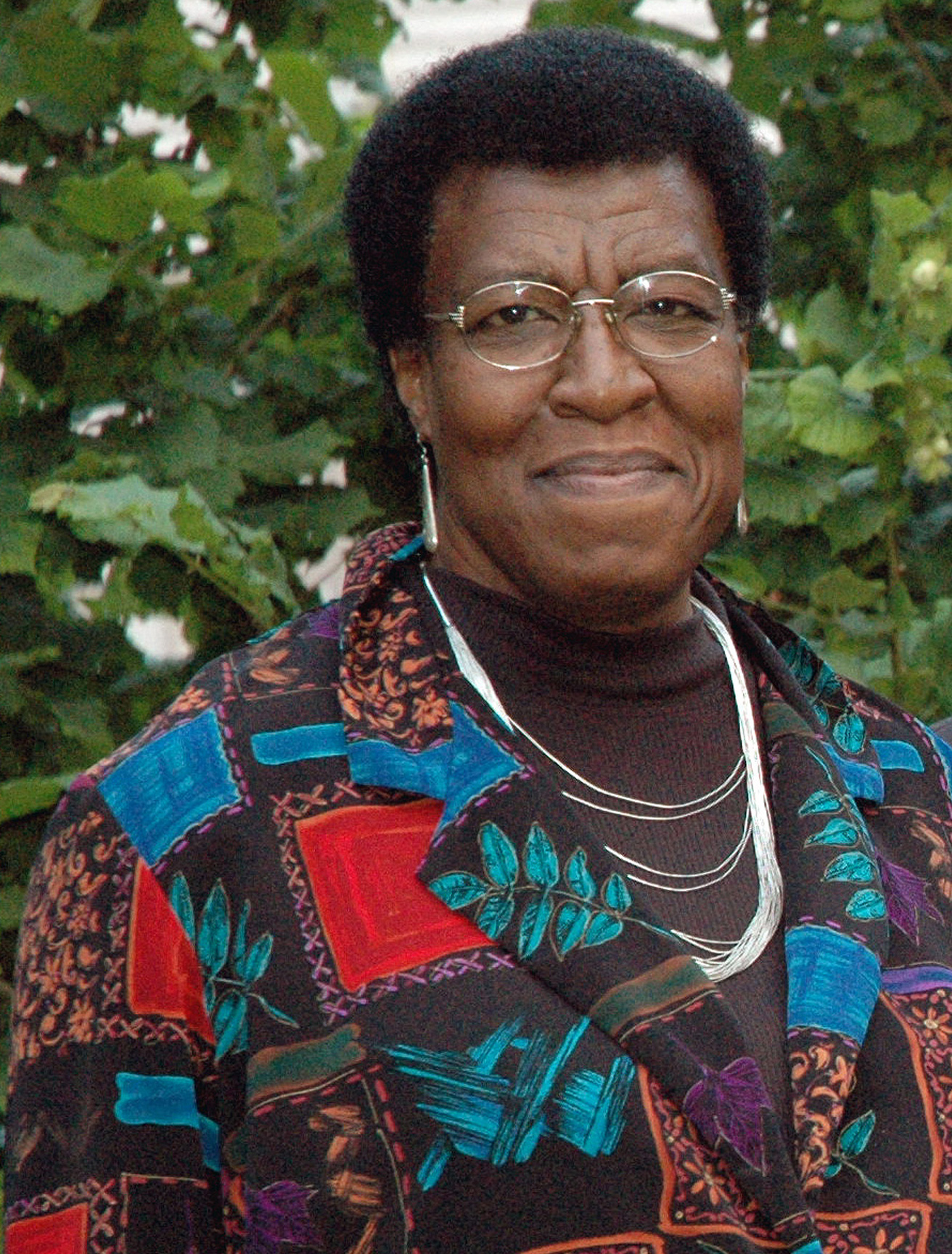
Not content to cover that weighty ground, Butler also puts forth a religious theme, with protagonist Lauren Oya Olamina (which surname we learn is from the Yoruba region of Nigeria) the daughter of an Evangelical preacher. Lauren is in the process of devising a faith of her own, which she calls Earthseed in reflection of its vision of destiny – the expansion of Earth’s humanity to live among the stars and spread their ‘ seed’ throughout the universe.  Lauren’s coming to grips with that calling and beginning the process of dissemination is the true theme of the novel, all the others serve to set the conditions and inform the necessity of her doing so.

Butler’s writing is immediate and colorful yet quick and concise, her plotting is complex without falling into the sort of techno traps that affect much Sci-fi.  Resultingly, the Parable of the Sower is a work of literature which uses its genre as vehicle, not a commercial work safely exploiting a comfortable niche. A sequel, Parable of the Talents (1998) presents a further step in Laruen’s and Earthseed’s journey, culminating in departure of their first space craft on a colonizing mission.  That having been Butler’s final published novel, it is sad to consider how she might have continued the tale, had she not struggled with depression and writer’s block before passing away in 2006, at the too-young age of 58.  

Very glad to have encountered both book and author, and highly recommend them to any readers interested in where our politics are leading the USA, exploring the canon of science fiction, alternatives to mainstream religion or just curious about where human society may be headed – in both the near and the far terms.
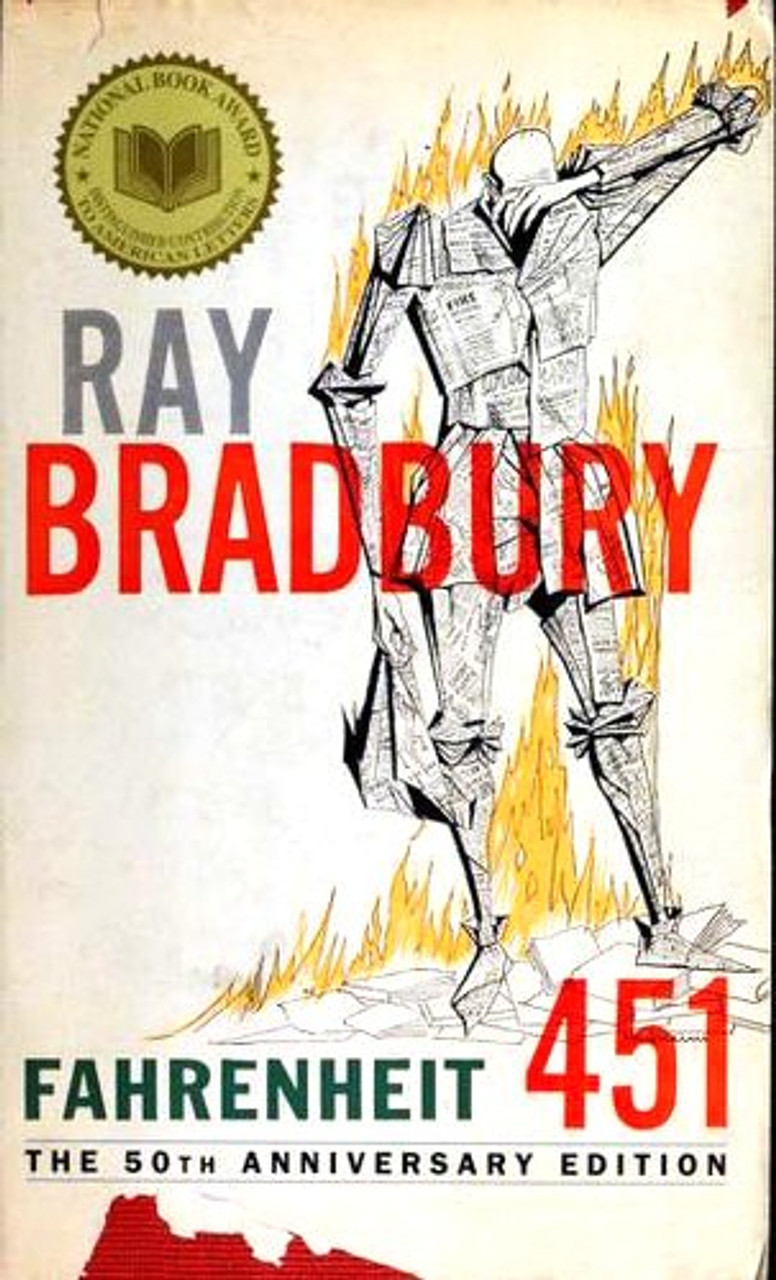
Fahrenheit 451, Ray Bradbury

Like a 75-year-old car, Bradbury’s most lauded novel feels a bit clunky compared to the sleek and smooth commodity fiction churned out by today’s industrial publishing conglomerates.  As with any mode of transportation though, where a book takes you is more important than the vehicle itself, and Fahrenheit 451 offers a ride through the very territory over which our nation is currently circling. Pretty amazing for a story first anthologized in 1950 and expanded into this short novel in 1953!

Minds colonized by omnipresent ‘entertainment’ media pretending to provide viewers with a ‘reality’ more acceptable than their own; lives lived in bubbles of class and clique; an authoritarian government ginning up perpetual wars as excuse to police every facet of its citizen’s lives; new technologies immediately harnessed to enforce all of the above – Bradbury’s fears for his characters’ ‘future’ are amazingly close to today’s realities. 

In an afterword and coda written later (1982 and 1979, respectively), Bradbury makes clear that he traces all those developments to his fictional culture’s rejection of the written word.  Books there are viewed as corrupting distractions.  Not content with discouraging or banning individual volumes on the basis of specific content, this regime fears all books because they record, preserve and encourage independent thought.  The very possession of any book has been declared a major criminal act and the once laudable community symbol of the Firefighter has been perverted into a new role as government book burner (and incidental executioner of bibliophiles).

So here we are seventy-five years later, with citizens pressuring their libraries and schools to dispose of any books hinting at truths those particular citizens don’t appreciate; a juvenile Secretary of ‘War’ decreeing which slanted versions of history, philosophy and the social sciences may be read or discussed in the military’s colleges and academies as the White House extorts even private universities to teach to the President’s personal prejudices.  Meanwhile, surveys confirm that fewer and fewer and fewer persons are reading any books by choice, preferring instead to have information spoon-fed into their brains via profit-tailored algorithms curating content for their profit-driven mass electronica. In spooky parallel to Bradbury’s Firemen cum Fire-setters, the current administration has given control of many federal agencies to fanatical minions who despise those agencies’ statutory functions, wishing instead to destroy or pervert them by flipping them from protecting the environment or civil rights, for example, to opening the former to plunder by political contributors and restricting the latter’s protections to only those who bow down to the MAGA movement in all its glory and gory ambition (while sporting an appearance that comports to Mr. Trump’s old-Hollywood vision of how true Americans are supposed to look).

Despite some age-appropriate road wear and rust in its wheel-wells, Bradbury’s Fahrenheit 451 is no junker, but a precious classic vehicle for waking up the masses, every bit as timely today as when its rubber first hit the road.  It deserves to be read or reread as widely as possible, so more citizens will see what is happening and do what they can to stop it.

P. S. – Along with Orwell’s 1984, and Animal Farm, Vonnegut’s Slaughterhouse-Five, Huxley’s Brave New World, Anthony Burgess’ A Clockwork Orange and others from the mid-Twentieth, this novel has helped to shape the fears and ideals of multiple generations.  Margaret Atwood’s The Handmaid’s Tale, Cormac McCarthy’s The Road, Emily St. John Mandel’s Station Eleven and Octavia E. Butler’s Parable of the Sower are notable among many other recent and creditable volumes with similar aspirations of enlightenment and warning.  Now more than ever, all such books deserve to be read and shared.

Like this book or this post? Please Share it!

Interested in what you read on this site – please subscribe. It’s free!

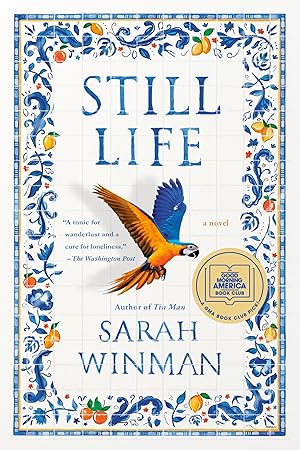
Still Life, Sarah Winman

The romantic novel as still life painting – an unlikely assortment of exquisitely-rendered events (the objects) carefully arranged for maximum effect (starting with Evelyn and Dorothy in 1944, then moving forward in jumps and fits, then returning to Evelyn in 1901), the entire assemblage framed by the city of Florence in all its history and culture and gastronomic variety. 

When I search the text for ‘still life’ I find reference to all the still life paintings Evelyn inherited; thought by some to be no more than decorations, to her they are the grail, which seems perhaps a comment on the genre as a female space. Another instance, also, in which she, having become an art professor, theorizes on the genre’s power as coming from, not in spite of, the seeming triviality of individual objects or domestic situations which actually contain specific phrases of the overall painting’s meaning and purpose.  How it freezes time, raises up the contributions of those who provide for others (as opposed to the ‘movers and shakers’). And a final instance of the two words together in the passage  “…Empty bowls.  Rotting fruit.  Passing time.  But still life in all its beauty and complexity…” thus making clear the author’s multiple intents: still life as a genre of painting, life as a collection of individuals interacting and connecting as do the objects in a still life painting, an account rendered in the manner of a still life painting and, ultimately, that ‘life’ is still ‘life,’ whether one is old, or disappointed, grieving or alone or has serendipitously found what they’ve been looking for all along.

(Worth noting the large number gay characters; more than would be expected solely because of the novel’s interest in art, literature and other creative pursuits.  Clearly the result of many decisions by the author, who herself came out in the 1980s, and a welcome reminder that human variety is not a product of the late twentieth century.  Noted also that not quite all the hetero relationships in the book are constrictive, doomed and/or abusive, but the tally certainly trends in that direction.)

_______

Eight months after reading this novel and recording the notes above, I came across the title again and was not certain whether or not I had read it.  Reading my notes at this remove, I’m struck by how interesting and satisfactory they make the book sound and yet I did not recall it (sincere apologies, M. Winman). Entire reason I started writing notes like these was the hope of no longer doing that… 

Is it time, perhaps, to slow down and not consume so many books but rather to savor the few?  But what other way to find those few, given that recommendations and reviews are so unreliable?  And isn’t that dilemma just what life itself is all about?  One has to experience its entirety – the exciting and the tedious, the success and failure, the love and the rejection, the yin and the yang and the black and the white and the good, the bad and the ugly – in order to learn what is truly astonishing and beautiful and we wish we had done a better job of savoring and holding onto – what will be so difficult to say goodbye to when one finally shuffles off.

Maybe it’s simply time for me to re-read some of those books which a first read confirmed to be worthwhile. 

Like Sarah Winman’s Still Life.