(The novel, E Unum Pluribus, is narrated by Jack Shirley, an office intern whose gender behavior doesn’t always fit the expectations common in contemporary Amero-European culture. Anticipating that Jack’s character may arouse comment, this is one in a series of posts sharing the author’s thoughts around those expectations.)
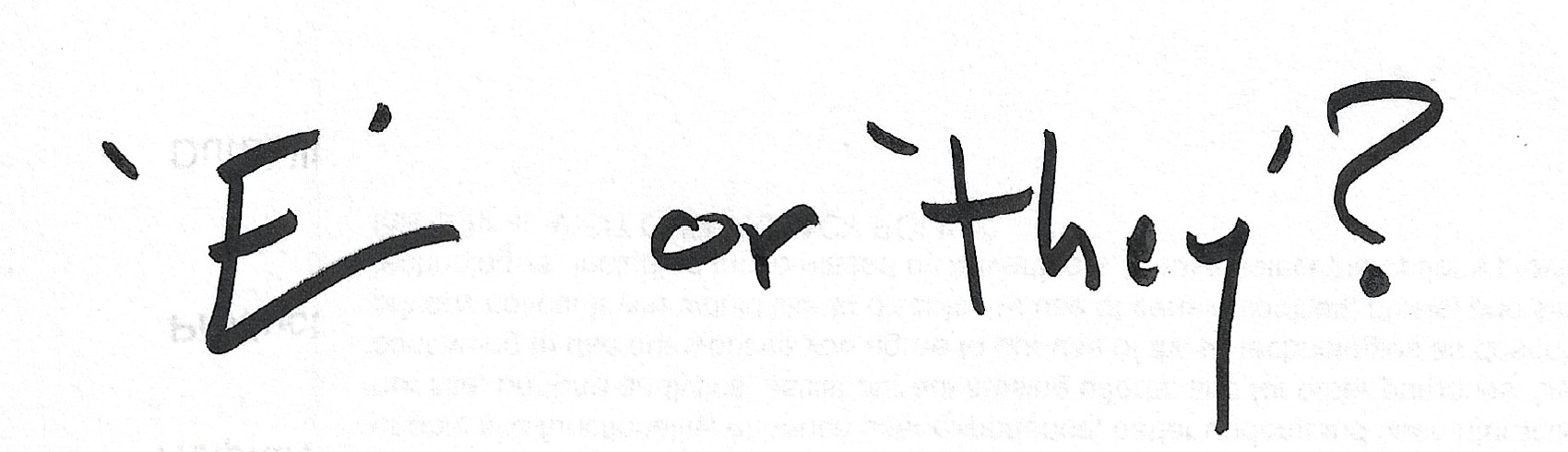
Earlier posts about gender-free pronouns (E, em, eir, or similar) probably invite the question: at a moment when English language users are starting to be comfortable with ‘they/them/their’ as singular pronouns for nonbinary persons; why not just accept that as progress and move on? A few thoughts:
Some English language verbs are formed differently when applied to a singular subject than to a plural one. Chris is a single person, so he or she ‘has’ red hair, but if we’re considering more than one person, they ‘have’ red hair. So, if I’m using a singular they/them because I happen to know that Chris identifies as nonbinary, do I say ‘they has red hair’? Feels pretty odd, to these ears. Similarly, if Taylor is a woman, she ‘was’ late; if Taylor is a man, he ‘was’ late, but if Talyor is nonbinary, is it ‘they was late’ or ‘they were late’? Either way feels wrong. On the other hand, adopting a non-gendered singular pronoun like ‘E’ allows it to form verbs the same ways as any other singular pronoun: he writes, she writes, E writes . Done.
Even more basic than forming verbs is the confusion inherent in dual-purposing pronouns that we’ve long understood as plural so that now they (sometimes) refer to (some) single persons while (most of the time) they are still plural. When discussing a group of people, for example, if you say ‘and then they…,’ does that ‘they’ refer to an action by the entire group, or to the same action by one non-binary individual in the group? There’s no good way to tell.
That plurality question also points up a more profound issue with using ‘they, them’ as singular pronouns for only those individuals who see themselves as non-binary: it is requires that those individuals declare themselves NB in the first place. A declaration which, depending on when and where it is made, may well open the person to criticism, social rejection, pressure for medical or psychological treatment of a perceived ‘disorder’ (as if perfect order were the natural state of any personality!) or even legal proceedings. At the least, it implies that being non-binary is to be, in some way, ‘other.’ Not typical, not ordinary like ‘a man’ or ‘a woman.’ Adn further, to certain points of view, questionable, suspect, abnormal, or even ‘perverted.’
And no, it doesn’t help that using ‘they/them’ for any single nonbinary person suggests that being nonbinary means you’ve got a more pluralistic inner nature than others: some halfway defined, half-realized man/woman hybridization thing going on, or multiple-personalities even. When actually, the greatest benefit of some individuals’ having had the courage to violate binary gender stereotypes is its potential to free all of us. To nudge us into realizing that there are not just two different (and mutually exclusive!) ways to be human, but as many different and overlapping ways as there are human beings.
Using gender-free pronouns as default for all persons makes it easier to speak of, comprehend and accept each individual for who E truly is, without first having to sort em into one or the other of two – and only two – rigid verbal boxes. And, better still, without judging em on how well we think they do or do not fit whatever definition anybody believes each of those boxes require. On this day. In this community. Or state. or Country, or… You get the idea.
Gender-free language better reflects the complexity and uniqueness of every person than limited use of jury-rigged singular ‘they/them’ pronouns can ever do. Making it the default language wherever gender or sex are not actually relevant (i.e: the great majority of public communications) is neither progressive nor conservative nor woke; it’s just clear, accurate and functional language.
Which is, after all, the best kind.
P. S. – E Unum Pluribus is a speculative fiction exploring one way in which our current ‘culture wars’ may bring an end to the U. S. A., and what may rise in its wake. With a thrilling plot driven by politics and economics (as well as gender, class, language and even the origins of faith) the novel is currently being serialized online and anyone can read it, at no cost, by navigating to the home page of this website and selecting E Unum Pluribus from the top menu, or via this link: https://robinandrew.net/2026/01/01/e-unum-pluribus/

