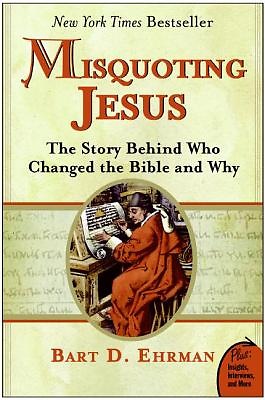
To those who claim the Bible* is the unerring word of God delivered directly from his mouth, Ehrman, an academic whose career has been spent in study of these scriptures, offers a potent rejoinder.
After a brief biographical summary making clear he is himself a committed Christian, Ehrman provides a layperson’s introduction to his discipline of Textual Criticism: the objective analysis of written documents and how their words came to be as they are. Seen through that lens, he explains, the scriptures we read today are demonstrably the product of countless scribes, translators and interpreters over two millennia, some of those persons known by name and reputation but most of them unknown except through the small fraction of their manuscripts which have survived. Working often in isolation and in various languages of which each had their own varying level of fluency and comprehension, these pre-printing-press copyists produced an undeterminable number of individual handwritten manuscripts, of which time and circumstance allowed only a random selection of perhaps complete, partial and fragmentary examples (still numbering in the tens of thousands,) to survive and be further winnowed and selected by compilers for their use as the basis for all of today’s printed Bibles. Recent digital collating and cross referencing of those surviving manuscripts have revealed them to contain hundreds of thousands of differences. So much for any one version being the inerrant word of the deity.
Not surprisingly given the process, some of those differences appear due to simple human fallibility – i.e.: plain old mistakes. Of the remainder, Ehrman attributes some to the fact that each scribe worked from a different selection of source materials, often fragmentary and often contradictory, so choices were made, differences repeated and passed down to the ages till they became considered ‘gospel’ (in the casual use of that term). Importantly though, other textual variations are seen as reflective of theological or societal debates and conflicts in the time and place a particular variant was created. Anti-Jewish prejudice within the Christian movement, anti-Christian persecution in the wider community, pushback from earlier philosophical traditions, etc.; when scribes or their masters decided the scriptures needed ‘clarification’ to reflect what was currently considered ‘proper’ doctrine, changes were made. Thus, the ‘Misquoting’ of this book’s title.
This recounting of process also reminds that, even according to the most doctrinaire recounting of their origin, the ‘Books’ making up what we now know as ‘The Bible’ were initially written as letters, sermons, essays or such, each for a specific audience or purpose. Only after such initial use, were they distributed more widely and some preserved, though still individually. Not until still more centuries had passed did various scholars gather some of those ‘books’ together for reference or sharing and still later did the one or another developing church hierarchy settle on the current (and still somewhat contested among Christianity’s many sects and scholars) selection and organization of ‘the’ Books of ‘The’ Bible.’ Even since then, the text has continued to be re-translated, and re-corrected to reflect evolution of our vernacular languages, evolving scholarship and even newly discovered source material (the oldest currently known extant manuscript was only discovered in the late nineteenth century and not made available for study for decades after that; others could turn up any day). No one, it becomes clear as one reads Ehrman’s book, can reliably demonstrate exactly what words were in the ‘original’ text of any ‘Book,’ much less the entire Bible.
Lest the reader think this is all about trifles – the mistranslation of some ancient Greek adjective, the degree of Jesus’ anger or impatience with one particularly beggar’s neediness, Ehrman’s later chapters include examples of major theological points which are presented differently in various early manuscripts and Bibles. Whether Jesus is rightly considered to have remained a Jew throughout his life; whether he was a ‘normal’ mortal human who only later was ‘adopted’ to become the Son of God or an entirely paranormal being who came down and only pretended to be human; some of these discrepancies in the record go to the heart of important beliefs, including the entire ‘Holy Trinity’ construct. ** In these examples the stakes become more clear: conscientious believers look to the Bible for the most authoritative issues in their spiritual lives, but if the actual text to which they turn has been muddled and changed countless times, how reliable is any directive any particular reader believes they see in its text?
Near his work’s end, Ehrman steps beyond strict analysis, ventures to wonder whether, if an all-knowing and all-powerful God had really set out a millennium or so ago to transmit his fixed and imperative words to humans, He would not have chosen to do so in some less malleable form (etched on tablets of hardest granite taller than the monoliths of Stonehenge perhaps, or carved into the face of some durable mountain ala Mt Rushmore, for my own examples). The fact that what we know as ‘The Bible’ has come down to us by such a fallible train of events, Ehrman seems by this point to take as evidence that not only was it not ‘written’ by God, it’s words were not individually and specifically inspired by him and so cannot be taken as ‘His’ final and literal word on any subject.
This primary work of Christian literature, then, is the product of an extended and complex series of human choices about how to record their own human thoughts about Jesus, God and the world. The words of specific persons who based them upon the words of generations of other persons about events of which they all learned from other persons, only a few of whom actually lived in the time of Jesus – and even fewer of whom actually heard or interacted with him. Such a work is, despite those caveats, tremendously valuable as one piece of a complex history and philosophy, as a record of what the early Christians thought and as an illustration of timeless human nature. Ehrman evinces no regret for having spent his career studying it, but rather a continuing fascination and awe at the complications encoded in this cornucopia of early writings, each with its own history and claims upon authority.
Similarly, any reader – Christian or otherwise – who is willing to approach Misquoting Jesus in a spirit of intellectual curiosity will be well rewarded with new understanding of the very human aspects of its subject. A valuable piece of scholarship.
P. S.: E Unum Pluribus is a speculative fiction about how this ‘Great Experiment’ we call the USA may self-destruct – soon. Along the way, it suggests that even the new ‘Dark Age’ which may follow that collapse could harbor the seeds of some future enlightenment with its own new contributions to spirituality and belief systems.
The novel is currently being serialized and anyone can read it, for free, starting at: https://robinandrew.net/2026/01/01/e-unum-pluribus/
*- the “Bible” as used in Ehrman’s book refers primarily to the New Testament, though many of the methodologies and concepts its author describes could readily be applied also to the even-more ancient texts of The Old Testament – and probably to many other texts which predate the era of mass-mechanical and electronic reproduction.
** In a particularly striking example, Ehrman cites John 17:15, in which the currently standard texts have Jesus pray to God “I do not ask that you keep them from the world, but that you keep them from the evil one.” Looking back to a highly respected early source manuscript, Codex Vaticanus (fourth century CE), he finds the same verse reads simply “I do not ask that you keep them from the evil one.” An entirely different prayer suggesting a drastically different image of Jesus’ personality and character as a teacher/spiritual guide.



 RobinAndrew