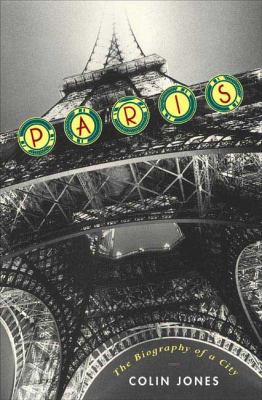
Virtually a reference work, this self-confessed “Impossible history” of one of the world’s great cities comes buttressed by many pages of notes, a graduate level bibliographical guide, index, population table, modest number of illustrations, sequential maps showing the evolution of fortifications and boundaries, and even a list of the (major) buildings discussed.
For all that, the text itself is mostly quite readable, and manages to remain even-handed when discussing the political oscillations of the city’s fortunes. Jones’s personal viewpoint is most glimpseable in the depth with which he discusses the impacts of the real estate marketplace and urban planning (a discipline for which nineteenth century Paris was something of an origin point and test case). These, we hear, heavily influenced not only the visible face but also the economy, sociology and politics of the city, its surrounding suburbs (the banlieue), region and nation. The rise and growth of antiquarian/protectionist architectural sentiment is given an appropriate level of attention, since it is largely that movement and its successes which have bequeathed us today’s tourist and cultural mecca.
As for the aforementioned political oscillations, to one whose prejudices were shaped by the American education system within an Anglophile culture, Paris is eye-opening in relating the wave after wave of governments established, contested and washed away in favor of the next new or recycled concept. From far back in the era of multiple kingdoms, principalities and ecclesiastical domains to contesting Empires of the middle ages to the early-modern era of Communes, communists, Republicans, Vichy capitulation and Republics (five, to date), it is amazing that anyone has been able to establish any stable business, institution or assets at all. A thought worth considering as the USA is going through its own populist spasm which may – at best – be followed by a future swing in some opposing direction.
One thing which does seem to have remained relatively consistent through Paris’ administrative history: even when the city and nation were not overtly socialist, their governments have always exercised far greater powers of eminent domain than we in the USA are accustomed to. Some small justification, perhaps, for the disdain which some Americans profess toward anything ‘those Frenchies’ (or any Europeans for that matter), may have to say about social policy or virtues. Reading about the centuries-long role Paris has played in nurturing the very idea of self-government by the polity though, makes that disdain seem more short-sighted than ever.
Another significant takeaway: the wealth of literature generated in Paris’ Arrondissements over the centuries would require a lifetime of reading to consume and appreciate. Preferably in the original, since even my feeble attempt to learn French quickly convinced that its full nuance is unlikely to survive translation. One reason, perhaps that, Jones begins his introduction with a literary quote and analysis. In retrospect, this turns out to be a wholly appropriate entry point for what is as much a human story as a geographical one. At every stage of its history, the promise of Paris has called to millions, to such a degree that its population has always been largely non-native, immigrants increasing its numbers even as low birth-rate, high mortality and the exodus of those unwilling or unable to meet its demands were constantly working to diminish them.
Fascinating even in its occasional excesses (just like its subject), Paris – The Biography of a City easily earns its space on the shelf.
(Note: published in 2004, this volume necessarily does not cover the City’s most recent decades.)
If you know someone who might be interested in this post,
please feel free to share it.
If you like what you’ve read here,
please subscribe to RobinAndrew.net.
It’s totally free!


 RobinAndrew