Tag Archives: Booker Prize

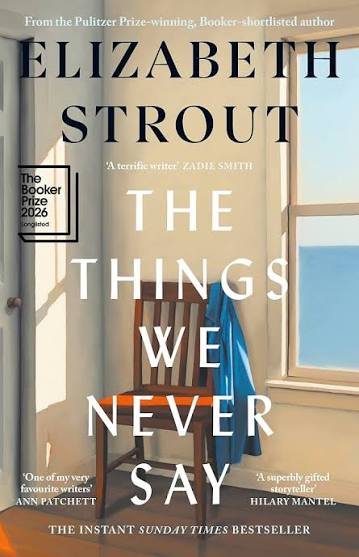
The Things We Never Say, Elizabeth Strout

Among the joys of picking up an Elizabeth Strout novel: you know what you are going to get – in a most positive sense. You know the setting will be a quaint but somewhat struggling sub-suburban/semi-rural New England. You know the characters will be superficially unremarkable – no celebrities (or at least none who roll in their fame), no influencers with millions of followers, and almost no ‘social media’ (except of the traditional sorts: conversations, visits, dreams and daydreams, a few telephone calls and maybe even some paper and pen documents…). You know the incidents will all seem insignificant – until subsequent events and revelations show just how loudly they have echoed through a life or lives which you, by novel’s end, have grown to care about. Deeply.

In short, you’re going to get a highly sensitive, brilliantly insightful look at flawed yet still love-worthy human beings living the sort of challenges humans have lived for generations, despite whatever technological and sociological progress or regress the world around us may claim we have been making.

M. Strout does not write blockbusters; unless you count the way her authorial choices block-out the distractions that make us think we are different from one another or our ancestors.  Or the way she busts us out of the Edwardian clutter of irrelevancies which so often blind us to life’s uncertainty and tenuousness, its inevitable endings and the myriad inimitable beauties along its road.

If you’ve read Strout before and are closer to the end of life’s span than the beginning, The Things We Never Say is another delightful and rewarding chapter in her oeuvre.  If you’ve not read her before, start with one of her earlier works and save this latest until you’re ready to consider the things you have never said to those you’ve you loved, or they may never said to you.

  • My Name is Lucy Barton (2016), is a great place to begin your acquaintance with Strout.  If you come to love that world and want to linger inside it, there are four later related volumes: Anything is Possible (2017), Oh William! (2021), Lucy by the Sea (2022) and Tell Me Everything (2024). 
  • For an even deeper dive, start with Olive Kitteridge (way back in 2008) and its sequel, Olive, Again (2019), reading them either before, or as bookends to, the Lucy Barton series.

But please, if you don’t read many books, if you’re in your later years (like me), or if you’ve already read much of M. Strout’s earlier work, don’t hesitate to dive into The Things We Never Say.  You’ll find tons to love and care about, and more wisdom than most novels twice its modest 200 page length.

P.S. – speaking of things that deserve to be said, the new speculative fiction, E Unum Pluribus, is currently available online, in six free installments.

Packed with intrigue and fueled by politics, economics and murder (as well as gender, class, language and even the origins of faith), E Unum Pluribus imagines how the USA’s current culture wars may bring about its end, and how much we stand to lose if we let that happen. Anyone can read the novel totally for free simply by navigating to the home page of this website and selecting E Unum Pluribus from the top menu, or via this link: https://robinandrew.net/2026/01/01/e-unum-pluribus/

If you appreciate this post, please share it as widely as you wish.

And, if you like what you read here at robinandrew.net, please subscribe – it’s totally free, always!
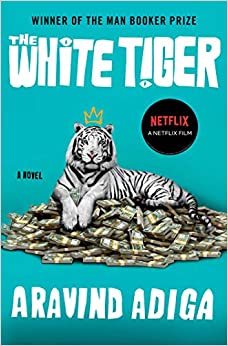
The White Tiger, Aravind Adiga

Darkly humorous, this Booker Prize-winner plays with our desire to believe its hero is actually a decent man despite his early admissions of guilt. When, late in the tale, his crime becomes clear (the ‘unreliable narrator’ turns out to have been entirely reliable), we are challenged to decide whether we condemn or forgive him, given the greater evil of the world in which he is required to survive, and in which we all play a part, regardless of how remotely.

Set among the impoverished majority of early 2000s India, The WhiteTiger can be read as a primer for those unfamiliar with that society, but they are also clearly an abstract for the hundreds of millions in similar straits in other nations around the world (“the colossal underclass,” as Adiga is quoted describing them on one website).  Insufficient resources, insufficient opportunity, insufficient education, insufficient justice; all these contribute to Balram Halwai’s ruthless take on survival.  That ruthlessness though, armors a soft heart – his anger takes forever to rise, his violence is not enjoyed, but endured for what it will achieve.  Even when he grudgingly admits to condemning his family back in the village of Laxmangharh, his reasoning is more amoral rather than immoral – he takes no pleasure in their fate, but rates it only incrementally worse than that to which they had already been condemned by birth: a few more decades of poor, ignorant backwater toil before the death which eventually comes for us all.  The same ‘cage’, as he describes it, from which he has so narrowly escaped.

That metaphor of the white tiger (a creature, we are told, of which there is only one born in an entire generation) works on multiple levels.  Not only are the poor caged as truly as animals in a zoo, so too is there little value in being a unique individual -beautiful, talented or valued in any way – if one must still live one’s life in a cage with nothing to do but eat sleep and procreate.  And when Balram kills and steals from his employer Ashok in order to escape, one is challenged to judge those acts any less natural (and neutral) than a tiger who, finding its cage door left open (the novel’s ‘red bag’ on the car seat…), might well kill and consume its keeper on its way out of the zoo.  Not out of perversity or evil, but simply as an act of survival – kill or be killed, eat or be eaten. 

In a brief author interview appended to the e-book edition, Adiga vouches for the reality of his settings and the corruption he describes.  This is fiction but not speculative fiction; poverty and oppression such as this really exist, and those with certain strengths or intellect may well be driven to extremes such as Balram’s in order to feel they have escaped it – even if, to these middle-class American eyes, his upward step seems a very small one.  All those heavily-accented voices on unsolicited phone calls, those poorly-worded spam e-mails and destructive malware episodes we hear about on the evening news – this novel educates us as to why anyone would spend their hours in what we are so quick to dismiss as criminal activities.  They are, perhaps, just surviving in the best way they can find.   

Amid such bleakness, it is very fortunate that both author and character bear an abundance of wry humor. Naming Ashok’s American-born wife ‘Pinky Madam’, is one inspired example, the comic self-aggrandizement of Balram delivering his entire memoir in a series of late-night monologues directed to the soon-to-visit Premier of China is another.  An abundance of such touches ensure that that this bleak message is not bleak in the telling.

A unique and eye-opening prize-winner well worthy of its award, and a useful reminder of how undeservedly-fortunate we of  ‘the first world’ really are.