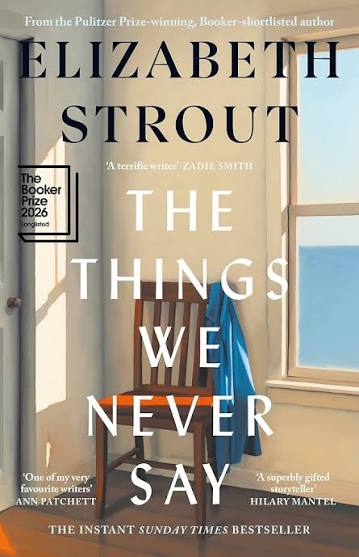
Among the joys of picking up an Elizabeth Strout novel: you know what you are going to get – in a most positive sense. You know the setting will be a quaint but somewhat struggling sub-suburban/semi-rural New England. You know the characters will be superficially unremarkable – no celebrities (or at least none who roll in their fame), no influencers with millions of followers, and almost no ‘social media’ (except of the traditional sorts: conversations, visits, dreams and daydreams, a few telephone calls and maybe even some paper and pen documents…). You know the incidents will all seem insignificant – until subsequent events and revelations show just how loudly they have echoed through a life or lives which you, by novel’s end, have grown to care about. Deeply.
In short, you’re going to get a highly sensitive, brilliantly insightful look at flawed yet still love-worthy human beings living the sort of challenges humans have lived for generations, despite whatever technological and sociological progress or regress the world around us may claim we have been making.
M. Strout does not write blockbusters; unless you count the way her authorial choices block-out the distractions that make us think we are different from one another or our ancestors. Or the way she busts us out of the Edwardian clutter of irrelevancies which so often blind us to life’s uncertainty and tenuousness, its inevitable endings and the myriad inimitable beauties along its road.
If you’ve read Strout before and are closer to the end of life’s span than the beginning, The Things We Never Say is another delightful and rewarding chapter in her oeuvre. If you’ve not read her before, start with one of her earlier works and save this latest until you’re ready to consider the things you have never said to those you’ve you loved, or they may never said to you.
- My Name is Lucy Barton (2016), is a great place to begin your acquaintance with Strout. If you come to love that world and want to linger inside it, there are four later related volumes: Anything is Possible (2017), Oh William! (2021), Lucy by the Sea (2022) and Tell Me Everything (2024).
- For an even deeper dive, start with Olive Kitteridge (way back in 2008) and its sequel, Olive, Again (2019), reading them either before, or as bookends to, the Lucy Barton series.
But please, if you don’t read many books, if you’re in your later years (like me), or if you’ve already read much of M. Strout’s earlier work, don’t hesitate to dive into The Things We Never Say. You’ll find tons to love and care about, and more wisdom than most novels twice its modest 200 page length.
P.S. – speaking of things that deserve to be said, the new speculative fiction, E Unum Pluribus, is currently available online, in six free installments.
Packed with intrigue and fueled by politics, economics and murder (as well as gender, class, language and even the origins of faith), E Unum Pluribus imagines how the USA’s current culture wars may bring about its end, and how much we stand to lose if we let that happen. Anyone can read the novel totally for free simply by navigating to the home page of this website and selecting E Unum Pluribus from the top menu, or via this link: https://robinandrew.net/2026/01/01/e-unum-pluribus/
If you appreciate this post, please share it as widely as you wish.
And, if you like what you read here at robinandrew.net, please subscribe – it’s totally free, always!

