Tag Archives: book-review

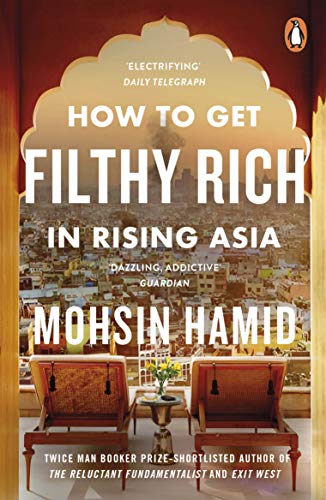
How to Get Filthy Rich in Rising Asia, Mohsin Hamid

Version 1.0.0

Posing as satire of the Western world’s self-help book genre, this clever volume starts out strong (“Look, unless you’re writing one, a self-help book is an oxymoron.  You read a self-help book so someone who isn’t yourself can help you, that someone being the author.”) and finishes even stronger.  There is a stretch about three quarters through its slender 220 pages that treads close to familiar crime and corruption thriller terrain, but happily that is only a dalliance, employed by Hamid to bring his protagonist down to earth and set up the final chapters wherein we realize what sort of wealth is really being promoted here, and in what way this book truly proposes to help its readers help themselves.

Along the way, we get a glimpse of what life is like for many hundreds of millions across the globe.  A lesson given greater impact by being written in the second person, casting the reader as protagonist (“The whites of your eyes are yellow, a consequence of spiking bilirubin levels in your blood.”) This choice is particularly effective at impressing readers from prosperous northwestern-quadrisphere cultures (such as myself) with the realities of life for those who indirectly support our affluence (“The virus affecting you is called hepatitis E. Its typical mode of transmission is fecal-oral.  Yum.”)  Later, when a different range of emotions arise among characters in circumstances superficially different from our (my) own, this second-person setting makes plain the conclusion that we are all the same underneath, no matter how different our economics make us seem at first glance.

Lest this sound like a civics lesson, I want to emphasize that the writing throughout is full of wry insight and humor.  To that, the final chapters add great warmth and sympathy for the human condition and an understanding of love, aging and the grace with which those can be faced – when complex and imperfect beings rise to their best potential.  An unexpected and very welcome reward at the end of a brisk and entertaining trip.

Ultra-impressive work by Hamid, who is fast becoming a favorite author.  Originally from Pakistan, he has dual English citizenship, degrees from Princeton and Harvard Law and experiences in the worlds of corporate law and McKinsey consulting to complement his South Asian frame of reference. Author of five novels so far and at least one work of non-fiction (Discontent and its Civilizations: Despatches from Lahore, New York and London, 2014), his is a voice which deserves to be heard, and widely.

Paris Undercover

Version 1.0.0

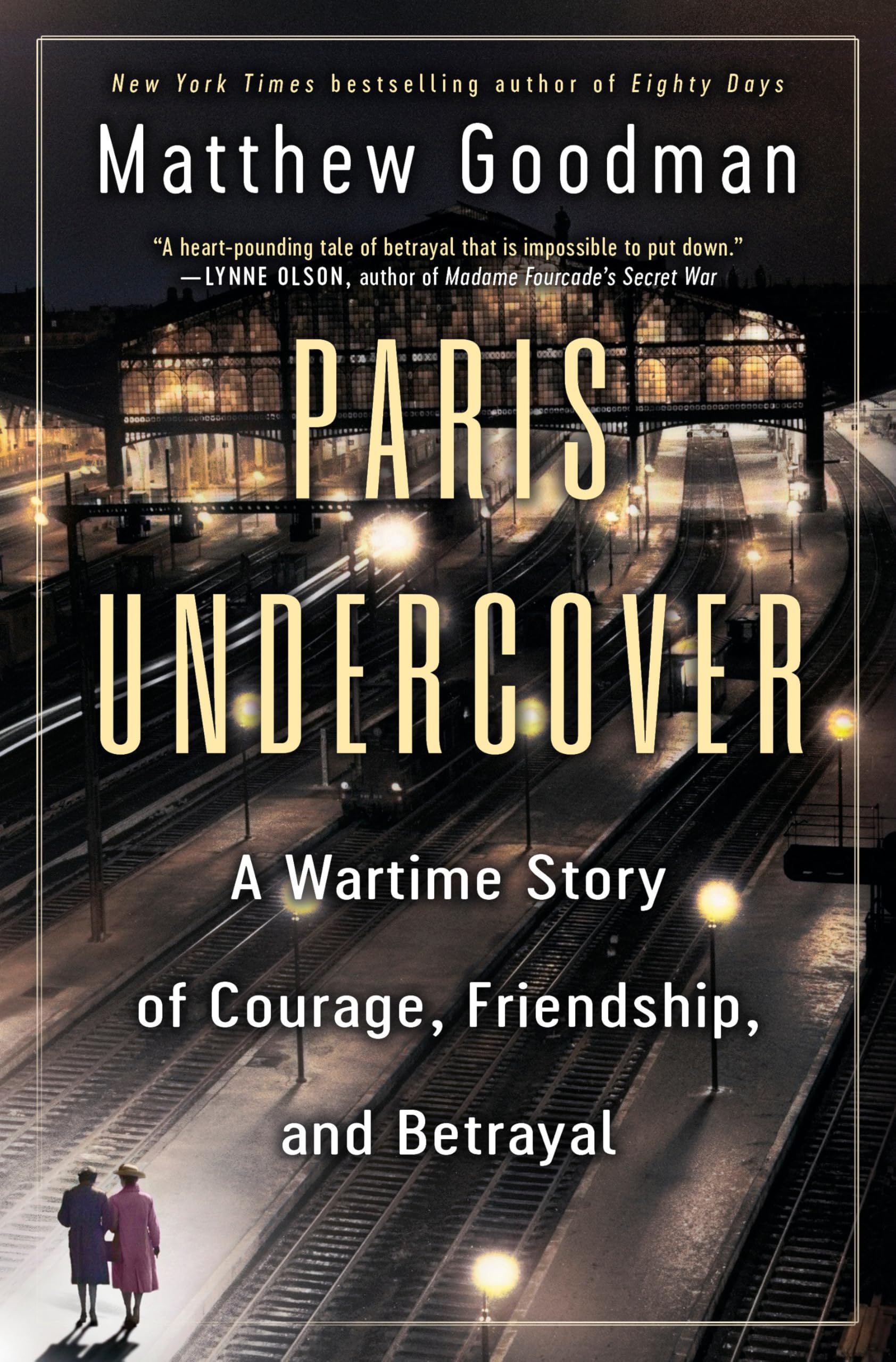
Paris Undercover – A Wartime Story of courage, Friendship and Betrayal, Matthew Goodman (2025)

At times inspiring, at others horrific, this is an impressive example of historical scholarship and its value in setting the record straight – as opposed to its all too prevalent effect of skewing history to the writer’s preferences.

In the midst of WWII the Etta Shiber’s purported memoir Paris-Underground is published in New York describing the exploits of herself and Kitty Bonnefous, two female resistance workers in Nazi-occupied France.  How that book came about, how much it was fact and how much fiction, and what were the effects its publication, are this current book’s subjects.

Part One of this volume gives us a factual record of the women’s actual lives and actions, up through Etta’s capture trial and imprisonment by the Nazis, thru her eventual release and arrival in New York. (At least I believe this is the factual version.  Given what follows, I do wish Goodman gave us a more explicit assurance to that effect.  In particular, his choice to open with the moment of Etta’s arrival in New York and then backtrack to their exploits confused me when, in Part Two, he informed us that is the way in which Etta’s book was structured.)

Readers looking for a pleasant and inspiring book could perhaps stop right here, and be somewhat satisfied.

Part Two is Goodman’s account of how Etta’s book came to be, how it was or was not written and by whom (there are differing accounts), and the impacts it had on her life..(This is where Goodman details that book’s departures from fact, and where I became a bit confused as to whether what I’d previously read was the true facts, or a replaying of the wartime book’s fabrications.  Perhaps a more diligent reader would not experience any confusion, but I did). What does seem clear though, is that Paul Winkler, himself a Jewish refugee from France, had the leading role as publisher and assembler and probably came out farther ahead financially than anyone else did.  Certainly the book sold well, and Etta Shriber did not get much for it.  What is also clear is that the book’s publication would certainly cause the Nazis to revisit Kitty’s case with even more sadistic vigor than before, likely with deadly consequences for her and others.

By the end of this section, one is angry with Winkler and others, but mostly on the edge of one’s seat, impatient to learn where Kitty has been imprisoned how she has fared while this profit-oriented sideshow was taking place in the safety of North America.  An excellent demonstration of how even a nonfiction book can be structured to maximize its suspense.

Part Three: Into the Night and Fog is the crux of Goodman’s work, a detailed account of Kitty’s imprisonment and mistreatment, the effect of Etta’s book on her such, the terrible  privations she and other prisoners of the Nazis had to endure to survive and even after being ‘freed’ by Soviet troops and, at long last, Kitty’s eventual return to the land of the living, where she lived to very nearly 80 years of age, at last enjoying some comforts and peaceful pleasures despite the debilitating effects of her ordeal.

(Given the chaos and destruction endemic to wartime, especially the end of a World War, it is amazing that Goodman is able to reconstruct this period in such detail and anecdote.  Since the overall purpose of the current volume is to expose the fabrications of Etta’s earlier book, it would have been worthwhile for him to address head on how he is able to be so comprehensive and how he avoided inserting his own imaginings in it, though the extensive Acknowledgements, Notes and Bibliography do help in this regard.)

As with other accounts of wars and particularly the Nazi Reich, one comes away from Paris Underground near despair at the eagerness of some men (and a few women, too) to inflict unnecessary pain and agony on other humans.  And, at the same time, amazed at the ability of many humans to survive mistreatment and hardships that would seem, if described in the abstract, unendurable.

A compelling and thoroughly worthwhile read, but not pleasant, and not for the faint of heart.

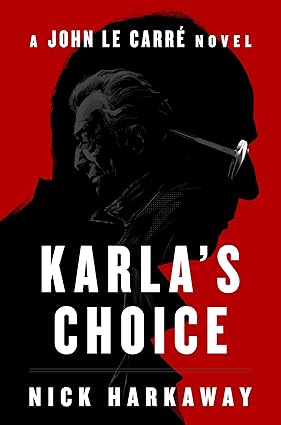
Karla’s Choice, Nick Harkaway

Picked this up less than fully convinced that a John Le Carre novel sans Le Carre was really needed.  Fact it was penned by the master’s son, Nick Harkaway, made it somewhat more promising than the various Ian Fleming-less Bond retreads by unrelated followers (of whom Harkaway is one, the admirable William Boyd another).  Was encouraged before the start by a statement in the Author’s Note that “There were always supposed to be more Smiley books.”  LeCarre’s having graciously left ten years of blank foolscap between The Spy Who Came in From the Cold and Tinker Tailor Soldier Spy also suggested room for this insertion.

From the start, what I found was encouraging, gliding along quite happily to the familiar rhythms and contexts of LeCarre’s world as scored and conducted by Harkaway (who has the benefit of having actually been present and somewhat privy to his father’s creative processes).   A pleasant enough experience, but not eye-opening – until somewhere around 80% of the way through – stop reading here if you don’t want to spoil the experience for yourself…

Just as I’d begun to worry this might be all retread, Susannah, the naive civilian whose cry for help initially set the entire story into motion, despairs at Smiley’s apparent lack of principle and crosses the Iron Curtain into Hungary (at the time a Communist autocracy tightly leashed to the Soviet Union) to commandeer his mission for herself.  Though believable based upon her earlier actions and personal history, this impulsive act nonetheless flips us into another plot entirely, as Smiley and his professionals must improvise in hopes of catching up with her.  Then, just as I’d accepted that and begun to anticipate the excitement it must generate, Harkaway switched form entirely – stopping the clock to preview various character’s future reminiscences on whether Smiley’d had no idea this was coming and was now in totally reactive mode, or had anticipated and accepted Susannah’s action as inevitable and gone with the flow or had, in fact, callously conceived, arranged and ensured such a dangerous act in order to achieve his own ends at the probabl cost of her innocent life.  By dancing a follow-spot rapidly over Smiley’s talent, skill and commitment even as it highlights several canonic characters’ own abilities and relationship to the master, Harkaway makes clear that moral principle, guilt and regret are the true subjects of the novel, assuming LeCarre’s mantle very nicely, thank you. 

Minutes later (in reading time, that is) we’re back into thriller form, watching as George discovers he has been made and is being tailed, and then as this unassuming ‘little man’ deals brilliantly with the challenges (including a car chase with Smiley at the wheel – never thought we’d see that!).  These scenes are virtuosic for both character and author, and from there it is a race to a signature LeCarre finish: bloodshed held off-screen, morality front and center and more than a hint of anticlimax, until Harkaway surgically exposes just what values and choices lay behind the various participants’ actions. Despite the infamous Karla (through-line villain of the entire Smiley oeuvre) having appeared very sparingly and with minimal back story, it turns out that his ‘choice’ is indeed the true point of this novel.  Not to mention a worthy gift to the fans in how it adds color and insight to Le Carre’s own chronologically-later volumes. Very nicely done!

Credit where credit is due:  I read this in e-book form – one of the more benevolent byproducts of our evolving digital hegemony.  An e-book I had borrowed online from a public, i.e. ‘government funded’ (cue the sinister theme music) library – one of those many liberal-culture institutions from which our marginally-elected leaders are currently scrambling to rescue us.  Had downloaded it in moments and for free – another benefit of the ‘mommy state’ imposed upon us by the ‘deep state’ which is now being shredded in favor of absolute free-market fundamentalism. Who knew we had so much to lose?  Anyone with eyes…

Having thus tested the waters and found them delicious, I’ll now be purchasing a hard-copy of Karla’s Choice so as to compensate author and industry for conspiring to make such an entertaining and worthwhile title available.

Kköszönöm mindenkinek – ’Thank you everyone.’