A free people will always be a diverse people, so a free nation must always be a diverse nation.
Ross Douthat, during a recent interview* advocating a more prominent role for religion in American culture and politics, argued that progressivism fails because “You need something else on the horizon…So that we can live in a specific way that we are supposed to live.”
This argument might carry more weight if there existed some single voice calling all humanity by some clear and direct method (simultaneously taking over every video screen on the planet in its owner’s first language perhaps, to steal an example from fiction) with specific instructions on how we are supposed to live.
In real life though, there is no such singular directive. A Roman Catholic might point to The Bible – but what he’d actually be pointing to would be a specific reading and selections from its scriptures which themselves have evolved from loosely-documented source materials translated from one arcane language to another by men of less than perfect knowledge, their translations and interpretations fought over, compromised upon and codified over two thousand years by a man-made (literally – no significant women’s voices having been allowed) bureaucracy not always unconcerned with its own survival and wellbeing.
An Eastern Orthodox voice might agree with Roman Catholic doctrine on some aspects of the good life, but disagree on others; a follower of the Russian Orthodox church could have differences with one or both. A Southern Baptist or any of dozens of other denominations who also see themselves also as Christians and reference the same scriptures would have even further varied ideas of how to live. An Orthodox Jew or observant Muslim from the Holy Land would certainly have strongly differences with any of those, despite their faiths springing from some of the same roots and looking to some of the same sources. A Buddhist, a Sikh, a Hindu, or a believer in any of the multitude of less populous or just less publicized denominations, sects, or faiths (of which I am too ignorant to list them all), might find very little to agree upon in Mr. Douthat’s ordained ‘how we are supposed to live’ directive.
So long as whatever spiritual entity which may be out there watching over humanity chooses to speak in obscure language and to only a few of us at any given time or place, persons of sincere faith and goodness are going to disagree – honestly, deeply and righteously – about how those with whom they share the planet are “supposed to live.”
History records countless instances where embedding religious beliefs in governance have led to unequal treatment, religious persecution, economic damages, societal upheavals, violence, killing and right on up to the brutality of total warfare; all in the name of one or another party’s conception of “the way we are supposed to live.” Even in realms which claimed their populace were of a single faith, differences and resulting tragedies have not been erased – and often become all the more brutal to those in the minority. That such injustices may be somewhat less prevalent in our ‘modern’ era than before that is more a matter of incremental progress toward accepting differences than of the species having settled on a single religion.
If, then, one hopes to maintain a government ‘for the people,’ one of its primary principles must be to recognize the diversity (which is not an expletive, btw, as some wish to use it these days) of our beliefs and not enforce the views of any one faith on others who do not share them. To tolerate and actually protect the freedom of each to worship and live as they wish, so far as their actions do not constrain the freedoms of others.
For any extensive society to live in real and lasting peace, it must look elsewhere than any religion for its common rules on how to live. That is what the USA has attempted to do (with sometimes greater and sometimes less success) for over 250 years. Others have tried as well, again with greater or lesser success, but generally more promise than those which have chosen theocracy. Rather than giving up on that effort and moving toward some declaration of national religious identity, we and our descendants will be better served by recommitting to pluralism and to working together, allowing those of all faiths (including no religion or God) the freedom to live their own prescription to the greatest extent possible without it preventing others from living theirs.
Nationalizing any religious identity, no matter how watered down or camouflaged by clever marketing or promoted by obviously insincere lip-servers, is not the answer.
(* “Ezra Klein is Worried – But Not About a Radicalized Left,” New York Times, September 18, 2025)
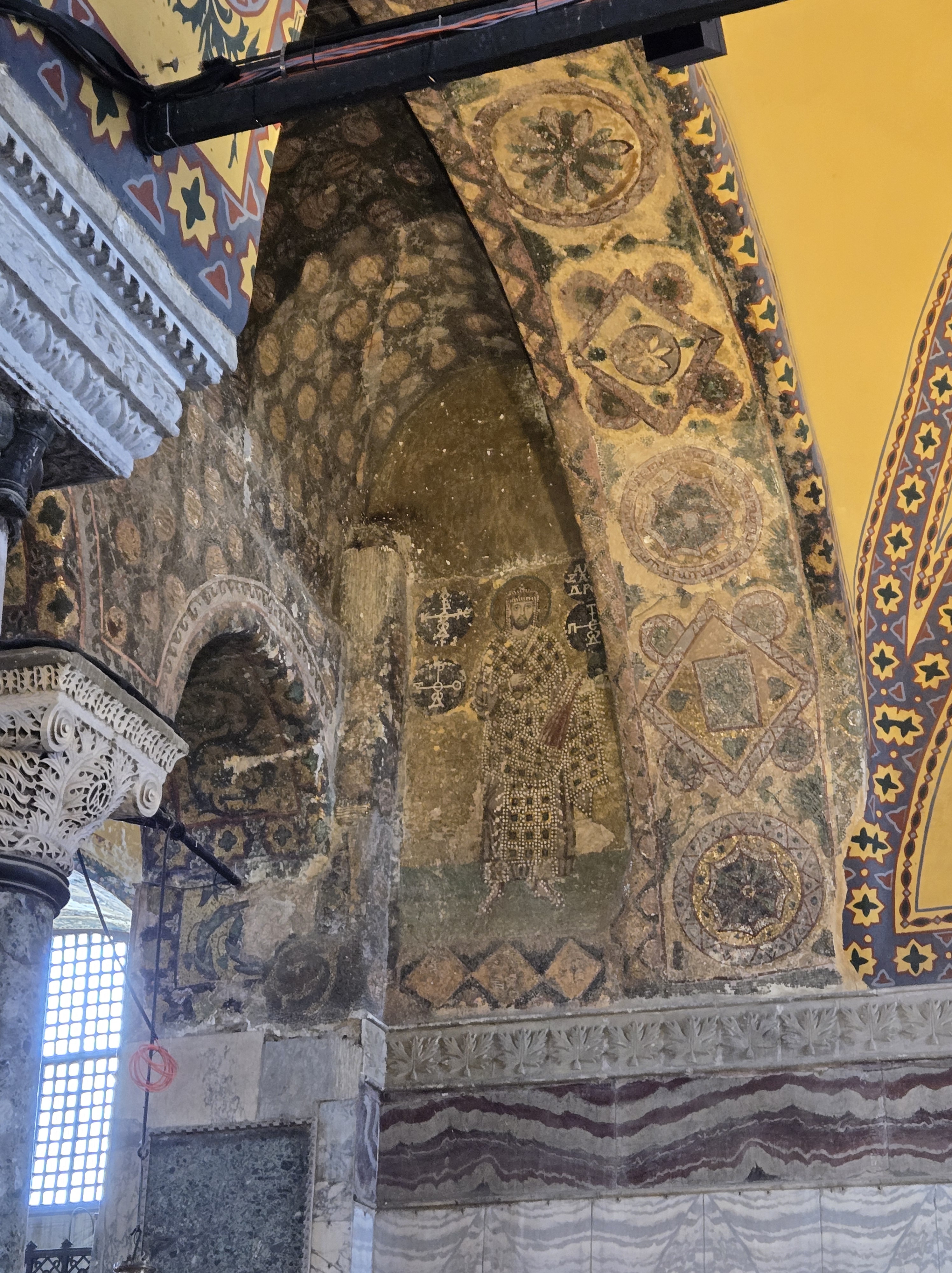
Image: The Hagia Sophia, Istanbul, Turkiye, has been a place of worship for both Christians and Muslims over the centuries. Photo by author.
If you like this post, feel free to share it.
If you like what you see on this site, please subscribe, it’s free!














 RobinAndrew