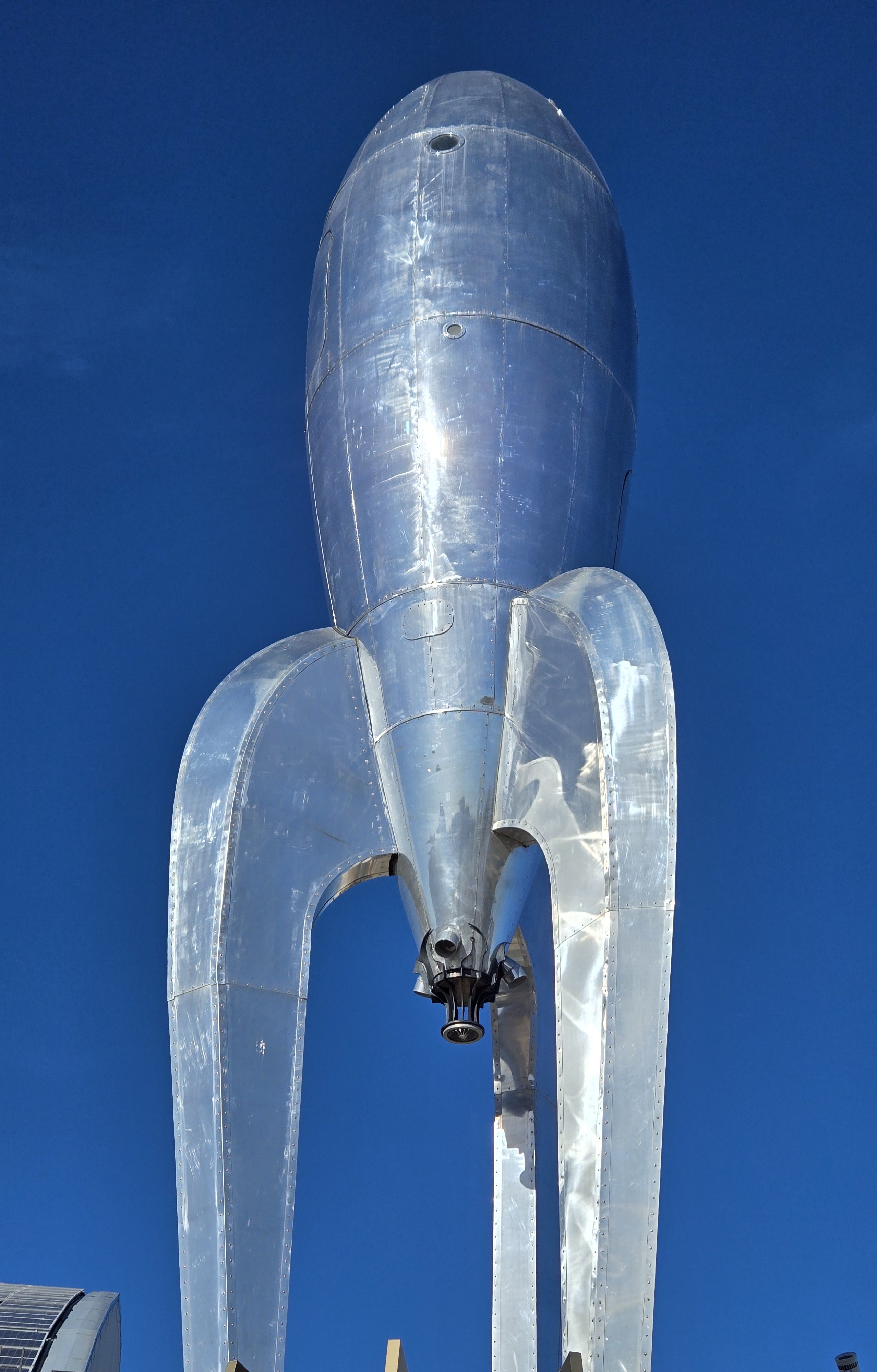
Naomi Klein and Astra Taylor had a piece in the Guardian recently* regarding the obsession among our Billionaire Boys Club with shipping humans off to colonize outer space. The same trend toward maximal manspreading came up a few days later in a NY Times piece by Michelle Goldberg**.
Now, there’s nothing inherently wrong with wanting to be part of something as ground-breaking as off-planet settlement would be. No shame either, in pining to experience a greater extent of our universe than our earthly perch affords – who wouldn’t love to have taken that “One small step for man, one giant leap for mankind” (even if one imagines improving the wording just a touch)?
But really, not many sapiens are ever going to voluntarily commit to open-ended confinement in a tight cannister with the likes of Elon Musk, Peter Thiel, Sam Altman and Jeff Bezos. Crewed, in all likelihood, by the same sort of self-infatuated ketaminers who staffed-up Mr. Musk’s short-lived Doge blow-out… All for the privilege of living regimented lives in close quarters designed, by necessity, for maximum functionality with minimum resources.
Those hardy souls who are interested in signing on would do well to seriously ponder Fermi’s Paradox, which goes something like this: given that current scientific knowledge allows us to calculate the truly astronomical number of galaxies, star systems and orbiting bodies which are out there, and that earth sciences continue to expand the range of hostile conditions under which earthly life can exist, there must surely be innumerable opportunities for life to have developed on other worlds, so why is it we’ve still never encountered any evidence of it other than here on our own little blue ball?
The best answer I’ve encountered lies at the heart of Kim Stanley Robinson’s marvelous novel Aurora*** when his narrator considers how intimately and perilously the intelligent life we do know of is suited to exactly that environment in which it evolved. Robinson’s short answer to Fermi’s question is that by the time a species gets clever and knowledgeable enough to try living elsewhere, it is also clever and knowledgeable enough to realize it is better off staying home.
Which brings us to what really struck me in reading those Guardian and Times opinion pieces: when was the last time we heard any of today’s tech titans or AI impregnators voice appreciation for the glory of our natural world? Given more than enough resources to spend their lives in Earth’s most awe-inspiring environments, environments which would be impossible to recreate with even their absurd resources, it seems our over-lords choose instead to cocoon themselves in nine-figure superyachts, carbon-spewing private jets, high-rise apartments or gated acreage hermetically sealed off from the noxious byproducts of their own industries.
It’s enough to make one pine for the days of Teddy Roosevelt – a wealthy elitist with plenty of faults but who at least retained the innocence to appreciate the wonders all around him. Or anyone else with sufficient wisdom to recognize that billions of years of growth and change have modelled us humans to succeed brilliantly in this particular and unique habitat, and the humility to realize we must care for that habitat, in something like the natural state to which our organism is so fatally suited, if we are to have any hope of saving ourselves or our descendants.
Space exploration is a worthwhile endeavor which pays many dividends, but in no way should it be a substitute for, or impediment to, preserving our current star base so it may continue to nurture all our billions of heirs, not just the very privileged few who will ever have the opportunity to head out toward other stars.

*’The end times fascists are plotting their escape from our world. Our mission is clear’, Naomi Klein and Astra Taylor, The Guardian, 2026-09-13
**’Why Tech Oligarchs Are Willing to Risk Apocalypse,’ Michelle Goldberg, New York Times, 2026-09-12
***Aurora, a novel, by Kim Stanley Robinson, copyright 2015 by Kim Stanley Robinson – ideas paraphrased here, in respect of copyright – seek out the original and read it, it’s better!
P. S. – E Unum Pluribus is a speculative fiction exploring one way in which our current leaders’ obsessive pursuit of wealth and power may bring an end to the U. S. A., and what sort of world might arise in its wake.
With a thrilling plot driven by politics and economics (as well as gender, class, language and even the origins of faith) the novel is currently being serialized online and anyone can read it, at no cost, by navigating to the home page of this website and selecting E Unum Pluribus from the top menu, or via this link: https://robinandrew.net/2026/01/01/e-unum-pluribus/

