Tag Archives: World War Two

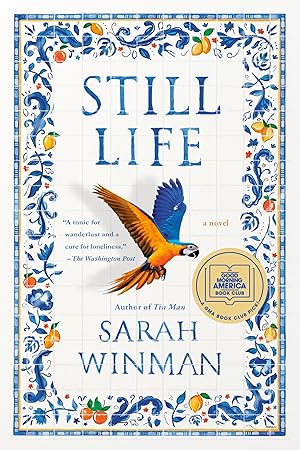
Still Life, Sarah Winman

The romantic novel as still life painting – an unlikely assortment of exquisitely-rendered events (the objects) carefully arranged for maximum effect (starting with Evelyn and Dorothy in 1944, then moving forward in jumps and fits, then returning to Evelyn in 1901), the entire assemblage framed by the city of Florence in all its history and culture and gastronomic variety. 

When I search the text for ‘still life’ I find reference to all the still life paintings Evelyn inherited; thought by some to be no more than decorations, to her they are the grail, which seems perhaps a comment on the genre as a female space. Another instance, also, in which she, having become an art professor, theorizes on the genre’s power as coming from, not in spite of, the seeming triviality of individual objects or domestic situations which actually contain specific phrases of the overall painting’s meaning and purpose.  How it freezes time, raises up the contributions of those who provide for others (as opposed to the ‘movers and shakers’). And a final instance of the two words together in the passage  “…Empty bowls.  Rotting fruit.  Passing time.  But still life in all its beauty and complexity…” thus making clear the author’s multiple intents: still life as a genre of painting, life as a collection of individuals interacting and connecting as do the objects in a still life painting, an account rendered in the manner of a still life painting and, ultimately, that ‘life’ is still ‘life,’ whether one is old, or disappointed, grieving or alone or has serendipitously found what they’ve been looking for all along.

(Worth noting the large number gay characters; more than would be expected solely because of the novel’s interest in art, literature and other creative pursuits.  Clearly the result of many decisions by the author, who herself came out in the 1980s, and a welcome reminder that human variety is not a product of the late twentieth century.  Noted also that not quite all the hetero relationships in the book are constrictive, doomed and/or abusive, but the tally certainly trends in that direction.)

_______

Eight months after reading this novel and recording the notes above, I came across the title again and was not certain whether or not I had read it.  Reading my notes at this remove, I’m struck by how interesting and satisfactory they make the book sound and yet I did not recall it (sincere apologies, M. Winman). Entire reason I started writing notes like these was the hope of no longer doing that… 

Is it time, perhaps, to slow down and not consume so many books but rather to savor the few?  But what other way to find those few, given that recommendations and reviews are so unreliable?  And isn’t that dilemma just what life itself is all about?  One has to experience its entirety – the exciting and the tedious, the success and failure, the love and the rejection, the yin and the yang and the black and the white and the good, the bad and the ugly – in order to learn what is truly astonishing and beautiful and we wish we had done a better job of savoring and holding onto – what will be so difficult to say goodbye to when one finally shuffles off.

Maybe it’s simply time for me to re-read some of those books which a first read confirmed to be worthwhile. 

Like Sarah Winman’s Still Life.
Paris Undercover

Version 1.0.0

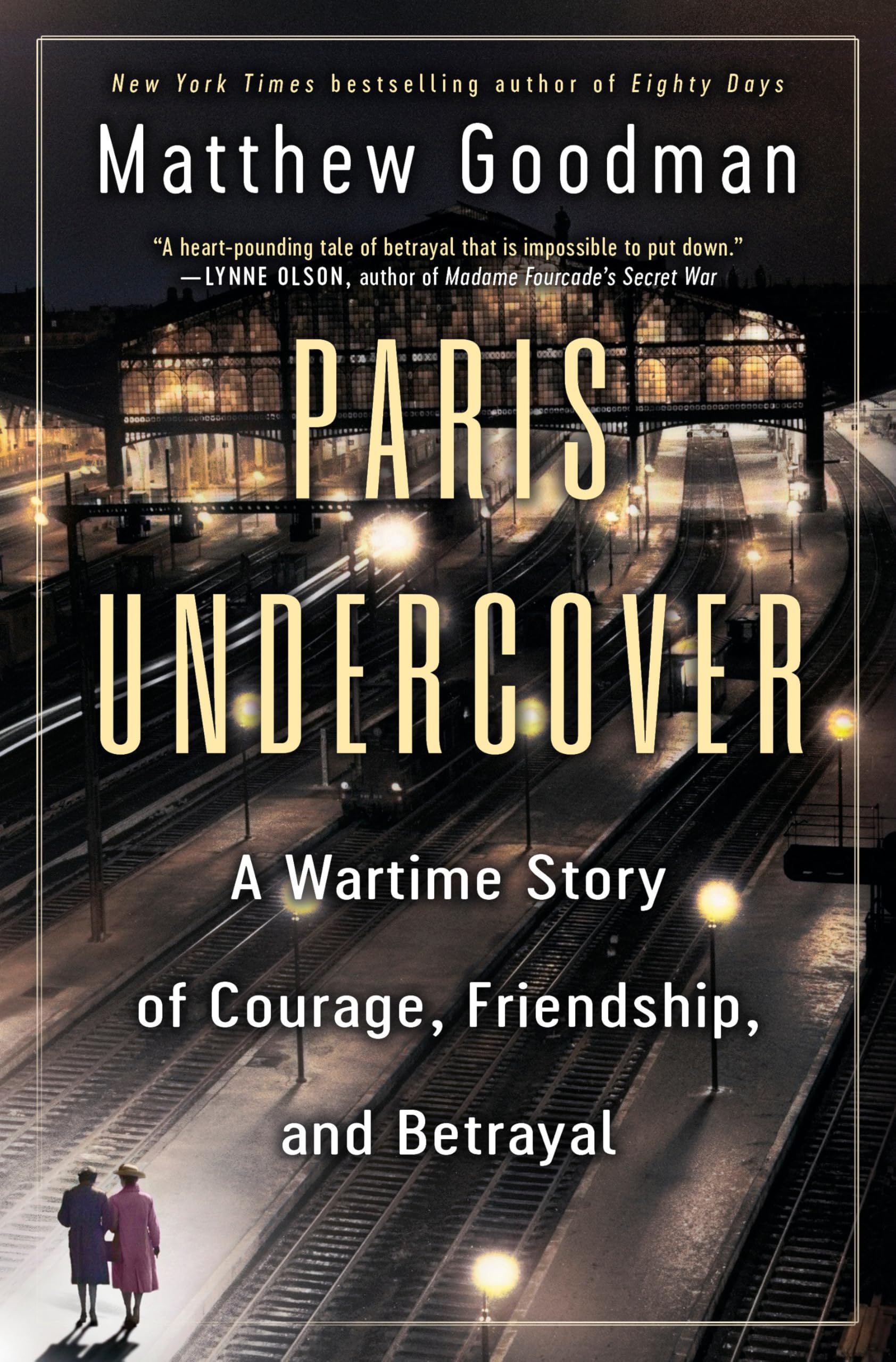
Paris Undercover – A Wartime Story of courage, Friendship and Betrayal, Matthew Goodman (2025)

At times inspiring, at others horrific, this is an impressive example of historical scholarship and its value in setting the record straight – as opposed to its all too prevalent effect of skewing history to the writer’s preferences.

In the midst of WWII the Etta Shiber’s purported memoir Paris-Underground is published in New York describing the exploits of herself and Kitty Bonnefous, two female resistance workers in Nazi-occupied France.  How that book came about, how much it was fact and how much fiction, and what were the effects its publication, are this current book’s subjects.

Part One of this volume gives us a factual record of the women’s actual lives and actions, up through Etta’s capture trial and imprisonment by the Nazis, thru her eventual release and arrival in New York. (At least I believe this is the factual version.  Given what follows, I do wish Goodman gave us a more explicit assurance to that effect.  In particular, his choice to open with the moment of Etta’s arrival in New York and then backtrack to their exploits confused me when, in Part Two, he informed us that is the way in which Etta’s book was structured.)

Readers looking for a pleasant and inspiring book could perhaps stop right here, and be somewhat satisfied.

Part Two is Goodman’s account of how Etta’s book came to be, how it was or was not written and by whom (there are differing accounts), and the impacts it had on her life..(This is where Goodman details that book’s departures from fact, and where I became a bit confused as to whether what I’d previously read was the true facts, or a replaying of the wartime book’s fabrications.  Perhaps a more diligent reader would not experience any confusion, but I did). What does seem clear though, is that Paul Winkler, himself a Jewish refugee from France, had the leading role as publisher and assembler and probably came out farther ahead financially than anyone else did.  Certainly the book sold well, and Etta Shriber did not get much for it.  What is also clear is that the book’s publication would certainly cause the Nazis to revisit Kitty’s case with even more sadistic vigor than before, likely with deadly consequences for her and others.

By the end of this section, one is angry with Winkler and others, but mostly on the edge of one’s seat, impatient to learn where Kitty has been imprisoned how she has fared while this profit-oriented sideshow was taking place in the safety of North America.  An excellent demonstration of how even a nonfiction book can be structured to maximize its suspense.

Part Three: Into the Night and Fog is the crux of Goodman’s work, a detailed account of Kitty’s imprisonment and mistreatment, the effect of Etta’s book on her such, the terrible  privations she and other prisoners of the Nazis had to endure to survive and even after being ‘freed’ by Soviet troops and, at long last, Kitty’s eventual return to the land of the living, where she lived to very nearly 80 years of age, at last enjoying some comforts and peaceful pleasures despite the debilitating effects of her ordeal.

(Given the chaos and destruction endemic to wartime, especially the end of a World War, it is amazing that Goodman is able to reconstruct this period in such detail and anecdote.  Since the overall purpose of the current volume is to expose the fabrications of Etta’s earlier book, it would have been worthwhile for him to address head on how he is able to be so comprehensive and how he avoided inserting his own imaginings in it, though the extensive Acknowledgements, Notes and Bibliography do help in this regard.)

As with other accounts of wars and particularly the Nazi Reich, one comes away from Paris Underground near despair at the eagerness of some men (and a few women, too) to inflict unnecessary pain and agony on other humans.  And, at the same time, amazed at the ability of many humans to survive mistreatment and hardships that would seem, if described in the abstract, unendurable.

A compelling and thoroughly worthwhile read, but not pleasant, and not for the faint of heart.

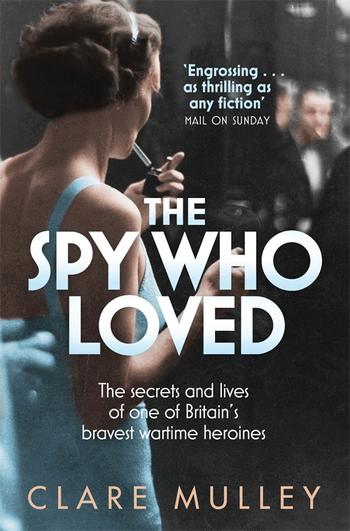
The Spy Who Loved, Clare Mulley

The paperback of this historical biography looks just about as substantial as a copy of Ulysses sitting on the shelf, but at 350 pages it is roughly half as long; is it printed on heavier-than-typical stock perhaps?   Or just buttressed by two Appendices, over thirty pages of attributive notes, a dozen of bibliography, and other supporting material.  Not that the story isn’t substantial, as we follow Christine Granville (nee: Krystyna Janina Skarbek) through the twists, turns, detours and (literal) dead-ends of WWII espionage in a depth of detail which is quite astounding, given that the crucial years of her life were lived in wartime, in secret and under varying names and legends.

Daughter of a dying aristocracy and a nation about to enter the two-stage coma of Nazism and Communism, Christine found purpose and a home of sorts among the secret service and, even more, the partisans, guerillas and Maquis of occupied Europe. For years she dared and dodged, evaded and enabled in ways that clearly contributed to the war effort. That she survived it all is little short of astonishing. When the war ended, however, and the British establishment decided it no longer required her services, she found herself adrift in many ways.  Despite the assistance and loyalty of many comrades, especially those also of Polish origin, she was still struggling to find a place in peacetime when a bit player – a merchant seaman with whom she had struck up a friendship of uncertain intimacy, then left – murdered her in an act of jealous impotence. 

Mulley does a fine job documenting all of this, and has clearly done an enormous effort in the research collating and checking departments.  More than that though, she has depicted the impact of the war from an original viewpoint, with special attention Britain’s taking advantage of Polish patriotism before abruptly abandoning their cause in order to appease Stalin – so he would assist the allies in correcting the damage caused by their earlier appeasement of Hitler…

Nor does the author ignore feminist elements of this story – the unusual degree to which Christine’s father treated her as equal or superior to her older brother, the many ways in which men in authority used her skills and then plied her for her favors, the independent and forward-looking manner in which she withheld or dispensed those favors for her own ends. And her own enjoyment. The tragic way in which what worked in wartime with principled and selfless patriots may have contributed to her death in a peacetime setting peopled by men with far fewer values or scruples. 

A bit slow to start, this slippery-slide through WWII gathers speed, tension and impact right up to its end, the final evening of Skarbec’s life, and more than retains interest through a brief but critical epilogue, where we see how several of the same men who competed for her love and endured disappointment when their efforts were not requited, formed an alliance to protect her memory from the worst tabloid exploitation and prudish disparagement.  That she engendered such loyalty is one more testament to the unique qualities of an extraordinary woman.  Brava.


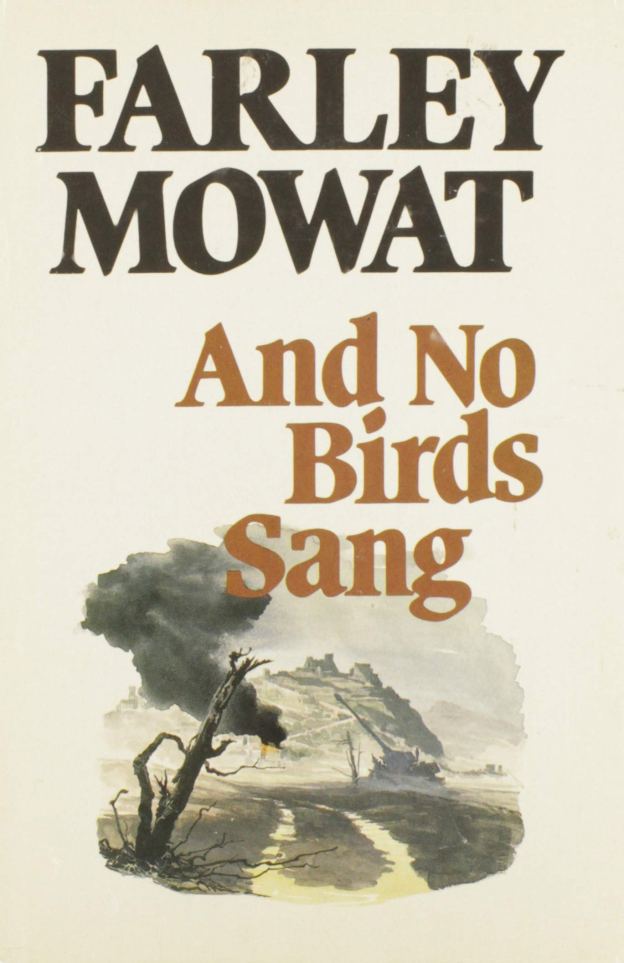
And No Birds Sang, Farley Mowat

Plucked this one off a second-hand store shelf after recognizing the author’s name.  Canadian Mowat had come to my attention for his naturalist-memoir, Never Cry Wolf, first encountered as a successful feature film in the early 1980’s, and read sometime thereafter.

Regarding this present slender volume, I find it somewhat uncomfortable that ‘charming’ is the first word which comes to mind in summarizing a book whose main intent – and emotional effect – is to honestly portray the utter brutality of war.  It is a testament to the author’s personality, his innate positivity against all odds (a characteristic evident in …Wolf, as well) and his ability to view whatever is before him with innocence and wonder despite its negative aspects, that reading his memoir is not a depressing experience.

The book chronicles a brief period in Mowat’s life in which he transitions from eager and idealistic youth to terrified veteran of a selection of humanity’s habitual horrors, as evidenced during the Allied invasion of Sicily in the Second World War. In the process he displaces conventional notions of glory and heroism with harsher truths of luck, desperation, endurance and the sometimes-terrible adaptations of which the human heart and mind are capable when required to cope with – and, if fortunate, survive – extreme situations.

Right after reading the book, I wrote that “In its own way, this belongs on the shelf with Wiesel’s Night, Krakauer’s Where Men Find Glory, Shehan’s A Bright Shining Lie and Moore and Galloway’s We Were Soldiers Once, and Young.  It’s that Good.” 

Looking up Mowat’s bio just now though, to check my memory of his bibliography, I come across a very serious criticism that places that judgement in a different light.

Mowat, it seems, was dogged during his career by allegations that his environmentally-themed works were actually more fiction than non-.  Wolf researchers hotly contradicted the supposed observations and experimentation in Never Cry Wolf, and even the simple timing and circumstances of his visits to wolf-country were not borne out by available records.  Experts on indigenous peoples of the Canadian Arctic were equally damning on his supposed adventures among those tribes, as were better-credentialed historians on his conjectures about pre-Norse explorations by a people he called ‘The Albans,’ for whom no other record exists.   What there apparently are records of, on the other hand, are a quote of Mowat saying that he “never let the facts get in the way of the truth,” and something of a personal motto, found among the author’s papers, that “…when the facts have particularly infuriated me, Fuck the Facts!”

Attending a different author’s reading some years ago, I was dismayed to hear her make a similar admission regarding a magazine piece about travel adventures (the genre in which she had made her name).  Her excuse was that people go to travel magazines seeking a certain sort of release from mundanity, it was her job to provide that, and since the reader would never know which parts were truth and which fabrication, there was no harm done.

To me, labelling any work as non-fiction (which includes presenting it in a publication not identified as fiction) is to make a claim of authority and factuality; it creates a certain covenant between writer and reader.  Encountering in fiction an event or insight which is not familiar to them, the reader evaluates it speculatively, and forms an opinion of whether or not it represents actuality, doing so largely in light of whether it conforms or not to the reader’s own experience.  Encountering the very same piece of information in a work presented as non-fiction, we are explicitly being directed to take that information as superseding any counter experience or belief we may have – ‘this is the truth, accept it.’  Such a claim of authority must properly be earned by a certain amount of rigor, and self-discipline which includes, as its lowest bar, not simply ‘making shit up’.

I’m just sayin’…

In the end then, And No Birds Sang gives a reader cause to ponder not just one but two weighty, and yet very different, themes: the experience of fighting in a war, and the experience of reading about any other person’s experiences.  Pretty good payoff for fewer than 200 pages.  

City of Girls, Elizabeth Gilbert

Most famous perhaps for her new age-y self-help memoir Eat, Pray Love, Gilbert is also and initially a novelist and this, her latest, is no slouch.  Substantial at 465 pages, it covers the mid-Twentieth Century through the life of upstate New York ingenue Vivian Morris, who receives an education and much more once she relocates to the city of the same name.  Sex and alcohol fuel much of the raucous early going, till the story abruptly shifts locale and tone around page 300. Disconcerting, that; and a serious disappointment to this reader, until a few chapters later when the narrative returns to its previous location and regains some (but only some) of its attitude.  From there the tale matures along with its protagonist, moving from girlish dalliances to womanly relationships and thoughts.

Which may be the author’s point.  While the title seems for a time to refer to the young women of the early chapters, and later to a play of the same name which becomes prominent for a while, it becomes ultimately a shorthand for all the different relationships between women which sustain these characters and the few social arrangements which care for and value them – the men in Gilbert’s telling being almost universally disappointing to the women, and often just as much so to themselves.  Her one male exception is introduced very near the end, a terribly-damaged creature with a heart of gold, who is, tellingly, an even greater disappointment to himself than any of those who preceded. 

Another indication: the two wronged women who get tossed out of Vivian’s life are both sorely missed and the reader spends the rest of the novel hoping they will be brought back for some dramatic rapprochement.  On the other hand, the one male who drops out is not missed in the least, despite being her close relative and a tragic victim of greater events.

Overall, and thanks almost exclusively to the quirky women Vivian meets in the big city, one comes away with the impression of a life lived off the beaten track and outside the generally accepted definitions of success and happiness, yet more successful and more satisfying at its end than many which better fit the traditional definitions.  A theme well in keeping with Gilbert’s other writings and a quite satisfying ending to a charming journey.

(BTW, the above description of Eat Pray Love is not meant to put it down. In addition to being on-trend, it is also deeply felt, thoroughly entertaining and insightful.  I read it some 13 years ago with under-liner in hand and closed the book feeling more optimistic about my own life than I had in ages.  Which is one reason I picked up City of Girls, though a reading of Gilbert’s 2000 first-novel, Stern Men, during the intervening years was also instrumental.  Either way, I am glad I did, and ready to read more of this author any time.)

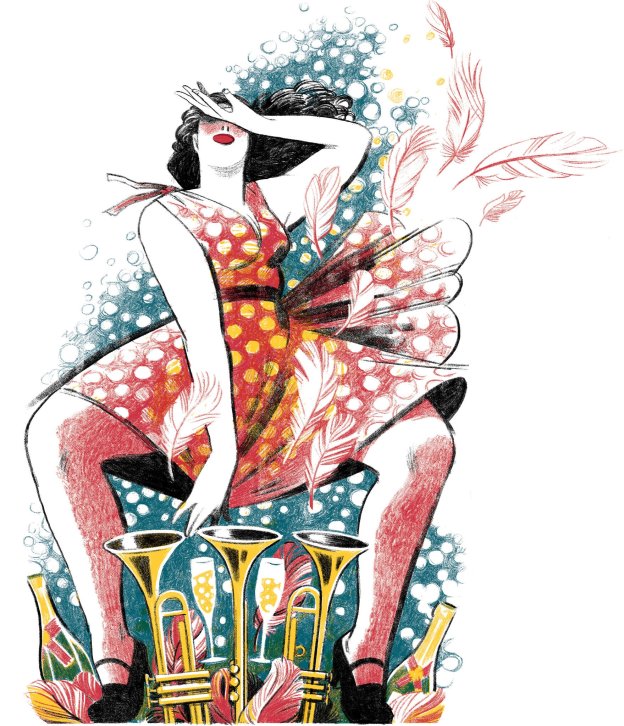
(Illustration by Eleanor Davis for N. Y. Times review)

The Splendid and the Vile, Erik Larson

A splendid telling of Winston Churchill’s first year as Prime Minister of Britain, 1940 to 1941, as the vile German war began its malignant blooming.  Drawing from the absurd wealth of diaries, letters and official records which exist from that time, Larson shows us the British Bulldog’s personality, character and lifestyle, as well as those of his family and closest confidants, while epic episodes of politics, drama and suffering provide the footlights’ glare.

Whatever else one may think of WSC, he was certainly an individual; his willingness to exhibit personal idiosyncrasies – and even his unclothed person – suggest someone who had been raised under the gaze of servants and caretakers, grown up in the glare of the media and by old age must simply have assumed everything about him was already public, so why hide it.

On a less salutary note, it is impossible to dismiss the luxury of British upper class existence, even in the midst of The Blitz.  Debs debut and the posh pose in clubs, gardens and elegant dining rooms even as soldiers die in far off places and civilians around the block.  Churchill has his preferred vintage of bubbly and brandy, his cigars and twice-daily baths and weekends at a country house to entertain family and friends – along with those officials whose cooperation he ensures by such bonding.  Most creepy of all, are the civilians in their gardens, lying back on the grass to follow aerial battles between friend and foe.  Forebears of us all, perhaps, watching disaster footage on the TV or internet from an even greater remove.

The greatest impression for this reader, given the date and place of reading (August, 2020, USA) is the contrast between one larger than life character and another. Where Trump demeans everything he touches, Churchill raised Britain from nation to ideal, elevated Beaverbrook (for just one example) from greedy industrialist to miracle worker, and uplifted each casualty of the war from cipher to symbol of heroic sacrifice in a just cause.  His speeches raised not only the ‘rabble’ but thinking minds as well and were driven not by hatred of the enemy but by love of its victims.  A subtle difference, perhaps, to some, but a crucial one. Would that all leaders had such character.

How splendid and fortuitous that the Eurocentric world had a leader like Churchill ready to step up when the future turned so very dark and cloudy.  And how splendid that later generations have authors like Larson to show us yet another angle from which to appreciate their value and their stature.