Tag Archives: Trump

It’s Not Too Late!

It Ain’t Over Till It’s Over*

It’s certainly too late to be first in citing Mr. Trump’s brazen demolition of the White House’s East Wing as a perfect encapsulation of what this administration is currently doing to our nation; plenty of commentators have already made that connection. 

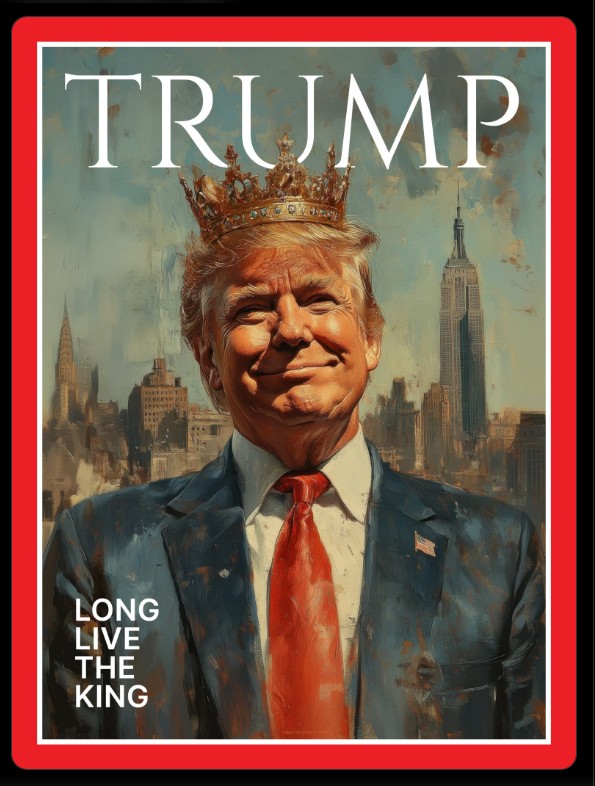
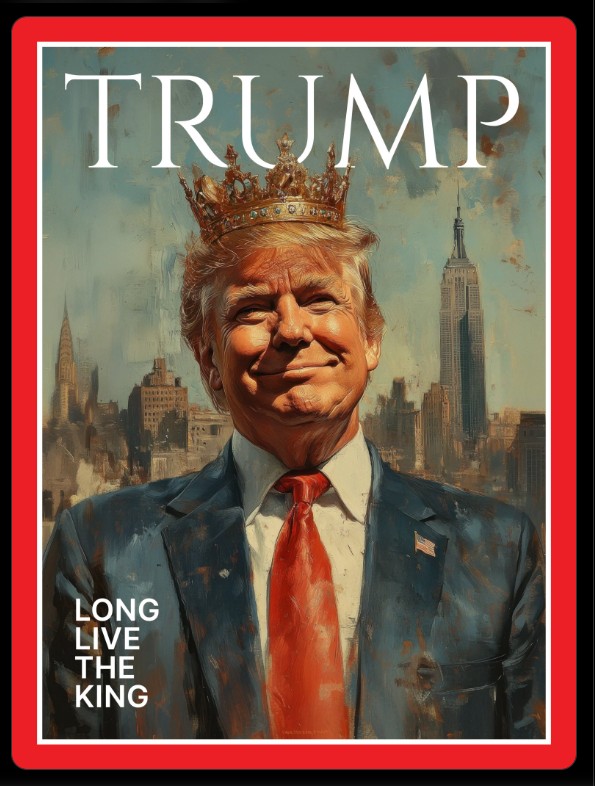
It’s even past time to point out that his childish posting of a meme depicting himself as King in a crown, piloting a fighter jet to dump a stream of what appears to be manure on crowds of Americans is an honest indication of the man’s arrogance, an utter embarrassment to any thoughtful U. S. citizen and a terrible message to anyone around the world who might still hope our nation and its system of government represent anything decent or thoughtful.

What is timely is to note that between excesses like those plus persistent obsequiousness toward Vladimir Putin, overselling of his achievements around the Israeli/Hamas cease fire, careless acceptance of Doge’s destruction and the current government shutdown, callous badmouthing of one of the largest peaceful demonstrations in U. S. history as “whacked out” “radical left lunatics” who “are not representative of the people of our country” (emphasis added), farcically ignoring or evading a plethora of laws and judgements, his gratuitous pardon of the execrable George Santos among so many others and now his astonishingly self-serving proposal to have the Justice Department pay hundreds of millions of taxpayer dollars to himself to soothe his bruised ego, Mr. Trump is very close to transforming the U. S. Government into one more personal asset he has acquired and can play with as he wishes.

It is abundantly clear by now that the Judicial branch can neither act quickly enough to prevent this disaster nor does it have any real power to limit Mr. Trump’s impulsive actions, since the Supreme Court neutered the branch with its ruling in Trump. V. United States.

As for elections, the progress being made at the State level in gerrymandering and limiting access to the polls make it frighteningly plausible that many legitimate votes will have been made irrelevant by November of 2028, allowing Mr. Trump or his successors to retain power for the foreseeable future regardless whether or not a plurality of eligible voters wish it.

It’s not too late, though, to plead with those Republican legislators who hold the majority in Congress to recognize and admit what we are witnessing – the eradication of conscientious leadership and the elimination of any accountability for the nation’s Chief Executive (and through his Pardon power, anyone else who curries his favor or feeds his greed).  Not too late to reinstate the balance of power intended by our Constitution, if Republicans are willing to look past partisan marketing and act wisely to oppose the worst of his excesses. 

And, finally, it is most emphatically not too late to plead for Republican voters to use the 2026 election to clear away any legislators who will not credibly commit to executing Congress’ responsibilities, rather than rubber stamping Mr. Trump’s every impulse of every moment.  This plea is aimed not at those Republicans who cannot imagine themselves ever disagreeing with him on anything, but at the great number of Republicans who still sincerely believe in thoughtful leadership and representative democracy, in a nation that values all of its citizens equally and respects their rights equally, including the right to disagree with an office holder. 

It is up to those Republican voters (of which I count myself one), to first nominate and then elect Senators and Representatives who will insist that Congress fulfill its role, including to make the nation’s laws, to levy appropriate taxes and decide how they will be spent, to declare (or not!) wars and – potentially – to use the only power which remains, the power of Impeachment, to ensure that the entire Executive branch follow the Constitution and “take care that the Laws be faithfully executed” in all the myriad aspects that that clearly demands. “Faithfully,” that is, not by disregarding legitimate court rulings, not by handpicking attorneys and prosecutors who will spout disingenuous rationalizations to delay judgements indefinitely, and not by trying to conceal what is really going on beneath a flood of winking, smirking and distractions.

If those voters and their chosen representatives can bring themselves to see the light, it may not be too late to preserve what Benjamin Franklin said in 1787 he had just witnessed being created:

“A republic, if you can keep it.”

*Frequently credited to Yankees coach Yogi Berra in the 1973 baseball season, at least one source says this quip is the result of a slow-motion game of Telephone, as a similar but less catchy comment was progressively distorted from one media report to another until politician Joe Lieberman erroneously cited the current language, in 1982.

The Children of Men, P. D. James

A Timely Commentary on current events – written nearly thirty-five years ago!

Grabbed this off a neighborhood free-books shelf on basis of the author’s familiar name and work; was surprised to find in place of the expected tea and class-system detective story a speculative political fiction written decades ago yet uncannily timely in its themes.  James* has always been a reliable commentor on the British government and governing class – she spent thirty years in the civil service after all (or rather, before being able to write all her more familiar titles) – but that has previously seemed incidental to the solving of mysteries.  Here, it is the main point.

Though first published in 1992, the novel is set in 2021 with a sci-fi sounding premise – that 25 years earlier it had become unavoidably obvious that all human males in the world had become infertile.  With the birth rate crashing in months to absolute zero, all of humanity was suddenly forced to comprehend the existential doom of universal aging, disability and death without the consolation of watching younger generations grow to replace them.  We are then given to understand how this resulted in apathy and lawlessness, perfect conditions for the rise of a fascistic strongman named ‘Xan’ (reference to Alexander ‘The Great,’ I’d guess).  Our guide through what follows is Dr. Theodore (Theo) Faron, an Oxford historian with a mythologically-tragic reason for retreating from public life but who was also a childhood friend of Xan and, until recently, an advisor to him in his autocratic reign.  When Theo is approached by a band of laughably incompetent would-be revolutionaries, the first half of the novel is set in motion. The second half (spoiler alert) is brought about by the discovery that Julian, a (female, despite the name) member of that conspiracy for whom Theo immediately begins to develop romantic feelings, is pregnant, a monumental event which suggests she and her child have the potential to save humanity from its dire fate.  From that development James builds a compelling thriller addressing moral questions of ends and means, guilt and forgiveness, God or not God and the temptation which even the most honorable person may experience when offered the chance to exercise power over others for what they believe to be good or necessary ends.

Xan’s resemblance to the current U. S. President is striking, and the arguments for his usurpation of total control over English life track almost perfectly with MAGA’s claims of necessity: societal disorder, citizens lost in despair and apathy, crises requiring responses more immediate than any deliberative process could manage, the purportedly inherent weakness and fecklessness of all so-called democratic processes.  The effects too, are symmetrical – arbitrary laws and judgement, scapegoating of immigrants and other ‘others,’ curtailment of individuals’ rights under brutal policing and cruel incarceration and an invasive security state to ensure those who have seized power get to hold it indefinitely.

All of this, James handles with intelligence and generosity (if sometimes overmuch time spent on the exact physiognomy of a face, niceties of vegetation, quality of sunlight or sky and the furnishings of various interiors; the one aspect in which the novel feels rooted in the author’s generation and previous genre).  Theo is a modest and honorable foil for Xan, who is himself allowed sufficient rope to make a moral case for his usurpation.  Their ultimate confrontation is well-scripted if a bit forced and the final decision which results from it is of Sophoclean magnitude and weight.

Among many impressively crafted moments is one where Theo, acting out of necessity to secure resources for the imminent birth of Julian’s child, discovers in himself the potential to enjoy violating norms and forcing others to his will, even to the edge of brutality.  Not only a worthy observation on human nature, this new self-knowledge plants a seed which allows the novel’s final moments and message to ring true.

Schooled by a difficult life, James may have honed her skills in the trenches of genre fiction, but The Children of Men affirms her a true literary artist.  It deserves to be revisited for that reason alone, and especially so in this moment, when its fictional time period has arrived and is turning out strikingly similarly, in some important respects, to what she imagined nearly thirty five years before.

*Officially: Phyllis Dorothy James White, Baroness James of Holland Park!

Note: There is also a somewhat loose film adaption by the same title, credited to five writers and directed by Alfonso Cuaron (Harry Potter and the Prisoner of Azkaban) with Clive Owen portraying Theo.  The film received critical acclaim, numerous award nominations and a few wins, as well as positions on various “Top” lists, but did poorly at the box office).

Feel free to share this post if you like.

If you appreciate what you find on this site, please subscribe – it’s totally free!

Pardon Who, Mr. Trump?!

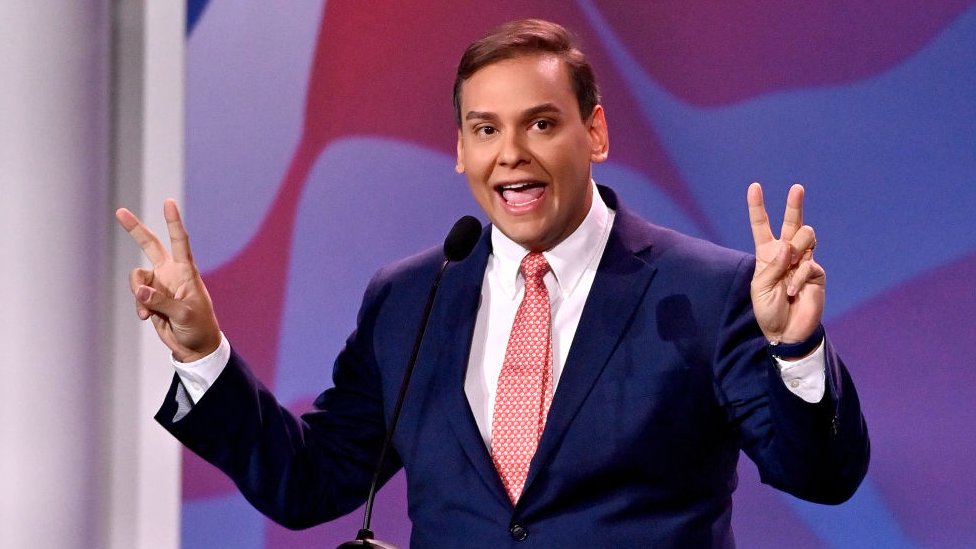
We learned yesterday that Mr. Trump has commuted the sentence of George Santos, the ex-congressman rightly convicted of fraud and identity theft. No reasonable explanation has been given for letting this criminal off after having served only a few months of a multi-year sentence with Mr. Trump’s wishes for “Good luck…” and “… a great life!”

Our executive has no concern, apparently, for the luck and lives of the people and organizations who now have absolutely zero chance of collecting the restitution due to them by judgement of the court which convicted Mr. Santos.

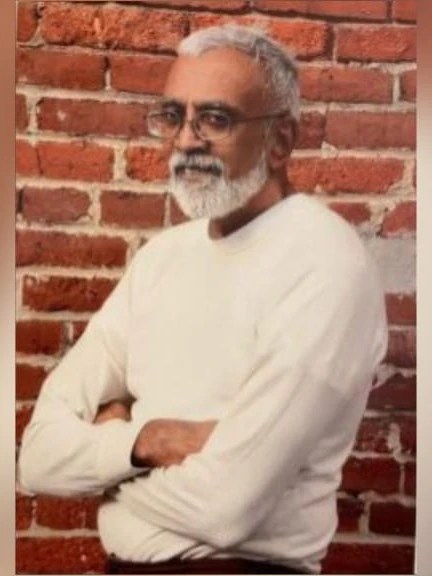
It is possible, perhaps, that Mr. Trump truly believes Santos “has been horribly mistreated…” and awarded this commutation to a political supporter for no reasons other than his love of justice and his compassion for the wronged. If so, let him demonstrate it by paying equal attention to the case of Subramanyam “Subu” Vedam, who was recently released from custody after serving 43 years in prison for a murder which reports say it is now clear he did not commit. Rather than being allowed to enjoy his “Good luck” and look forward to a “great life,” he was immediately taken into custody by ICE and placed in crude detention while they process him for deportation, based upon a drug offence to which he reportedly confessed as part of a plea deal; an offence which even if it has any validity, is entirely overshadowed by the exemplary behavior he displayed during 43 years of wrongful imprisonment..

If George Santos has been “horribly mistreated” in serving three months for multiple crimes which were obvious and adjudicated in full, how much more deserving of compassion is Mr. Vedam?

Mr. Trump, please demonstrate your thoughtful and compassionate nature by commuting his charges and allowing him to spend his remaining years with his family rather than in a nation thousands of miles away from them and to which he has virtually no connection. Or, if that is too heavy a lift, at the very least direct your Attorney General to initiate a full examination of Mr. Vedam’s treatment with even a fraction of the zeal she has exhibited in prosecuting your political opponents.

Show us your true colors, Mr. Trump!

Please share this Post

to bring more attention to Mr. Vedam’s

plight.

And, if you appreciate what you see on this site,

please subscribe – it’s absolutely free!

Share

One Ring to Rule Them All – The Breathtaking Cynicism (and Naivete) of Trump v. United States

It is over a year since the Supreme Court issued their 6-3 ruling on Docket no. 23-939, Donald J. Trump versus the United States of America, which ruling granted the President immunity from Federal prosecution for virtually any acts while in office.

No such immunity having been written in the Constitution, their reasoning (originalism be damned) seems to have been that the fear of prosecution would be an undue distraction from the office’s duties and that the fear of such prosecution would impede a President from taking actions he otherwise believed necessary or justified. 

This ruling was cynical first in that it assumed a person who had sought and won the highest office in the land would value his own fate (political, financial or otherwise) more highly than the proper execution of that office.   Sadly, in the opinion of some observers, they have already been proven correct on that count.

The ruling was cynical second in assuming that even such a self-interested person, upon achieving the office whose responsibilities include selecting the head of its Department of Justice would not have sufficient faith in his appointees and the legal system they administer to rely upon that system to issue proper verdicts in the event he was subjected to improper prosecution. In this, the Court disregarded the basic conservative rationale that the possibility of prosecution provides a necessary and effective deterrent to illegal behavior. In this respect, their cynicism has freed the incumbent to act with total disregard of credible legal justification.

Third, and most cynical of all, is that the Justices did not themselves have sufficient faith in the American legal system, of which they are the figurehead, to use their position, prestige and ruling to assure the President that he could rely upon that system for protection.  Every other person in every U. S. jurisdiction lives every day of their lives knowing they could be prosecuted for something of which they do not believe they are guilty, and every one of us has no choice but to trust in the legal system to protect us.  And yet, our Supreme Court deemed it unwise to ask the holder of the highest public trust to do the same?  Breathtakingly cynical, and shameful.

Those thoughts were on my mind at the time the ruling came out, and I considered posting them, but sadly, did not get around to it.  Now, as Mr. Trump’s second term reveals its true form, it is clear that ruling was not only cynical, but at the same time equally naive.  By freeing the President from any accountability other than impeachment (the highest hurdle in the legal system and one which has not once taken effect, in nearly 250 years), the court’s ruling has encouraged him to act as he pleases, including to persecute with impunity anyone he chooses.

Moreover, in doing so while also leaving in place his virtually unlimited power to pardon, the Court allows him to hand a ‘Get out of Jail Free’ card to anyone who does his bidding.  Far from protecting the nation, this greatly encourages improper acts of any sort by anyone who believes they can maintain the President’s favor.  In the few short months of this administration, we can already see this effect at work; that the Court’s majority did not foresee this outcome but instead enabled and encouraged it, exhibits breathtaking naivete, at the least. 

The result of these twin privileges, one clear in our Constitution and the other added to it by the recent decision, is that the chief executive may now act out his every whim, without fear of legal restraint for him or his followers.

If this was the ‘original intent’ of the authors of the Constitution, then that document is not at all what generations of us have been taught to believe it was.  If that was not the original intent, then shame be on the authors of the Court’s opinion in the case so very aptly named: Donald J. Trump versus the United States.

Doublespeak Becomes our National Language

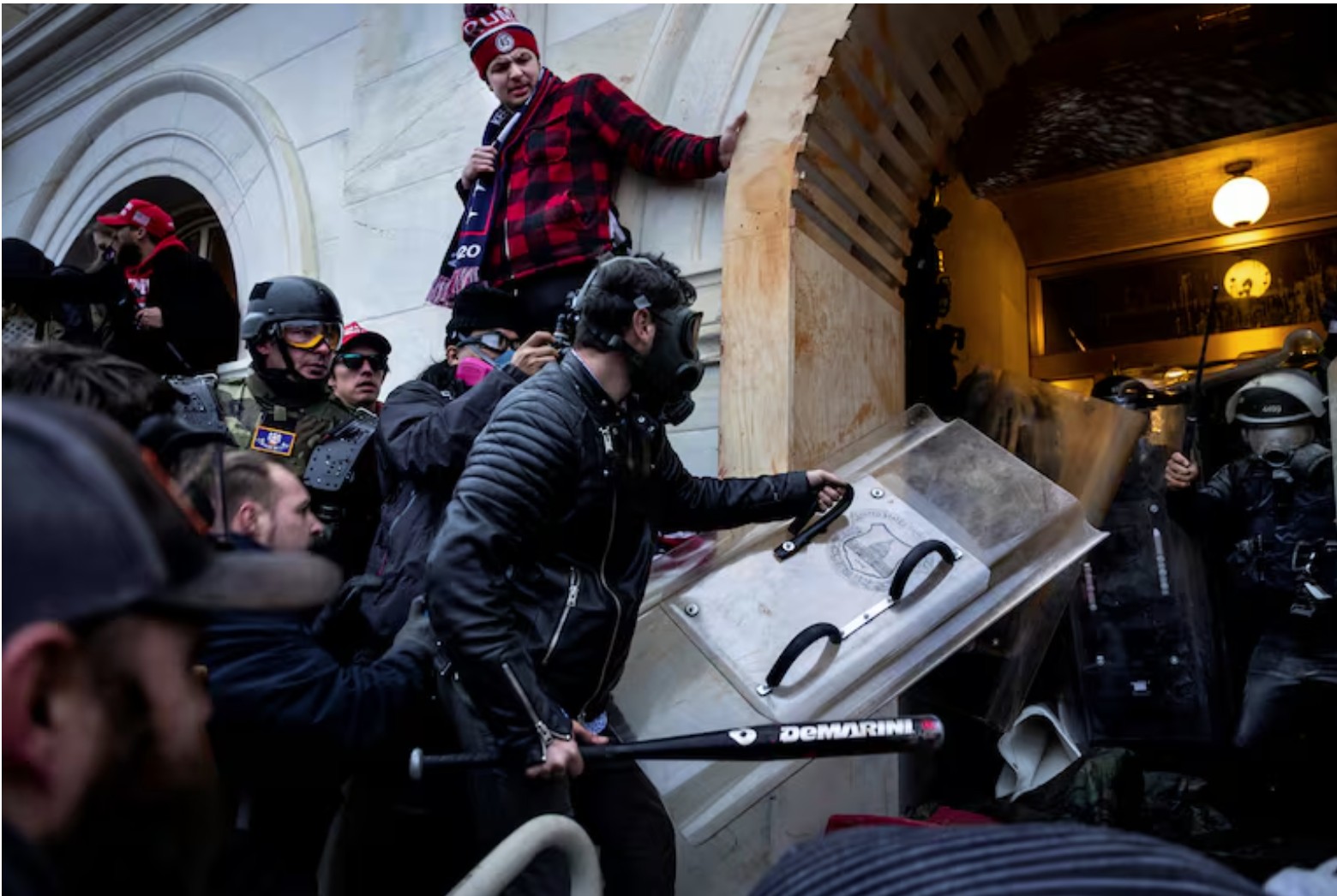
The events of January 6, 2021, wherein thousands overran security at the U. S. Capitol Building, directly and violently assaulted security forces then broke into and vandalized that pre-eminent Federal facility, all while threatening bodily harm and even death to the elected representatives doing the nation’s business there, did not require the then-President to take any action and were actually “a day of love,” in Mr. Trump’s words or “a normal tourist visit,” in those of Georgia Representative Andrew Clyde.

But:

The events of the last few days in Los Angeles, wherein crowds gathered in predominantly peaceful demonstrations, are “a rebellion or danger of a rebellion against the U. S. government”– the standard set by 10 U. S. C. 12406 of the Code on Armed Services which the administration has abused to justify creating a national crisis by deploying Federalized National Guard and active duty Marine troops – despite urgent assurances by both local and state authorities that there was no need to do so.

Doublespeak, George Orwell’s prescient creation, is alive and active in the words of those who now govern our nation.

(There’s no excuse for throwing rocks or anything else at police forces. No excuse for looting or vandalism either, but such criminal offenses are properly and regularly addressed by civil law enforcement forces. Assembling in public to voice and demonstrate common feelings about events in one’s community is neither rebellion nor incursion but a right guaranteed to all in the U. S. by our Constitution, our laws and abundant examples in our nation’s glorious history.

Mr. Trump, who famously declared “I love wars,” who tried to declare himself, “a wartime president” back in 2020, and is eagerly anticipating his opportunity to preside over a grand military pageant, made a tactical mistake by predicating his current reign on avoiding foreign wars. To escape this bind, it seems, he has decided it is in his political and economic interest to find himself a domestic war. Stones thrown in LA are merely the pretext for this latest escalation of his own aggrandizement.)

“Good night and good luck,” indeed.

Autocracy Now!? – a personal opinion

Following Mr. Trump’s second ascension to the Oval Office, Op Ed pages were flush with pundit pieces pondering whether our nation might be slipping toward autocracy.

Now, less than 10% thru the man’s political resurrection, the verdict seems clear. Since January 20th, 2025, we’ve:

Watched Mr. Trump invite elected leaders of sovereign nations to the White House on pretense of official business only to then enact staged humiliations (complete with laughably inaccurate accusations despite his having the entire resources of the Federal Government at his disposal to provide accurate information), all to generate “…great television…” in his perpetual self-promotion campaign.

Cringed at his lazy and feckless use of social media (“Vladimir, STOP!”), to ‘negotiate’ international disputes on which turn the lives and fates of millions, no doubt provoking scathing contempt among the hardened dictators who simply ignore his maunderings as they go about their bloody business.

Witnessed him elevate minor entertainment personalities to positions of real power despite their lack of relevant experience, and begun to see the damage their recklessness is inflicting both at home and abroad.

Cringed as his craven ‘spokespersons’ dodge, divert and dissemble to suggest his public pronouncements do not mean what their words plainly say and that reality is whatever their Don says it is, rather than what we perceive with our own eyes, ears and reason.

Seen him predicate foreign policy not on the basis of any lasting principle, nor of the Nation’s interests, but of his own need to appear ‘strong’ and to ingratiate himself with the most brutal and paternalistic figures on the world stage, currying their favor and reveling in the pomp and praise and gilded royal treatment they gladly dispense as a cheap price for neutering our nation’s hard-won soft power.

Observed him repurposing the Justice Department into a tool for personal vendetta, while neutering the rule of law wherever else it suits him through pardons, elimination of oversight and simply ignoring any statute, decision, precedent or custom he does not choose to follow.

In short, the question those Op Eds asked has already been answered: As of this writing and for all practical purposes, governance of the United States is no longer enacted by Congress, nor administered by the various Federal agencies and offices, nor constrained by the rule of law.

Those functions have, instead, been subverted to the whims of a single person whose overriding goal is to elevate his self-image above even the office of the Presidency while simultaneously feeding his obsessive greed and coagulating power in his name alone.

The autocracy is here, and it is U.S.

(The current questions are: how long will it last, and how badly will it end?)

The Crisis is Upon Us!

To all those pundits still talking of the courts reigning in Mr. Trump, or of a ‘possible’ constitutional crisis ‘ahead’:

Fugeddabout it!

An administration led by the ‘world’s greatest negotiator,’ who claimed he could end two overseas wars easily, cannot get a single unjustly imprisoned man released from the country with which they previously negotiated an agreement to remit him?

This is an obvious refusal to comply with the courts, shrouded in the weak and passive-aggressive excuses of snickering adolescence.

The constitutional crisis is here, folks, right before our eyes!

(First posted as a Substack Note, 2025-04-13)

These Truths, Jill Lepore

It is difficult to imagine a more appropriate book for this time (summer 2020 – the lead-up to The Trump Election) and place (anywhere, USA). Lepore employs her awesome knowledge of US history to remind us who we are and enlighten us as to who, what and where we come from. 

This she does with all the drama and detail of an excellent novel, using individuals and their words to illustrate each minute point of disagreement, argument and compromise.  And it is that last which sticks in this reader’s mind; how our constitution and form of government, rather than being the immaculate perfection suggested by those who laud them in defense of their own (usually reactionary) purposes, are and always have been the flawed result of a process that not only pressured, but actually required persons of principle to accept results which complied only partly to their principles.

Another eye -opener is the limited role which rigid principles have played in our history.  Had all the persons alive during the founding refused to compromise on their principles, there would quite simply be no USA.  Perhaps a miscellany of separate states (with some still slave-owning up to the present?), perhaps some component of a prolonged British Empire, or perhaps something even more strange to us – a continent divided horizontally somewhere near the Mason Dixon line into an  enormous Mexico and equally expansive Canada.  This thread illuminates also the role of fundamentalism in elevating disagreements to become fights and, not in- frequently, wars.  Lepore cites many different sorts of fundamentalism – religious, capitalist, democratic, constitutional, etc., considering how they often interrelate and how our current state of technical evolution has enhanced them and so lead us into the legislative paralysis we are currently experiencing.

Another oh-so timely note: without overtly linking herself to the BLM movement or 1619 project, the author’s contention on race is unmissable: that distinctions on the fallacious basis of skin color and the dominance of wealthy property owners over a more-populous slaving/working  class are as intrinsic to our background as is the love of democracy and equality, if not even more so.

No brief description can do this effort justice, just as any less-expansive book would fail to do its subject justice.  Fascinating and depressing, These Truths can also remind us that turmoil such as we are living through today is no stranger to the USA, any more than it is a stranger to all the nations, cultures and civilizations humans have spawned and discarded over the millennia.

All of which places These Truths is very high on the list of most valuable volumes I’ve read in years.

The Feral Detective, Jonathan Lethem

 A contemporary noir, loosely-framed by the protagonist’s despair at the election of the ‘orange monster’ and the economic and cultural divides it reflects, but also deeply embedded in broader 21 st century dislocation and despair.

Intriguingly, Lethem tells the tale thru the voice of Phoebe Siegler, a refugee from the urban entertainment/media complex, rather than Charles Heist (what a surname choice that is!), his idiosyncratic detective. This allows for more thoughtfully-analytic observations by the character, and a more literate tone than would the latter. It also makes for some brave writing, as Lethem voices Phoebe’s sexual longings and encounters with Charles. One would love to know what female readers feel about his level of success, but to me it rang true, if perhaps a bit enhanced by what a man hopes a woman is seeing. Lethem also finds something new in the L A area by choosing for his locations the little-known towns of Upland and Clarement; the resort hermitage of Mt. Baldy (a personal touchstone, having driven, hiked and skied there) and the Mohave Desert just over the mountains from the big city. The tenuous economics of these locales, and the multitudinous opportunity for misfits to isolate themselves resemble the same raw ingredients which Southern writers have long mined from their home turf, but being still part of LA makes for a freshness and perhaps a more accessible connection to readers not of the sub-Mason Dixon world. Interesting and engaging, but I’m not hungry to read another installment, if indeed this is the start of a series (a possibility suggested by the ending, but inconsistent with Lethem’s intellectual adventurousness, nor his career path and to date).

Two Guys Walked Into a Movie Theater

One day in the spring of 2020, two men paid their money and stepped into a darkened movie theater, just as the trailers were rolling. TC sat in right-about the same spot where he always sat when he went to the movies, because it was familiar, and easy, and comforting to always know where he was going to sit without having to think too much about it. SB, after looking around carefully to see which seats were available, picked the one where he thought he’d get the best view of the screen, and the best-balanced sound…

That scene came to mind as I thought back on two recent reads. Ship of Fools, is by Tucker Carlson, who worked for CNN and MSNBC before joining the Fox network in 2009, where he is now far more opinion-entertainer than newsman, and is said to be one of the three or four most listened-to Trump whisperers. Tailspin – the People and Forces Behind America’s Fifty-year Fall, is by Stephen Brill, whom Wikipedia describes as a lawyer, journalist and entrepreneur, founder of The American Lawyer magazine and cable channel Court TV. Seeing the two volumes on the local library’s New Arrivals shelf I was struck by how similar their pitches were, both claiming to illuminate the reasons behind the present economic stagnation of middle and lower-middle class incomes, the persistence of poverty, decline of manufacturing, slow death of rural communities, tragic rates of incarceration (particularly among minorities) and frighteningly-high unemployment among high-school-educated men of all races, etc., etc. Despite the superficial similarity of focus, the books could hardly be more different, thanks to their authors’ individual approaches.

Where Brill’s writing is thoughtful, Carlson’s shouts. Where Brill cites data and quotes specific articles and documents, Carlson cites anecdotes. Where Brill criticizes both sides of the political aisle, Carlson exclusively blames ‘liberals,’ on the basis that they are no longer ‘liberal enough’ to counteract unnamed other forces (he cannot bring himself to admit those forces may claim to be ‘conservatives’) against whom they should be more effective. Nor is Carlson willing or wise enough to point out the role of corporations’ single-minded pursuit of short term profits in all this.

Both authors do note the role of ‘elites’ in all this decline, but again with differing critiques. Carlson wags the scolidng finger and derides the lack of success which so-called experts and academics have had in making things better, without offering any credible alternative.  Brill drills deeper and highlights how well-intentioned efforts to end discrimination and hereditary advantage have allowed – even driven – the brightest and most self-centered among us to work the systems and levers of commerce and government to their own advantage, thus empowering the 1% (or thereabouts, the blame is not nearly so centralized) to entrench their own wealth and power to the detriment of all other forces and factions.

Most tellingly, after each section addressing one of these maladies, and after thoroughly analyzing the problem and its origins, Brill cites at least one specific example of individuals or programs who are working with at least some degree of effectiveness, to address the issue. None of these efforts are big enough to make a ton of difference, but each of them is a signpost, suggesting what might work if applied at a larger scale. As an entrepreneur, he is well aware of the power of markets, when they are properly motivated (when there is profit to be had, that is). As an observer though, he is also wise enough to recognize that some problems (availability of health care to the poor or elderly, for example, or useful job-training for inner city and deeply-rural residents) will never motivate a pure free-market. Some issues will not be improved without communal action driven by other motives, which historically has only been mobilized at large scale through government action, or at least leadership.

Carlson makes little or no effort to suggest solutions except to demonize liberals, experts, academics and, it seems, just about everyone but bloviators, reality TV figures, radio talk show hosts and avid fans of the above.

As the current period of self-isolation tapers down, Americans (and those in other countries too) need to decide how to address its impacts. In so doing, we can treat the immediate symptoms and in the process perpetuate the problems that predate Covid 19, or we can see solutions that address both the short and the long term. It is that challenge which sent me back to thinking about these two very different ways to illuminate the same issues.

Halfway through the movie, TC and SB both smelled smoke, and watched in horror as a thick dark cloud quickly rose up to block out the screen image. Before they could react, the film stopped running and the house lights came up for just a moment, then immediately went black, revealing that, for some reason, the exit signs were not working either. In the darkness the audience started to panic.

Sitting in his familiar spot, TC began talking excitedly to those around him, reminding them that back in the good old days theaters used to have ushers who carried flashlights with lovely little red shields over the lenses. “If this theater still had ushers like that,” he emphasized, voice rising with indignation, “we could follow them out.” Standing full height in the choking darkness, he shouted to the entire theater, presumably out there listening for his leadership. “I want to talk to the manger,” he screamed several times, before falling into a fit of coughing and wheezing.

Meanwhile, SB, seeing the darkness around him, had whipped out his cell phone and powered up its flashlight app.  Crawling to stay below the worst of the smoke, he used his light to find others and encourage them to follow his example as he made his way to one of the exits. Others who had lit up their own phones made paths to the other exits, and out through the lobby to daylight and safety.

“Where the hell is the manager?” TC screamed, between coughing fits loud enough to be heard throughout the unseen, and now nearly empty, theater.  “I’m gonna rip him a new one,” cough, cough, “to make sure he brings back those ushers. If… “ cough, cough, “we ever,” cough, cough, “get out of here, that is,” cough, cough, cough.

And the rest, as they paraphrase, is silence.