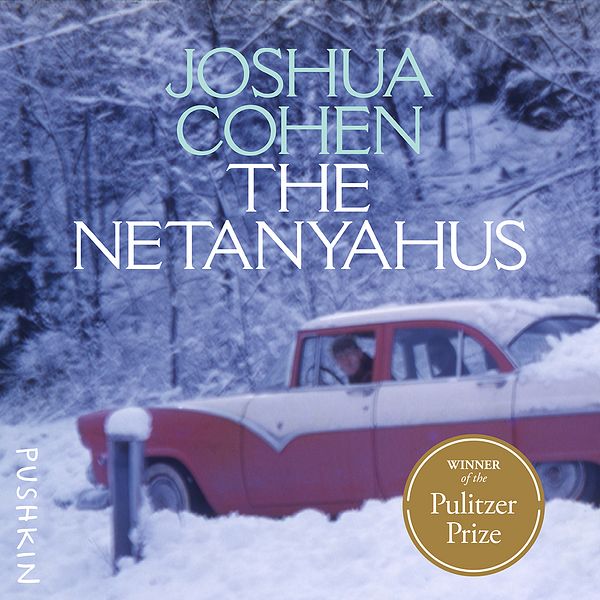
Started reading this in the mistaken belief that it was non-fiction and was immediately put off by the narrator’s (and, I assumed, author’s) arrogant attitudes and artificial style of speech. Once I realized it was fiction, those became crucial elements of the narrator’s character and the entire story, rather than obstacles. A chastising lesson in the difference between forms and the expectations they set up in a reader – and the responsibility of the reader to know what sort of a book e is opening up!
That said, this impressive novel is not without its challenges. Cohen is knowledgeable and compelling on Jewish culture and Zionist history and politics. His “Credits” make clear this is based on a real incident involving real individuals; the literary critic and educator Harold Bloom, whom Cohen knew well in his last years and on whom he loosely bases his narrator, Ruben Blum; Benzion Netanyahu, a Polish born scholar of medieval Judaism and activist for the creation of the State of Israel – and the father of Israel’s current strongman, Benjamin ‘Bibi’ Netanyahu (who appears briefly, as a child); and, to a lesser but critical degree, Benzion’s father/Bibi’s grandfather, Nathan Mileikowsky, a Russian born activist, Rabbi and author. The incident – Benjamin showing up at Blum’s university for an interview with his wife and children unexpectedly and chaotically in tow – is also real, though to what degree is up for debate.
The first half of the novel is serious to the verge of textbook, if a bit satirical, showing us the attitudes of Blum and the surrounding culture (nineteen fifties/sixties backwaters US academia) toward Jews. One note that struck this reader was how closely the described intentions of Zionist theorists appear to confirm the contentions of Rashid Khalidi’s The Hundred Years’ War on Palestine, which I had begun prior to reading Cohen’s book and am still working my way through (it’s dense). In this view, it has always been the intent of core Zionists to possess not just what the UN mandated, but all of what have been called, at one time or another, Palestinian territories (reduced today, through a rolling mix of annexations, wartime seizures and occupations, to Gaza and The West Bank – minus the many Israeli settlements already inserted within those boundaries). The Balfour Declaration and subsequent legalistic measures to enact some sharing of those lands between Israel and the ‘non-Jewish residents’ (to avoid taking a side by describing them as ‘Palestinians’), which I naively believed bestowed a solid legality to the nation, have never been fully accepted by the more ardent Zionists. Rather, they acceded to these grudgingly and only as temporary accommodations for short term benefits, with always the hope and/or intention that eventually the nation would take by force what it could not win politically. That even the Balfour Declaration came about only because Zionists and settlers (who were mostly recent arrivals, rather than having been resident prior to the early 20th Century and Zionist movement) backed the British and other nations into conceding it through raids, sabotage and what some have called terrorism, foreshadowed this long-term belligerence.
The novel’s tone changes dramatically in its second portion, as the Netanyahus (or Yahus, as Blum comes to call them, in one of the author’s most amusing bits) arrive and what had been an academic exercise turns into a slapstick comedy of poor manners, poorer parenting, arrogant presumptiveness, cliché infighting between spouses and barbed daggers at academics in general. For this reader, who finds nearly all ‘comic’ writing an oxymoron, that sectionis less successful and somewhat overextended.
The Netanuyahus is saved in part by the aforementioned orientation on Zionist history and in another part by the insight it provides into the making of one future Prime Minister.
To wit: if the actual Bibi Netanyahu comes from such stock as these fictional father and grandfather, then there seems no way in hell or heaven that he will ever honestly support the idea of a Palestinian state. Coupled with his actions so far since the tragedy of October 7, 2023, this leads one to conclude there will be no other outcome of the present Israeli/Palestinian conflict than Israel’s elimination of the Palestinians as a people or political entity and the integration of all previously Palestinian-controlled lands into an increasingly theocratic, increasingly Orthodox and bindingly-Jewish state of Isreal.
Benzion’s scholarly opinion that this tragedy is a result of Medieval Iberia’s choice to maximize economic advantage by portraying Judaism as a race rather than a religion makes it more tragic, not less. History and religion are not so far apart as some of Cohen’s characters would like them to be.
An impressively erudite novel, depressingly timely.
P. S. – As Cohen tells us, the literal meaning in Hebrew of ‘Netanyahu,’ the surname which Benzion chose to replace his father’s (‘Mileikowsky’) is “gift of God.” This suggests that the attitude of supreme arrogance and entitlement which Cohen portrays in the character modeled upon Benzion is likely very true to its original.
P. P. S. – Early on, Cohen depicts the anti-progressive bent of conservative strains in Jewish and early Zionist thought. This reader was struck hard by the similarity of that reactionary and absolutist world view with that of America’s present-day nuovo-populists and MAGA fundamentalists. One more reason for our Mr. Trump and his fundamentalist Christian supporters to side so strongly with Mr. Netanyahu’s Israeli policies, if their shared paternalism, avarice, brutality and need to perform Alpha Male masculinity were not sufficient.

 RobinAndrew