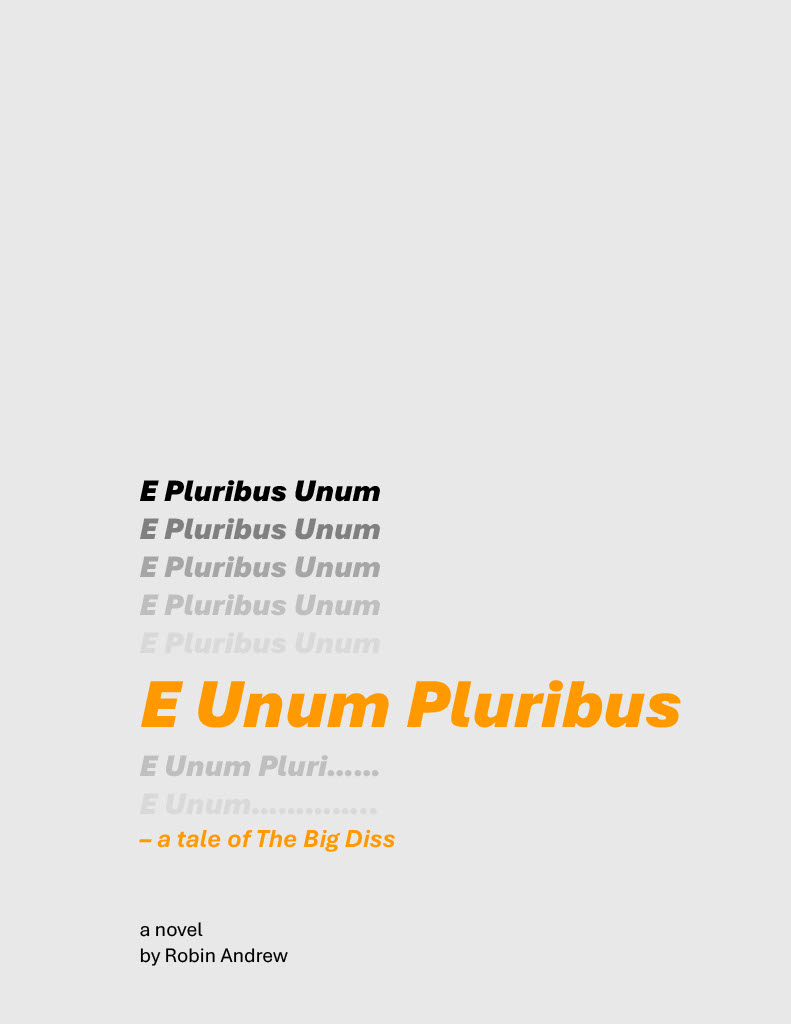
As the years 2016 to 2020 unfolded, I found myself preoccupied with a particular aspect of human history: that even the greatest empires, dynasties, governments and nations have each eventually ended and been replaced by…something else. The ongoing self-segregation of Americans along various lines – urban/rural, elites/masses, investors/workers, digital/analog, etc – suggested our own nation’s end might come sooner than later, and not through some external conquest, virulent plague or invasion of space aliens, but our simple failure to appreciate the myriad benefits of remaining ‘United.’
Starting in 2021, those thoughts began to coalesce into a speculative fiction, structured as a tale of murder and conspiracy happening a decade or so in our future in one of many new sovereignties sprung up among the remains of the U. S. of A. The novel toys with other themes as well – of language and gender, identity, guilt and even the origins of faith and belief – but speaks loudest in its depiction of just how much we all stand to lose if we remain divided into factions which each act only for their own needs and interests.
Writing the book took many months and once it seemed ready, the publishing industry proved impenetrable, even as the politics of disorder and division grew stronger. By the end of 2025 it had become clear I must find another pathway to the public and so I offered the first installment in a post which can be reached via the following link:
That and all subsequent installments may also be accessed via the ‘E Unum Pluribus’ buttons in the top menu or the right-side Categories list of this website’s home page.
Maybe the novel will find an audience this way, maybe not, but regardless, if you believe in the message that we Americans must overcome our divisions and preserve the USA as a government of all the people, by all the people and for all the people – or if you simply support authors being heard without reliance upon the gatekeepers of corporate commercial publishing – please share this post and the above link as widely as possible.
Sincerely hoping the world of E Unum Pluribus turns out to have been a naïve exaggeration, and wishing this great nation the good fortune of avoiding it, I thank you,
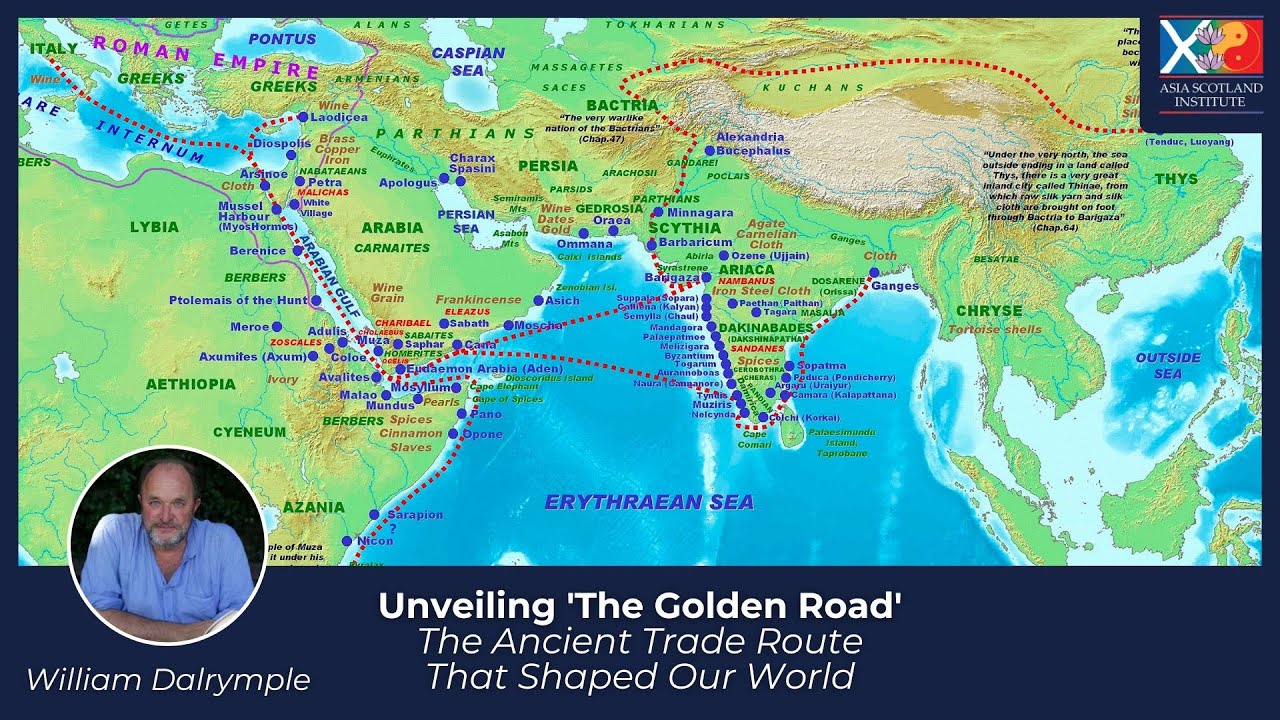
It’s long been a curiosity to me that The Buddha lived and preached in the lands which we know as India, but the populace of that region today are mostly Hindu followers (with significant minorities of Muslims, Sikhs, and other less-publicized faiths). Conversely, Buddhism is mostly associated in the modern mind with lands beyond India: Tibet, China, Japan, Thailand, the other southeast Asian nations… And then, of course, there is Indonesia, a massively populated sleeper nation (in the ‘Western’ view) which I have read holds more Muslims than the entire Middle East! And BTW, how come Marco Polo’s fabled Silk Road doesn’t show up on any maps except those created to illustrate editions of his dubiously sourced travel memoir?
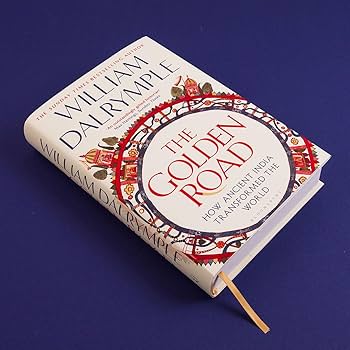
William Dalrymple, a Scottish-born historian living in Delhi, is eager to explain it all to us, beginning with a valuable Introduction that quickly spells out several themes. First, it demolishes the myth of ancient overland trade routes. In this telling, sea-borne trade was far more effective at moving goods – one ship able to carry many times the load of a donkey or camel and at the same time less vulnerable to the myriad possibly-hostile territories through which a long land route must pass between origin and destination. Add to that the reliable seasonal reversing of monsoon winds in the seas around India and you have a situation ripe for cross-culture pollination. Something I’d begun to consider recently through reading and viewing about Rome, its connections with Egypt, and recent archaeological work at Red sea ports which has yielded much evidence of sustained trade with India’s Western coast (via the Gulf of Aden and Arabian Sea).
As impressive as this dispersion is, it is hardly the end of the Golden Road’s story. Even as Buddhist missionaries (itself a new concept this small mind) were carrying their faith to the east where various rulers of ‘Chinese’ states endorsed it to various degrees, Mongols sweeping down from the north and Macedonians from the west were bringing other traditions to India, fracturing its Buddhist establishment and driving many back to the emotional refuge of the Vedic/Hindu tradition with its abundance of attractive gods and goddesses and the reassurance of the Brahmin caste system. (I know I am garbling these distinctions, it takes a scholar like Dalrymple to keep them straight, if even he can, so please forgive me.) Mix in the eventual arrival of Western Europeans and Christianity and one begins to see what a melting pot (to appropriate one of our local phrases) the Indian Peninsula has become.
Through it all, Dalrymple’s central objective is to remind us that wherever armies go, religion goes with them, and wherever religions go, other knowledge goes too. In astronomy, mathematics, medicine and other realms, residents of India were making momentous discoveries long before Europe or even China. Citing various early writings (most of them previously unknown, to me) he traces the origins of this scholarship and its dispersal through the various centers of study and libraries of texts it generated. Only when Islamic scholars brought those ideas and texts to the Middle East (Baghdad, etc.) and from there to the Iberian Peninsula (the Moors, as we tend to call them, thanks to Mr. Shakespeare), was it translated into Greek, Latin, Italian, German, etc. and thus available to fertilize the so-called Enlightenment which we like to think of as the foundation of our contemporary culture.
Dalrymple is an awesomely erudite guide to all this, his analysis of artwork in this or that cave in this or that obscure (to me) region of India is amazing, if sometimes overfilling. For those interested in the premise but not able to work through a 500 page tome, just reading the Introduction will give the basic premise. For those with time though, the depth and detail makes the case more convincing and imparts a vision of the rhythmic dance – the ebbing and flowing on a scale of centuries – which was required for this dance of cultures to bring us the world we know today.
At a time when the (supposedly) Enlightenment-based world order we have known and respected for generations seems in danger of self-destructing, it is appropriate to be reminded that we would never have gotten this far if not for the blossoming and dying of countless other orders. And also, it must be admitted, the clashes, conquests and destruction of kingdoms, nations and empires on multiple continents, over multiple millennia. No human creation lasts forever, but the best fruits of each can contribute to what comes next – though we may need to suffer a lot of wasted time, resources and lives before we get there.
 RobinAndrew