Read this book!
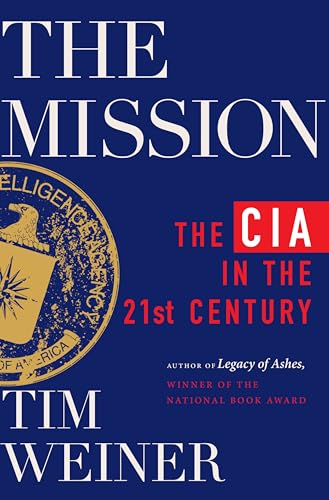
Admirably demonstrating the value of professional journalism, The Mission is factual, detailed, incisive and – despite being a nearly 400-page history of a government agency – thrilling. With more than one hundred participants interviewed, many verifiable sources and its most critical opinions credited to persons who clearly have both the knowledge and the background to deserve being heard, this is an authoritative accounting of a very complex subject.
Having previously written Legacy of Ashes to chronicle the first 53 years of ‘The Agency,’ as the CIA is colloquially known, Weiner begins the new millennium on a downbeat, depicting an Agency whose capabilities were sadly ignored and unmaintained once the Soviet Union collapsed. Deprived of the purpose and challenges which had pushed it to excellence (and sometimes overreach…) ever since it sprung from the seeds of WWII espionage to meet the needs of the old War, the CIA in 2000 was not held in great respect either inside the government or among the public. So little respected, we learn, that the shiny new Bush2 administration refused to listen when Director George Tenant presented substantial indications that Al Qaeda had something big planned, soon, and pleaded for authority to eliminate him before it could happen. To his great frustration, and the even greater losses of others, that plea was ignored – in early 2001!
Like a speed bump beneath all the smoke, dust and debris of the 9/11 attacks, political leadership quickly passed over their own failure to comprehend, instantly deciding The Agency was a great tool for what they conceived as their own brainstorm – the War on Terror. That effort, which had already been one of the Agency’s areas of focus for decades, would become the public reason for much of its activity over the next 25 years.
Using sourced quotations for section titles such as “We were all making it up as we went along,” “The U.S. didn’t want peace. We wanted the war on terror,” and “We have to say Iraq has WMD,” Weiner quickly arrives at one of this central themes: a continual conflict between The Agency’s focus on providing the most useful and reliable information it can glean out of hostile environments versus politicians’ desire for sound bites to serve their pre-determined policies (at best) and (not infrequently) their emotional needs. Unsurprisingly, CIA staffers from that era are harshly critical of the Bush2 administration and Weiner is cogent in describing how intelligence was ignored or actively misused in order to justify a doomed Iraq invasion to which the President and his team appear to have been fully committed from at least November 2001, if not earlier.
Even as The Agency is bent to serve debatable ends, Weiner gives us many tales of dedicated agents serving honorably; one standout being that of Tom Sylvester, who led a ten-person team into northern Iraq to prepare the ground for the Bush/Cheney invasion. An Arabic-speaking ex-Naval special forces operator, he took great personal risks to forge links with Kurdish forces, Sufi mystics and others, produced intelligence direct from Saddam’s highest ranks and closest advisors to guide invasion planning. Sylvester would go on to lead the Agency’s clandestine services two decades later, under very different challenges.
Another eye-opening episode is related in Chapter Ten, ‘A Beautiful Operation.’ Having heard over many years that Pakistani scientist A. Q. Khan was known to have shopped nuclear weapons secrets around the world, I’d always been curious how he got away with it. Answer: he didn’t; at least not for long. Weiner describes how, learning from a 1920’s sting played by the Soviet ‘Cheka’ spy agency against Russians who had fled the USSR, the CIA created their own front companies to do fake business with Khan, eventually penetrating his facilities and dealings sufficiently to have him arrested, tried and convicted. Moreover, where a quick drone strike could have eliminated Khan sooner but allowed his proliferation efforts to continue, their smart and patient approach allowed them to also roll up associates and customers, completely destroying his operation and drastically diminishing the danger of nuclear weapons getting into the hands of people like Muamar Gaddafi, and Osama Bin Laden. A service to humanity that required the Agency’s characteristic willingness to use dishonest means in order to further admirable ends which, Weiner notes, is a fundamental and unavoidable characteristic of all espionage.
The successful pursuit and eventual killing of Bin Laden is treated in detail of course, as are the waterboarding scandal and other episodes not so laudable. As we approach 2016 though, the tone of this history changes considerably, from one of challenges and ambitions to one of dread and despair. In both his narration and in the quotes he includes from various agency sources, Weiner makes clear just how little Mr. Trump understands or values the proper purposes of The Agency, and how far he and his allies have by now penetrated our nation’s intelligence agencies (and the FBI, as well). Acting more like double agents than principled overseers, they are now focusing those resources to protect not the nation but their own political and financial interests. With extensive attrition of experienced and qualified personnel and heavy thumbs laid on those who remain, every page increases the premonition that we are in for some oncoming catastrophe on the scale of 9/11 – or even greater.
The CIA has never been entirely a hero, nor an utter villain, but an institution of fallible human beings who are willing to serve as tool for those who make policy and direct its execution – the President, the Cabinet and, ultimately, the votes who put those officials in office. Its many characters have included some cads but are mostly honorable patriots, willing to compromise their own safety, morality and maybe even a part of their souls in service of a greater public good – protecting us all from the worst of the world.
At times a tale of ignorance and human weaknesses, at others a triumph of courage and will, The Mission is important information for every American. Please read it and share it with others! (If you can’t buy the book, check a copy out from your local library; if you can’t read it all, just start at Chapter Twenty-One, which carries the catchy title ‘Face-eating baboons.’) Democracy depends on informed voters!
P. S.: E Unum Pluribus is a new novel with its own take on where the pursuit of power for power’s sake may be leading our nation, and how even tragic events can spawn new possibilities for the future. It is currently being serialized digitally at no charge and you can be among the first to read its opening pages via this link:
If you prefer not to open links from unknown sources, just navigate to this site’s home page and scroll down to the post titled ‘E Unum Pluribus’ or select the item of that same name in the top menu. Any way you get there, it’s totally free!
 RobinAndrew