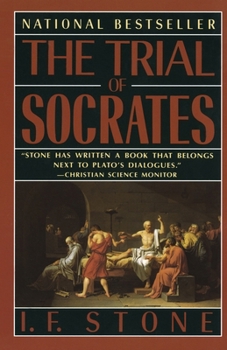
Isidor Feinstein Stone was widely known and read as a liberal/socialist leaning journalist and newsletter writer from the 1930’s to the ‘80’s. His introduction to the paperback edition of this book suggests it was the product of a late in life desire to move away from investigating current injustices and stake a claim to something timeless.
In that, Stone acquits himself admirably, analyzing the works of Plato, Aristotle, Euripides, Xenophon and others like a professor of the Classics, along the way citing a wealth of references both primary and secondary, some of which seem quite obscure. His commentary on specific words of Ancient Greek – their origins and multiple usages and especially the implications of how they’ve been translated (or mistranslated) over the ages – suggests an ability to read the original Greek language sources, which is impressive in one whose Wikipedia entry records only that he dropped out of the University of Pennsylvania
Greatest take away for this unschooled reader is to reframe Socrates from a revered name in the pantheon of Athens’ great philosophers into a rather disreputable rascal; a gadfly and rabble-rouser accused of corrupting the state’s youth by arguing the efficacy of oligarchic tyranny at a moment when such evils had very recently taken advantage of democracy’s natural disorder to seize power for themselves – twice! – and stood eager to do so again at any time. Also, as Stone puts it, a man who habitually and resolutely argued the negative side of every issue without ever offering a single positive value to which he would actually commit. This, in Stone’s view, is the real reason Socrates seemed to actively seek and welcome his death sentence (at an age when he could otherwise look forward only to sickness and decline) and turned his own death into a performance calculated to seal his place in posterity. As likely as it was that a defense on the grounds of free speech might have saved his life (the last chapters of the book analyze this in extravagant detail), Socrates would not demean himself by pleading a principle against which he had previously argued with all his eloquence. Even more, he seemed purposely to alienate his judges so as to be sure they would not honor their own and their City’s principles by freeing him on those same grounds.
Which last leads into the second lesson of this author’s analysis. An ardent supporter himself of the right to speak freely, Stone reminds the reader that such a right has very rarely been the policy of any government or governing system. Even among the Golden Age Greeks it was a niche freedom, always tempered by its applicability only to those accredited for a specific body or forum, or only those of wealth and privilege, only those meeting citizenship requirements, only those owning property, only those not owned as slaves or reviled as foreigners or uncivilized – the list goes on. That freedom of speech was not a universal value even among those greats in that great time and place is a very valuable reminder for those of us living in this one (U.S. A, 2025)
Certainly worthwhile to read and know, Stone’s analytics in The Trial of Socrates feel repetitive and over-argued; one imagines the same points could have been made in an essay rather than a book. But then, an essay about such a scholarly subject would never have achieved the visibility and stickiness this stand-alone book has (much less been deemed a ‘NATIONAL BESTSELLER’ as the paperback jacket proudly proclaims). Pulling Socrates off his pedestal at the same time it raises the U. S. First Amendment’s guarantee of Free Speech up onto one of its own is pretty good work for a small volume (247 pages plus Notes) by the college-dropout son of an immigrant shop owner? Achievements well worthy of a space on the shelf.
 RobinAndrew