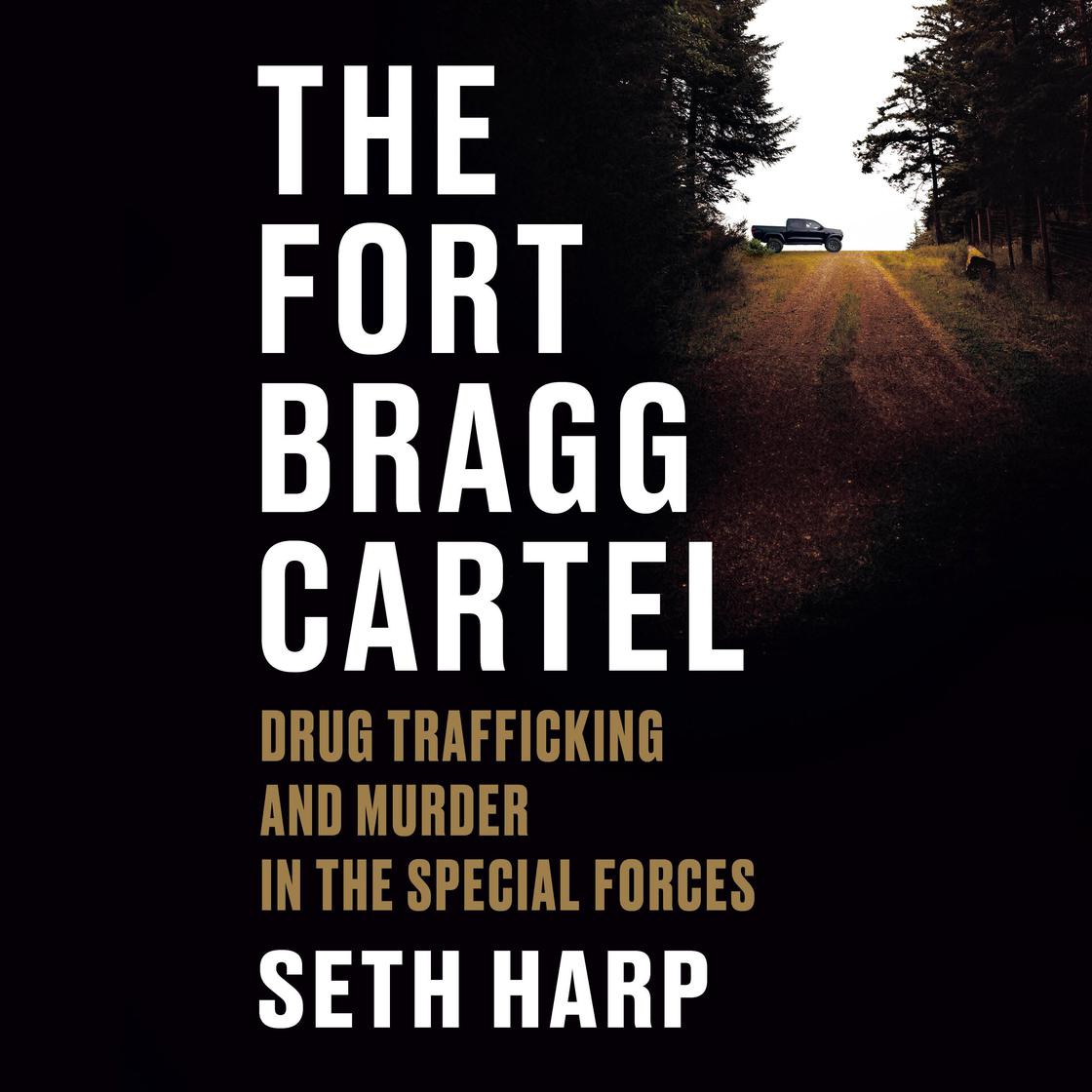
Having recently read The Mission, Tim Weiner’s history of the 21st Century CIA, which naturally contains many references to our nation’s Special Forces, it felt appropriate to check out this more populist look at one aspect of those forces.
Based on his own reporting for Rolling Stone magazine and other outlets, Harp gives us an abundance of anecdote; the parade of murders, suicides and drug- and alcohol-fueled behaviors on or adjacent to the Fort is head-spinning. He provides a substantial ‘Notes’ section as well, though, oddly, these notes are not called out in the text; one has to read them at the back of the book and then, if interested in a particular one, go to the page indicated and search for a key phrase to find the relevant text. Then too, many of these notes are not attributions. Better than no back-up at all, but less than totally convincing and perilously like the growth pattern of social-media conspiracy theories; a self-referential circle of fingers all pointing to one another with no object at its center. Regardless there is plenty of evidence here that things are not copasetic.
As its title suggests, the book contends that there has existed for many years some sort of organized smuggling operation centered on the Fort Bragg premises and that this operation is at least tolerated – if not actually headed – by unknown persons higher up in the chain of command than the various Special Forces operatives, support personnel and hangers-on who are directly involved in the book’s incidents. The argument in favor of this contention is largely of the ‘it seems too likely to not be true’ variety. At several dramatic points we hear about a thumb drive left behind by one of the murdered smugglers who claimed it documented crimes and criminals significant enough to act as his insurance policy – or to get him killed. Supposedly still held in evidence by one of several law enforcement agencies which have themselves been repeatedly painted as shielding military miscreants out of ‘blue line’ solidarity with the ‘green line,’ the closest we get to a big reveal of the drive’s contents is when one source tells Harp it actually contains no data, though whether that is because the crucial data was erased by some double- or triple-agent in the ranks or because it never existed at all is left unresolved. In other words, a big nothing-burger.
Regardless whether or not the actual Cartel exists, it seems undeniable that armed forces by their profession accustom some of their members to use of force and violence. That they groom some personnel, especially strength-proud young males, to believe themselves unbound by the moral and legal codes that constrain civilian life, and that these tendencies are strongest at the ‘tip of the spear,’ units like Rangers, Green Berets, Seals and Delta Force who are increasingly deployed to do the dirtiest ‘wet work’ of our national defense. Over the decades those ranks have shifted from short term citizen-soldiers to longer-serving career professionals at the same time their assignments have moved farther from ‘regular’ infantry tactics to special operations – small scale infiltrations, espionage, resistance support, sabotage, assassinations and other covert acts sometimes difficult to distinguish from the tactics of the terrorists they now spend much of their time hunting – or from those of hard core criminality. When soldiers are intensively selected and schooled for the attitudes required by that work, and that training is reinforced by months/years of ultra-high stress and pressure while surrounded by a culture that reveres and rewards self-reliance, cold-calculation and tolerance for brutality (while loosely dispensing powerful and addictive drugs to deal with the fallout), it should not surprise that some of those reflexes continue to direct behavior after their deployments are over or even after their careers have ended.
On the evidence in this book, military leadership cannot be trusted to thwart drug activity and the violence that accompanies it. Nor can they be relied upon to care for those service persons affected by it, much less to protect service families and the rest of us from the dangers which a few operators – even some who served honorably and heroically – present. As in so much lately, it is law enforcement agencies and the courts we must rely upon but unfortunately, if Harp’s reporting is accurate, the fraternal bond between military and the law sometimes precludes that, so we are left with a continuing tragedy of broken and deceased servicepersons, wives, families and communities.
As if that were not enough, The Fort Bragg Cartel’s greatest revelation, to these eyes, is not about drug activities in the U. S. but in Afghanistan. According to Harp’s reporting, prior to the U. S. invasion there the Taliban had, out of religious convictions, reduced poppy cultivation to near zero with corresponding impact on the flood of heroin and other drugs to users in ‘more developed’ nations. By itself, a clearly desirable outcome. Once the U. S. and its War on Terror allies took control though, cultivation began again due both to inattention (by U. S. leadership) and financial incentive (of those allied forces and perhaps also some of ‘our’ people). Once the U. S. pulled out and the Taliban resumed control, the production of poppies and heroin was again shut down! In Latin America as well, Harp reports, U. S. political objectives have sometimes led to cooperation and even support of narco-traffickers in exchange for their cooperation with U. S. political goals. Not a pretty picture, and one further negative consequence of how the War on Terror has been prosecuted and profited off of.
Despite trending more toward the true crime genre than the academic history line, The Fort Bragg Cartel is a useful summary of events worth considering. It raises worthwhile questions about our government’s role in the drug trade, and that makes it, at the end of the day, a Book Worth Keeping.
P. S.: E Unum Pluribus is a new speculative fiction about another time, another place and another government serving its own interests rather than those of its people. A draft of the novel is currently being serialized here at robinandrew.net and you can be among the first to read it, beginning with the post titled ‘E Unum Pluribus’ or by clicking on that same title in the home page’s Top Menu.
If you like what you read here or at robinandrew.net, please share any posts as widely as possible – and consider subscribing: it’s totally free!

 RobinAndrew