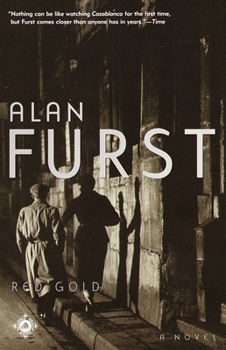
Through half a dozen novels I’ve read since 2014, Furst has never disappointed. In a deceptively quiet voice he portrays the complexity of life in situations too often cartooned as ‘dramatic’, ‘heroic,’ or ‘epic.’ Heroes are not sprung from the loins of goddesses, he shows us, but grown from the soil of ordinariness, seeded by terrible circumstances, watered by relationships with other decent human beings and nourished by the force of life itself as they seek the paths which will allow them to go on for another day, a week or if they are very lucky, even longer.
For Red Gold, we travel in the company of one Jean Casson, a Parisian film producer trying to survive under the Nazi occupation. Having once been picked up by German intelligence and escaped their clutches, he must now hide in plain sight, growing a mustache and dressing poorly as he adopts a false in hopes of not being recognized contacts from his old life. Learning to watch in every direction at every moment Casson, who is himself no socialist, drifts into contact with Communist resistance fighters, directed and bankrolled by the Soviet Union. They in turn find his character and connections useful, loosely employing him as liaison to other factions – free French disruptors, conflicted Vichy collaborators and anti-Communist nationalists partially directed and intermittently supported by the Allies’ military for their own ends. All of these, and also the Nazis, of course, are quite willing to sacrifice any individual at any time, if it serves their particular ‘greater purpose.’
As always, Furst paints a convincing and absorbing picture of life under occupation: the drabness, the cold, shortages and unexpected moments of plenty. Casson’s inner voice is witty enough to entertain and resourceful enough to keep him and the reader out of the worst trouble, at the same time he manages to find enough minimalist romance to leaven the despair. These characters have no foreknowledge of how the war will turn out; at any moment this depressing moment in history may take their life and so define it – a tragedy deeper and more painful than the destructive result of any brilliant explosion or dramatic car chase.
Life goes on, even under the heavy hand of war, and as much as some persons may fight for glory or principle, what most really want is simply to keep on living, with perhaps a bit of food, a sip of drink, a smoke or a hint of love to make it worth the effort.
Definitely an author to return to, and with around fifteen novels focused on the war years in Europe (published between 1988 and 2019 and collectively referred to as ‘The Night Soldiers series’) there’s plenty of opportunity to keep Alan Furst on the shelf.
(Note: Furst’s The World at Night (1996) shares a common plot and protagonist with Red Gold, so other readers may benefit from reading that volume first. His three earliest novels, published in ’76, ’80 and ’81, concern drugs and crime in the U. S. I’ve not sampled them but hope one day to do so).
My own latest novel is currently being serialized on this site. You can read the first installment in the recent post titled E Unum Pluribus.
If you like what you read here at robinandrew.net, please share any posts as widely as possible, and consider subscribing – it’s totally free!
 RobinAndrew