Tag Archives: travel

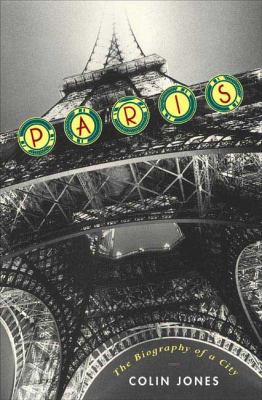
Paris – The Biography of a City, Colin Jones

Virtually a reference work, this self-confessed “Impossible history” of one of the world’s great cities comes buttressed by many pages of notes, a graduate level bibliographical guide, index, population table, modest number of illustrations, sequential maps showing the evolution of fortifications and boundaries, and even a list of the (major) buildings discussed.

For all that, the text itself is mostly quite readable, and manages to remain even-handed when discussing the political oscillations of the city’s fortunes.   Jones’s personal viewpoint is most glimpseable in the depth with which he discusses the impacts of the real estate marketplace and urban planning (a discipline for which nineteenth century Paris was something of an origin point and test case).  These, we hear, heavily influenced not only the visible face but also the economy, sociology and politics of the city, its surrounding suburbs (the banlieue), region and nation. The rise and growth of antiquarian/protectionist architectural sentiment is given an appropriate level of attention, since it is largely that movement and its successes which have bequeathed us today’s tourist and cultural mecca.

As for the aforementioned political oscillations, to one whose prejudices were shaped by the American education system within an Anglophile culture, Paris is eye-opening in relating the wave after wave of governments established, contested and washed away in favor of the next new or recycled concept.  From far back in the era of multiple kingdoms, principalities and ecclesiastical domains to contesting Empires of the middle ages to the early-modern era of Communes, communists, Republicans, Vichy capitulation and Republics (five, to date), it is amazing that anyone has been able to establish any stable business, institution or assets at all. A thought worth considering as the USA is going through its own populist spasm which may – at best – be followed by a future swing in some opposing direction.

One thing which does seem to have remained relatively consistent through Paris’ administrative history: even when the city and nation were not overtly socialist, their governments have always exercised far greater powers of eminent domain than we in the USA are accustomed to.  Some small justification, perhaps, for the disdain which some Americans profess toward anything ‘those Frenchies’ (or any Europeans for that matter), may have to say about social policy or virtues.   Reading about the centuries-long role Paris has played in nurturing the very idea of self-government by the polity though, makes that disdain seem more short-sighted than ever. 

Another significant takeaway: the wealth of literature generated in Paris’ Arrondissements over the centuries would require a lifetime of reading to consume and appreciate. Preferably in the original, since even my feeble attempt to learn French quickly convinced that its full nuance is unlikely to survive translation. One reason, perhaps that, Jones begins his introduction with a literary quote and analysis. In retrospect, this turns out to be a wholly appropriate entry point for what is as much a human story as a geographical one.  At every stage of its history, the promise of Paris has called to millions, to such a degree that its population has always been largely non-native, immigrants increasing its numbers even as low birth-rate, high mortality and the exodus of those unwilling or unable to meet its demands were constantly working to diminish them.

Fascinating even in its occasional excesses (just like its subject), Paris – The Biography of a City easily earns its space on the shelf.

(Note: published in 2004, this volume necessarily does not cover the City’s most recent decades.)

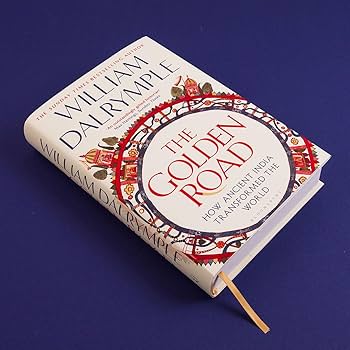
The Golden Road – How Ancient India Transformed the World, William Dalrymple

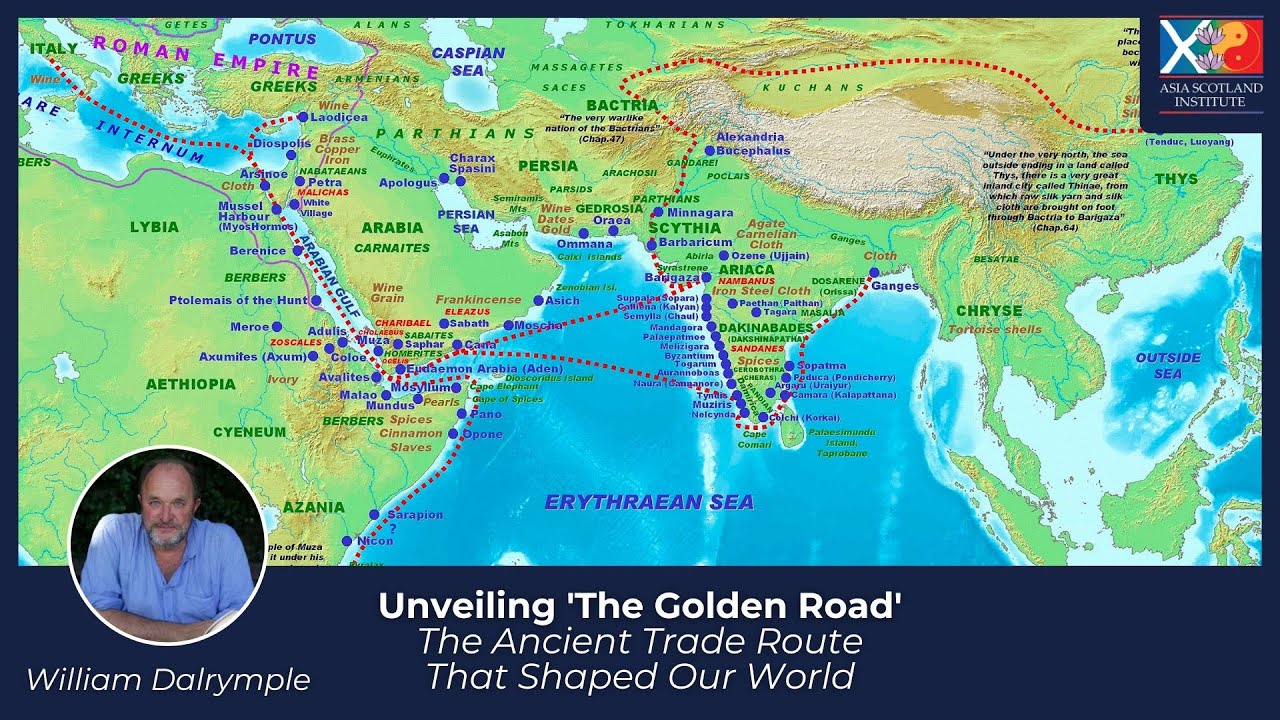
It’s long been a curiosity to me that The Buddha lived and preached in the lands which we know as India, but the populace of that region today are mostly Hindu followers (with significant minorities of Muslims, Sikhs, and other less-publicized faiths).  Conversely, Buddhism is mostly associated in the modern mind with lands beyond India: Tibet, China, Japan, Thailand, the other southeast Asian nations… And then, of course, there is Indonesia, a massively populated sleeper nation (in the ‘Western’ view) which I have read holds more Muslims than the entire Middle East! And BTW, how come Marco Polo’s fabled Silk Road doesn’t show up on any maps except those created to illustrate editions of his dubiously sourced travel memoir?

William Dalrymple, a Scottish-born historian living in Delhi, is eager to explain it all to us, beginning with a valuable Introduction that quickly spells out several themes.  First, it demolishes the myth of ancient overland trade routes.  In this telling, sea-borne trade was far more effective at moving goods – one ship able to carry many times the load of a donkey or camel and at the same time less vulnerable to the myriad possibly-hostile territories through which a long land route must pass between origin and destination.  Add to that the reliable seasonal reversing of monsoon winds in the seas around India and you have a situation ripe for cross-culture pollination. Something I’d begun to consider recently through reading and viewing about Rome, its connections with Egypt, and recent archaeological work at Red sea ports which has yielded much evidence of sustained trade with India’s Western coast (via the Gulf of Aden and Arabian Sea).

As impressive as this dispersion is, it is hardly the end of the Golden Road’s story.  Even as Buddhist missionaries (itself a new concept this small mind) were carrying their faith to the east where various rulers of ‘Chinese’ states endorsed it to various degrees, Mongols sweeping down from the north and Macedonians from the west were bringing other traditions to India, fracturing its Buddhist establishment and driving many back to the emotional refuge of the Vedic/Hindu tradition with its abundance of attractive gods and goddesses and the reassurance of the Brahmin caste system. (I know I am garbling these distinctions, it takes a scholar like Dalrymple to keep them straight, if even he can, so please forgive me.) Mix in the eventual arrival of Western Europeans and Christianity and one begins to see what a melting pot (to appropriate one of our local phrases) the Indian Peninsula has become.

Through it all, Dalrymple’s central objective is to remind us that wherever armies go, religion goes with them, and wherever religions go, other knowledge goes too.  In astronomy, mathematics, medicine and other realms, residents of India were making momentous discoveries long before Europe or even China.  Citing various early writings (most of them previously unknown, to me) he traces the origins of this scholarship and its dispersal through the various centers of study and libraries of texts it generated.  Only when Islamic scholars brought those ideas and texts to the Middle East (Baghdad, etc.) and from there to the Iberian Peninsula (the Moors, as we tend to call them, thanks to Mr. Shakespeare), was it translated into Greek, Latin, Italian, German, etc. and thus available to fertilize the so-called Enlightenment which we like to think of as the foundation of our contemporary culture.

Dalrymple is an awesomely erudite guide to all this, his analysis of artwork in this or that cave in this or that obscure (to me) region of India is amazing, if sometimes overfilling.  For those interested in the premise but not able to work through a 500 page tome, just reading the Introduction will give the basic premise.  For those with time though, the depth and detail makes the case more convincing and imparts a vision of the rhythmic dance – the ebbing and flowing on a scale of centuries – which was required for this dance of cultures to bring us the world we know today.

At a time when the (supposedly) Enlightenment-based world order we have known and respected for generations seems in danger of self-destructing, it is appropriate to be reminded that we would never have gotten this far if not for the blossoming and dying of countless other orders.  And also, it must be admitted, the clashes, conquests and destruction of kingdoms, nations and empires on multiple continents, over multiple millennia.  No human creation lasts forever, but the best fruits of each can contribute to what comes next – though we may need to suffer a lot of wasted time, resources and lives before we get there.

Thank you, Mr. Dalrymple.