Tag Archives: Science Fiction

Parable of the Sower – Octavia E. Butler’s 1993 Vison for Today’s Tommorrow

Following up recent rereading’s of Orwell’s 1984 and Bradbury’s Fahrenheit 451 I saw this speculative novel recommended for its prescience and found that characterization to be spot on. Writing back in 1993, Butler describes a Southern California that could believably result from just a few more years pursuit of our nation’s current course.  Widespread poverty thanks to an politicians who own power over actual governance, violence and destruction by a populace fragmented and distrustful of one another, worldwide ecological disasters, misuse of new technology for profit and oppression, legal and police powers used not to protect the rights of all but to entrench the power of the few and, overlaying all that, a portion of the populace turning to reactionary religious movements in hope of refuge.  A decidedly dystopian take on our situation, but very convincing and valuable as an eye-opener.  That it is set in our exact time (July 2024 – October 2027) despite having been written over thirty years before is almost spooky to one first reading it today.

Butler (born 1947, died 2006) was a pioneer: at a time when it was striking to find either a Black person or a female making a name writing science fiction she was both, going on to win Hugo, Locus and Nebula awards as well as a MacArthur Fellowship grant.  This first of her works that I have read (there will be more) is partly shaped by her ethnicity, featuring a mixed race band of refugees and touching repeatedly on how race has shaped them, has affected their fortunes and is still affecting them despite the near total collapse of nearly every other social structure. 

Not content to cover that weighty ground, Butler also puts forth a religious theme, with protagonist Lauren Oya Olamina (which surname we learn is from the Yoruba region of Nigeria) the daughter of an Evangelical preacher. Lauren is in the process of devising a faith of her own, which she calls Earthseed in reflection of its vision of destiny – the expansion of Earth’s humanity to live among the stars and spread their ‘ seed’ throughout the universe.  Lauren’s coming to grips with that calling and beginning the process of dissemination is the true theme of the novel, all the others serve to set the conditions and inform the necessity of her doing so.

Butler’s writing is immediate and colorful yet quick and concise, her plotting is complex without falling into the sort of techno traps that affect much Sci-fi.  Resultingly, the Parable of the Sower is a work of literature which uses its genre as vehicle, not a commercial work safely exploiting a comfortable niche. A sequel, Parable of the Talents (1998) presents a further step in Laruen’s and Earthseed’s journey, culminating in departure of their first space craft on a colonizing mission.  That having been Butler’s final published novel, it is sad to consider how she might have continued the tale, had she not struggled with depression and writer’s block before passing away in 2006, at the too-young age of 58.  

Very glad to have encountered both book and author, and highly recommend them to any readers interested in where our politics are leading the USA, exploring the canon of science fiction, alternatives to mainstream religion or just curious about where human society may be headed – in both the near and the far terms.
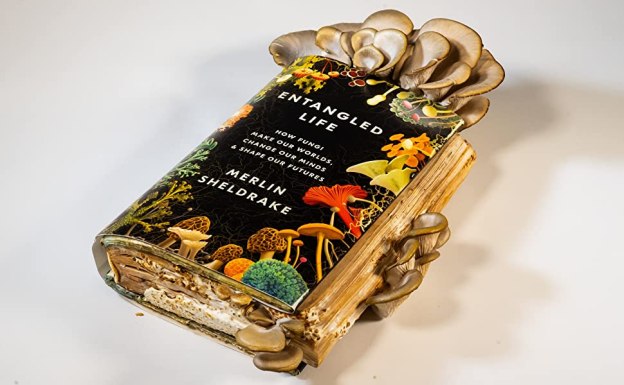
Entangled Life, Merlin Sheldrake

Ostensibly a natural history of the kingdom of Fungi, this volume achieves its highest interest and greatest value when biological knowledge is extended outward like mycorrhizal hyphae to enrich other fields of thought.  It was, for example, during the study of lichens, those unbelievably prolific and durable partnerships between fungi and algae, that the word ‘synergy was coined, leading both author and reader to ruminate upon the ubiquity of synergies in human activities and the value of opportunism in finding new ones.

Fungal networks are exposed as ancient precursors to the Internet (Sheldrake devotes an entire chapter to what he has dubbed the ‘Wood Wide Webs’, and their contributions to the natural environment and its unnatural derivative – agriculture).  Darwin’s theories are subjected to reinterpretation as cooperative relationships in nature are seen to outnumber competitive ones by geometric factors. (Though Sheldrake does not specifically go there, this particular insight bodes ill for American society’s preoccupation with win/lose ball-sports as training ground and philosophical oracle – how much better off might our politics and civics be if we had chosen a cooperative paradigm, geographic explorations, perhaps, than the winner-take-all destroy-your-opponent-at all-cost strategy of pro football?)

And how many of us, among the general populace, knew that plants themselves do not actually capture water or nourishment from soil, but rather must rely on fungi both on and inside their roots in order to exist at all?  That those fungi cannot survive without feeding off products of the plants’ photosynthesis seems less striking, though Sheldrake reminds us it is so only because of our plant centric (and animal centric, mammal centric, primate centric, human-centric) way of viewing the universe. Another worthy insight.

Beyond even those, there is the chaos concept of intelligence – how organisms without brains can yet engage in problem solving and deduction  Whether finding their way through a maze or creating a web to find food and then pruning back the unproductive branches to concentrate energy and resources where they will have  most effect, fungal networks suggest ways in which many human phenomena actually operate, and in which others might be made more effective.    A fungal contribution likely even more valuable to future generations than say, penicillin (molds being a subset of fungi). 

At times reading too much like a graduate compendium of current research (the chapter on ‘Mycelial Minds,’ focusing at great length on the effects and mechanisms of psilocybin – Magic Mushrooms – and with them LSD, went on far too long, for my taste), Sheldrake at other times comes across as geekily lovable, as when relating early childhood experiences that led him to this field of  study.    Cleary capable and erudite, he is a worthy PR rep for this too-oft overlooked and underpublicized part of our natural world. (which we learn is the ‘life kingdom of fungi’, independent of the kingdoms of ‘plants’ and of ‘animals,’ all of which are within the Domain of Eukaryota – who would have guessed?),   

Truffles may be the most highly-prized variety, but this volume makes clear there’s plenty more in the fungal kingdom worth biting one’s teeth into than just those stinky delicacies.

The Three Body Problem

Geek fiction of the sci/poli sort. Set within the landscape of China’s autocratic-socialist movements and brigades, this first of a three volume series considers the possibility of ‘First Contact’ with alien life as a matter of existential fear and conviction. Fear, on the one hand, that an advanced civilization will take over and obliterate us,  and conviction, on the other, that we ourselves have devolved so much we’ve become a malignancy on the earth and the universe – or, to quote a current political figure about an invasion of a different sort – “what have you got to lose?”

Liu is a citizen and resident of the PRC, not an ethnic Chinese educated or residing in the west, which may explain why the events and rhythm of the book feel so plodding and academic; one suspects they reflect expectations and tastes shaped by decades of bureaucratic media and arts.   His detailed and historicist attention to the physics behind the story is informative, but similarly derails a central tenet of what one normally expects in a popular novel – drama. Add to that characters whose individuality is expressed only in the very narrow and internalized manner allowed by their society’s emphasis on conformity, obedience and reticence, and you end up with something rather challenging to get through, despite what seems a fluid translation from the original Mandarin.

Still, Liu is intelligent, knowledgeable and original, so one is very curious to see where it all will go (as well as whether the pace will pick up in future volumes). Maybe worth the time…