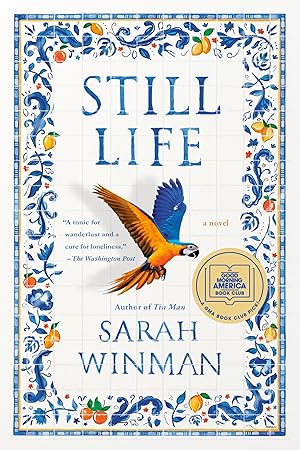
The romantic novel as still life painting – an unlikely assortment of exquisitely-rendered events (the objects) carefully arranged for maximum effect (starting with Evelyn and Dorothy in 1944, then moving forward in jumps and fits, then returning to Evelyn in 1901), the entire assemblage framed by the city of Florence in all its history and culture and gastronomic variety.
When I search the text for ‘still life’ I find reference to all the still life paintings Evelyn inherited; thought by some to be no more than decorations, to her they are the grail, which seems perhaps a comment on the genre as a female space. Another instance, also, in which she, having become an art professor, theorizes on the genre’s power as coming from, not in spite of, the seeming triviality of individual objects or domestic situations which actually contain specific phrases of the overall painting’s meaning and purpose. How it freezes time, raises up the contributions of those who provide for others (as opposed to the ‘movers and shakers’). And a final instance of the two words together in the passage “…Empty bowls. Rotting fruit. Passing time. But still life in all its beauty and complexity…” thus making clear the author’s multiple intents: still life as a genre of painting, life as a collection of individuals interacting and connecting as do the objects in a still life painting, an account rendered in the manner of a still life painting and, ultimately, that ‘life’ is still ‘life,’ whether one is old, or disappointed, grieving or alone or has serendipitously found what they’ve been looking for all along.
(Worth noting the large number gay characters; more than would be expected solely because of the novel’s interest in art, literature and other creative pursuits. Clearly the result of many decisions by the author, who herself came out in the 1980s, and a welcome reminder that human variety is not a product of the late twentieth century. Noted also that not quite all the hetero relationships in the book are constrictive, doomed and/or abusive, but the tally certainly trends in that direction.)
_______
Eight months after reading this novel and recording the notes above, I came across the title again and was not certain whether or not I had read it. Reading my notes at this remove, I’m struck by how interesting and satisfactory they make the book sound and yet I did not recall it (sincere apologies, M. Winman). Entire reason I started writing notes like these was the hope of no longer doing that…
Is it time, perhaps, to slow down and not consume so many books but rather to savor the few? But what other way to find those few, given that recommendations and reviews are so unreliable? And isn’t that dilemma just what life itself is all about? One has to experience its entirety – the exciting and the tedious, the success and failure, the love and the rejection, the yin and the yang and the black and the white and the good, the bad and the ugly – in order to learn what is truly astonishing and beautiful and we wish we had done a better job of savoring and holding onto – what will be so difficult to say goodbye to when one finally shuffles off.
Maybe it’s simply time for me to re-read some of those books which a first read confirmed to be worthwhile.
Like Sarah Winman’s Still Life.
 RobinAndrew