Category Archives: Books Worth Keeping

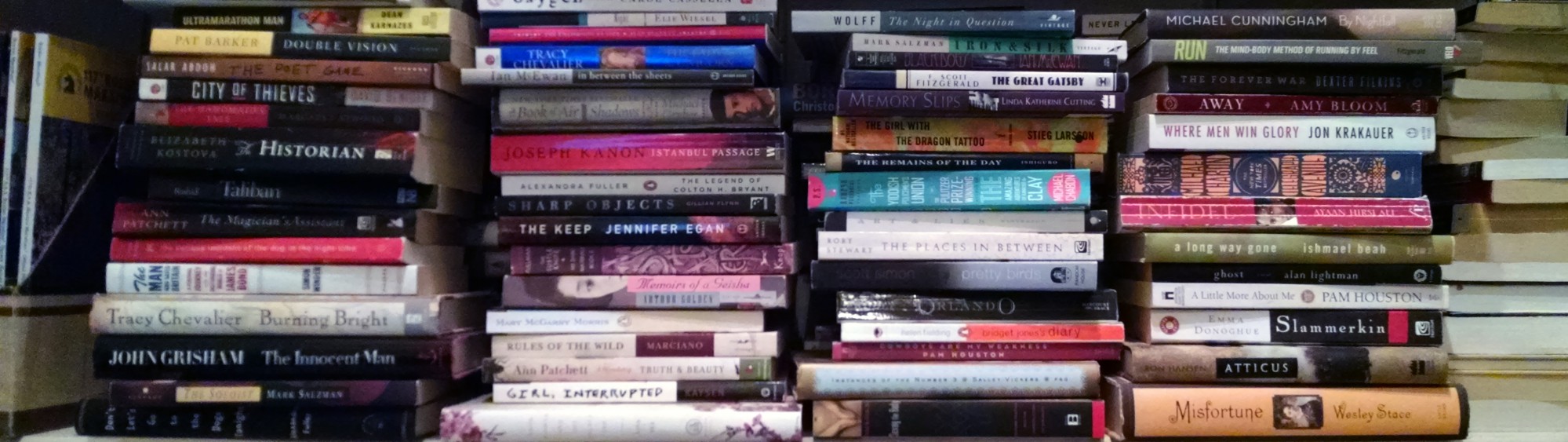
Plenty of books are worth reading once.
These selections are good enough that they deserve shelf space; to be remembered and referred to, and to cherish the prospect of one day experiencing them again.

Shakespeare’s Pub – A Barstool History of London as Seen Through the Windows of Its Oldest Pub – The George Inn

This amusing blend of history and anecdote traces not just the George, but all the coaching inns of Southwick, down through the centuries. Brown, who has made a career of writing about British beers and the people who brew, serve and consume them, has an obvious love of his subject and that translates into an enjoyable read, even with an iconoclastic glass of wine in one’s hand.

Has a decent eye also, for how individual history reflects that of the surrounding economy and culture. One of his revelations concerns the effects which the invention and rapid spread of railroad trains had on a wide range of industries, from the freight wagon trade, to passenger-carrying stagecoaches, stables and liveries, lodges/hotels, the hop trade, ports and the very patterns of settlement geography. Not gradual change either, but rapid and accelerating, able to wipe out an industry in one lifetime. That some of the trades displaced had done similar violence to other, earlier ones, suggests poetic justice when the trains themselves are later displaced by automobile and truck traffic (on roadways which necessarily evolved almost beyond recognition from the muddy and undisciplined things they had once been – ‘imagine, needing to make actual rules for which side of the road to drive on! Imagine!’).  Which reflects nicely on our current fearless leader’s proposal to preserve the coal trade. Really?

Touching on literature, cuisine, habit and morality, Brown suggests that the history of the George is only tenuously concerned with its physical manifestation, examining the existential question, if you replace only one small piece at a time, but eventually have replaced every piece of any object, is it still the original object? A question he answers in the affirmative – as he must, for the book’s topic to have merit…

My favorite bit though, is when a George-lover asserts that the ghost of Same Weller (of Dickens’ Pickwick Papers), has been seen around the place, allowing Brown a wonderful riff on the mental contortions required first to believe in ghosts, then in the ghost of a fictional character who never lived in the first place, and then that said ghost would haunt not the pub which the author named as his character’s locale but the one which some readers like to think the author may have had in mind when he created his fictional location, despite giving it the not-at-all fictional name of another actual pub down the street!

I like the way this author’s mind works, and will be seeking out his other beery books. Not to mention seeking out The George one again, as soon as we return to London-town.

The Legend of Coulter H. Bryant, Alexandra Fuller

A legend in structure and voice, this bittersweet volume recounting the unfairly-short life of one Wyoming cowboy/oil-hand has the added virtue of being true.

Bittersweet it is, in how tightly Bryant’s great assets – humor, modesty, caring, headstrong eagerness – are tied to his less-practical qualities – impatience and impulsiveness, difficulty with book learning, and a general unwillingness to make careful preparation for anything, including his own continued existence.

Bittersweet too, in  how the admirable desire to make a living in the midst of rugged nature can evolve into reckless exploitation and endangerment.  How the joys and virtues of Wyoming (or any other near-frontier region)and its lifestyle are intertwined with its hardships and its dangers.  Which seems, after all, the real root theme of Fuller’s slightly-dramatized biography, and no doubt the reason this Africa-born-and-raised author has chosen to make such a state her home.

Fluid and entertaining, The Legend of Coulter H. Bryant is also deeply moving; and very nearly poetic at times.

An masterful piece of work on an eye-opening topic, to an admirable journalistic end.

Scribbling the Cat, Alexandra Fuller

This author continues to impress both for the  boldness of the people about whom she writes, and for the conscience with which she records and expresses lives lived on the edge of what most mainstream readers and writers would consider to be the modern world.  From her own raggedly individualistic and idiosyncratic family to the Wyoming roughnecks of The Legend of Coulter H. Bryant, to this tale of an African ex-soldier on the cusp of regret and despair, she reminds that civilization is neither uniformly progressed nor equitably shared.  Along the way we are amused, thrilled, at times appalled and always captivated by the variety and beauty of lives lived less carefully than our grade-school teachers taught us we should do.

As in her two family memoirs, Africa is a central character here, her raw beauty, blood-smeared history and sometimes-fatally-high demands treated with love and respect.  One is left with a great desire to see  the place for oneself – note ‘see’ rather than ‘experience;’  Fuller is all too successful at exposing the faults and folly of those who hope to observe this land casually or in safety, and the risks one must accept in order to even begin to get to know this continent or its people.

There is, in this travelogue of a road trip (an expanded meaning for that expression, to be sure!) with the soldier identified as ‘K’ more than a little revelation of the author as well. Clearly Fuller was struggling to understand and accept her then-current existence as a married mother in safe, comfortable Wyoming.  As with Hemingway and so many others, the total immersion and sensory overload of life in the midst of conflict or on the edge of subsistence appears to beckon and fulfill in ways the workaday cannot.   It is no surprise then, to find in a Wikipedia search that another of Fuller’s volumes, Leaving Before the Rains Come, chronicles the disintegration of her marriage some time after the journey described in ‘Scribbling…’ (That title, by the way, is one of the multitude of euphemisms K and his fellow combatants use for the act of killing.)

A book to keep on the shelf, and an author to pursue.  Expect I’ll soon be reading the remaining 2 of her six volumes to date.

Life After Life – Kate Atkinson

A great fan of Kate Atkinson’s fiction, I put off trying this volume because its blurb sounded rather a domestic-family-history sort of thing, not my favorite subject matter.  The first few chapters did little to dispel that, but the super-hooky opening scene had already fulfilled its function and I kept on, to find about 10% of the way in that the story suddenly became more intriguing when Ursula died and her life began again, the first of many such re-sets.

Between those jumps, the narrative superficially resembles a classic British novel of woman’s place and yearnings, but as subsequent incarnations multiply with varying consistency, both character and reader become conscious of something more; the insidious impact which even a small amount of future-sight might have on one’s actions, reactions and dreams.  By the end of this substantial tale (a long-ish read in the beginning and end, though the middle portions hold the attention very well and overall one is sad to leave its world), both are armed with enough information to anticipate and dread events in roughly equal measure.

Testament to the effectiveness with which Atkinson parcels out information to the reader and her character, is that we discover and wonder at her situation in much the same way she does.  This manipulative skill was already apparent in her earlier Case Histories, but is here even more integral to the ideas being explored and the craft being applied.

Another point of appreciation is the degree to which Ursula’s life and tale are not ruled by romance.  Yes there are scenes of her first encounters with boys (informed by her lack of intimate education, these feel both historically accurate and quite amusing) and later affairs, but this is no Bronte or Austin creation, desperately seeking the right man to validate and support her. What really guides Ursula is the desire to craft a unique place and impact in the world that reflects her personality and abilities – a compass too often granted to male protagonists and not their female counterparts.

As always, it is conclusion that makes a story truly successful or not. Here the most dramatic act is unsettled – we are not allowed to see how it plays out – except that once we think a bit, we do know, both by our own experience outside the novel and by the coda-like scenes which follow it.  As much as we enjoy the return of one of her favorite relatives, he would not have been missing in the first place if her plan had succeeded as intended, so…

All in all, a thoroughly enjoyable and deeply satisfying work, reflecting and engendering serious thought about family, literature, destiny, philosophy and the very nature of existence.   Oh, and much less ponderous than that last makes it sound…

Worthy of a re-read, though unlike Ursula I do not find my time multiplying endlessly. And besides, there is a subsequent volume, A God in Ruins, picking up on another character from Ursula’s lives.

So much to look forward to!


Founding Brothers – The Revolutionary Generation, Joseph J. Ellis

A thoroughly engaging recap of several first-string players’ roles in our nation’s early innings.  Structured around six key incidents (The Duel, The Dinner, The Silence, The Farewell, The Collaborators and the Friendship) this relatively slim volume provides a compelling picture of the interpersonal conflicts among what we today recall so monolithically as our Founding Fathers.  Profoundly divided and conflicted, as Ellis dramatically illustrates by starting out with The Duel between Hamilton and Burr and elucidating it’s root causes, it is their very differences that gave us a system which has managed to accommodate our nation’s more profound conflicts for longer than any other republic ever has.

This is neither puff piece nor hatchet job; Ellis admits flaws in even his favorites (Washington foremost, with Adams as runner-up) and virtues in those he has pegged down (Jefferson, Franklin).  Only Aaron Burr is completely dissed, as selfishly opportunistic and without values (a modern parallel comes to mind…).  The penultimate impression is as the author clearly intends: gratitude that these men (and one woman, Abigail Adams, presented as wise, tolerant and far more worldly than members of her sex were given credit for in that time) happened along at such a moment.

Clearly they alone did not create the historic circumstances for independence, many others contributed to both causes and effects, but these eight (Hamilton, Burr, Jefferson, the two Adams’s, Madison, Franklin and Washington) played crucial roles.  Over 200 years later, still we live in their shadow and their debt.

A book well-deserving of its Pulitzer.


The Girl With All the Gifts, M. R. Carey

Took a risk in a London thrift shop and boy, did it pay off – a better-than-most dystopian future thriller, and far better than the usual zombie fare.  To be fair, Carey does not use the Z word, he call his creations ‘hungries’, but they are undead cannibals, so what’s to quibble about?  The real difference is that this author cares about the world they infect, cares about the future of humanity and his characters, and uses his premise to explore those, rather than the other way around.

Melanie (the Pandora of the title) is tough and smart enough to carry a story, as is miss Justineau, her teacher, and much of the novel is a two-character play as they get to know one another and the new world in which they find themselves, after a plague of sorts has killed much of the local population, turned others into hungries and done who -knows-what to the incommunicado rest of the planet. Sargeant Parks and Private Gallagher are effective foils, the former more believable than the latter, but both fleshy enough to care about, especially when the Private’s flesh is sacrificed lamb to the story line.  That’s about it for characters, as the hungries and the few Junkers who survive out among them remain quite as anonymous as they are disposable.

From the author’s notes, it seems this tale grew of small beginnings, but as it ended up, the main points is a large one; a cautionary note about the hubris of assuming our world will stay manageably close to what we know and love, and that any species, once ascendant to the top of the food chain, will necessarily stay there.  An easy and exciting read, well worth the time and afterthought.

I love thrift stores!

Inside the Dream Palace, Sherill Tippins

Subtitled The Life and Times of New York’s Legendry Hotel Chelsea, this revelatory recap on a counter-culture icon should cement its position in urbanist history.  Rooted in socialist utopianism of the mid-nineteenth century, the Chelsea  Home Club (as it was initially known and intended) has twisted and morphed to survive through a century and a quarter of changes in its physical, political and spiritual context.  As Tippins makes clear, though the physical plant has some novel and benevolent characteristics (its roof-top garden being among the most interesting), that survival is primarily the result of individuals; the many idiosyncratic and committed artists involved, from architect Philip Hubert – a self-defining non-conformist from an ‘artistic’ family – and his initial cadre of well-healed demi-monde, all the way through the fin de siecle , Roaring Twenties, depression, McCarthyism, Beats and Summer of Love to the tawdry decline of the Punk era.  Only now, in the twenty-teens, does it appear to have been taken over by the Mammon of real estate interests, which hope to re-open it in 2018 as – one fears – a high-tier simulacrum of artsy prestige.  One hopeful note is that the present speculative owners have been required to continue to accommodate a couple of dozen long term residents, even as they modernize and apostatize it to their own ends.

This is urban life in all its richness, chaos and fertility.  No where else would one find Mark Twain, Boss Tweed, O.Henry, Thomas Wolfe, Edgar Lee Masters, Dylan Thomas, Jack Kerouac, Brendan Behan, Arthur Miller, Arthur C. Clarke, Christo, Warhol, Kubric, Dylan, Ginsberg, Lennon Joplin, Hendrix, Viscious, Rotten – indeed any such assemblage of single-named notoriety – cohabiting with the nineteenth-century-sounding artist Alphaeus Cole, whose photo in his studio at the ripe old age of 108 concludes the volume’s illustrations.

Entertaining, enlightening and inspiring, this is a gem.  Long live the Chelsea!

(For those with a continuing interest, the accumulation of Chelsea-iana continues at  http://www.chelseahotelblog.com/  )

The Yiddish Policeman’s Union, Michael Chabon

The Yiddish Policeman’s Union, Michael Chabon

A joyful romp through an alternative future, at once familiar, and yet definitely not.  Around the bones of a noir-detective story, Chabon has draped the ‘what if’ of an alternate resolution to the Jewish people’s search for a homeland following the horrendous events of the mid- twentieth-century.  What if, rather than re-bordering the middle-east, world powers had somehow coerced those settlers to accept in its stead a sparsely-populated region of – southeastern Alaska?  Though less bluntly brutal than the real story, this hypothetical exile to Alaska gives vent still to that culture’s desire for self-fulfillment, along with their literature’s flair for tragedy, and for perseverance in her face.

Recognizable as relatives of New York tropes, these characters are just like anyone else, only more so – more ordinary, more battered, more lost in their own histories – and all the more sympathetic, for it.  Swept up in events they can barely comprehend, much less control, they search for small satisfactions wherever they can find them, which is mostly in one another – though “god-help-me if I’ll ever admit it to you,” is the universal attitude of greatest affection.

I raced through this novel, never wanting to put it down, till I saw the ending coming all too soon.  An ending, by the way, which felt not quite equal to an otherwise immensely impressive display of imagination and craft, but that is minor carping.  My final words on the subject?  Get it; read it, enjoy it.

A Yellow Raft in Blue Water, Michael Dorris

A work which grows, as one progresses through it, from anecdote, to story, to fable.  Dorris effectively manipulates the reader by telling first the tale of the youngest of three women – Rayona – inviting us to form opinions (or judgments, given the poor nature of some of her choices) of her character and actions.  He then proceeds to tell first her mother’s – and then her mother’s – stories, overlapping, braiding and, in the process, shattering our neat conceptions about what is good or bad, and who is right or wrong, victim or abuser.

Dorris’ prose is generally straightforward, allowing objects, events and his characters’ thoughts to tell the story.  Only occasionally does it rise to more florid description, but it is the detail and personalities which make the story seem so real, the women totally convincing even when their actions are not ones with which many readers may sympathize.  That, and the author’s even-handed telling, which seems to reflect the moral conviction with which his bio suggests he lived his too-short life.

A work which has its own objectives, neither the quick entertainment of the popular novel, nor the showy intellectualism of the academic, but an honest desire to tell of people too easily forgotten, and thru them reveal a bit of basic human truth.

West With the Night, Beryl Markham

It is delightful to read of a woman having such adventures in the early 20 th century without apparent trace of gender resistance or romantic overlay.  Perhaps it is the wildness of Africa that allows this, or perhaps self-editing, but either way, Beryl Markham’s memoir  furnishes a shining example of the non-universality of our commonly held stereotypes.

As a writer, Markham tends to the florid, as is typical of her era.  Still, she can kindle excitement at a chase, and when it comes to her own actions, she leans to dryness and understatement.  One actually wonders if a biographer might expose even more drama in this material than does the subject herself.  The Africa of which she tells has plenty of inequality, though the racism which underlies it seems, in what is perhaps a Colonialist’s view, genteel and respectful.  Of course there is plenty of exploitation going on beyond the horizon, setting the stage for later, less sanguine, interactions.

An enjoyable and eye-opening artifact of time and place, as well as a glimpse of an admirably independent spirit.