Tag Archives: Israel

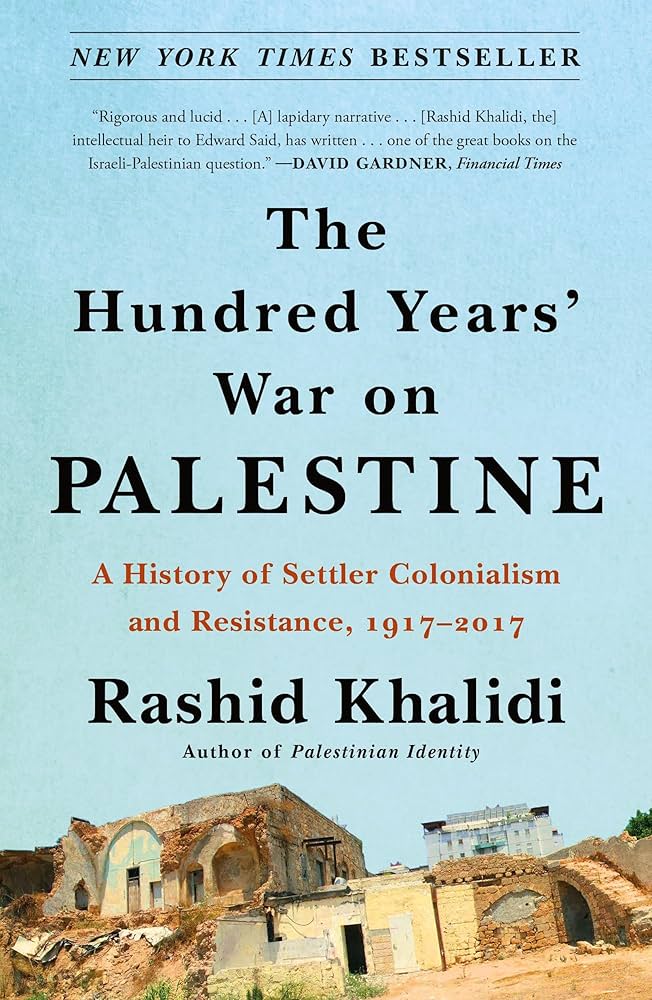
The Hundred Years War on Palestine – A History of Settler Colonialism and Resistance, 1917-2017

Starting with early Zionist writings, Rashid Khalidi takes the reader step by step through the intricacies of Israel’s founding and expansion – and the parallel displacements of the families which once called the same ground their home (aka, the ‘non-Jewish residents’, to those by whom the label ‘Palestinians’ is taken as an affront).  No doubt there are some who will say his history is biased – despite being heavily referenced and filled with quotes from actual participants and documents – but then, what historian’s account is not shaped by their education and values? 

The overall impression one gets from reading The Hundred Years War… is of a disorganized and unsophisticated populace whose interests have repeatedly and consistently been subordinated by stronger forces to those of the Jewish persons who chose to emigrate to the region starting in the late 19th century for the purpose of establishing a nation of, by and for Jewish people.  It further claims that the colonial powers with the most control in those parts chose to favor the Zionists for a variety of geopolitical reasons, some about the Jewish people, some not, but which they hoped conveniently to sweep under the same geographic carpet. 

After recounting events from 1917 to 2017, Khalidi (writing sometime between 2017 and 2020), completed his history on a note of strained optimism.  Admitting that the year 2017 “… might seem an opportune moment for Israel and the United States to collude with their autocratic Arab partners to bury the Palestine question, dispose of the Palestinians and declare victory,” he cautioned that “It is not likely to be quite so simple.” In explanation, he offered the possibility that shifting popular opinion around the world combined with a U. S. government tight-focused on Mr. Trumps avowed ‘America First’ reorientation might “allow Palestinians and others to craft a different trajectory than that of oppression of one people by another.”  Despite generations of  poverty and virtual imprisonment in their ghetto territories, despite Mr. Trump’s obvious sympathies toward Netanyahu and his methods (which are after all, ones Mr. Trump would dearly love to emulate in dealing with any who do not genuflect to him) Khalidi at that time held out a slender hope that the balance of events might shift just enough to allow the non-Jewish inhabitants of the contested lands some form of self-determination and self-rule.

Reading today, we know that the years since 2017 have not been kind to that hope.  The bright promise of 2011’s Arab Spring petered out, leaving autocracy the rule and cutthroat capitalism the guiding principle for much of the Middle East.  Despite Biden’s election in 2020, progress toward any just solution was impeded by the fact so many interested parties bought the line that Jared Kushner’s so-called Abaham Accords meant peace was fully under way, rather than seeing them for the callous money-for-silence racket they actually represented.

Most tragically, the brutal Hamas attack on Israel beginning October 7, 2023 dashed whatever hopes remained by giving Netanyahu and his conservative buttresses the perfect pretext for what they may have wanted all along – the virtual elimination of a non-Jewish ‘people’ in the Palestinian region, paving the way for total and permanent Israeli control of all the lands once referred to as Palestine.  Even avoiding the wilder conspiracy theories,* it is still possible to say that Israel has since taken full advantage of the attack as justification to bury any possible path to Palestinian self-determination. The U. S., far from becoming less of a player, has been drawn by Mr. Trump’s greed and ego into proposing a ‘Peace’ plan which is anything but, consisting of removing the non-Jewish indigenous people while his cronies rebuild their homeland (at significant profit) into a luxury resort wherein, if the original inhabitants are allowed to return at all it will be only to fill dead-end service jobs in the venture-capitalist’s high-dollar playground by the sea. 

For over one hundred years, The Hundred Years War on Palestine… shows us, repression has generated pushback, military tactics have generated militant responses and violent repression has been met with more violence.  There is, unfortunately, little reason to imagine that cycle will stop now – unless the result of Mr. Trump’s ‘Peace’ plan is that there will simply are no longer any ‘Palestinians’ in Palestine to remember that their ancestors once occupied those lands.  In that case, this book may well be crucial in reminding future generations of how they were disappeared, and why, and by whom.

If you like what you read here or at robinandrew.net, please share any posts as widely as possible –and consider subscribing: it’s totally free!

P. S.: E Unum Pluribus is a new novel that considers the enormity of what the U.S.A’s current leadership may cost our nation, and how even tragedy of that magnitude may yet spawn new possibilities for the future. It is currently being serialized and you can be among the first to read its opening pages here by opening the post titled ‘E Unum Pluribus.’

*  Among the conspiracy suggestions I’ve read are:  Did Israel (and Netanyahu specifically) allow/encourag the Gulf States to provide many millions in funds to Hamas over the years because that would keep the Palestinian Authority, Hamas and other factions at one another’s throats, preventing the PA from unite the populace and so becoming more effective at dealing with Israel? Was it not obvious to Isreal and the U. S that the Abraham Accords, by leaving the Palestinians virtually no peaceful means of advancing their legitimate interests, would result in the most radical among them resorting to non-peaceful means? Did Israeli leadership in fact turn a blind eye to warning signs leading up to the Oct 7 attack because they were willing to risk some losses in order to have a pretext for their desired cleansing and achievement of the greater Zionist vision? And, if none of those claims are true, why has Netanyahu never allowed any substantive inquiry into the intelligence failures surrounding Oct. 7, when his entire administration is predicated on the claim that he and only he can keep Israel safe from exactly that sort of attack?

Thank you, Washington Post!

Just yesterday I read Clare Malone’s All the Billionaire’s Men (New Yorker, 2025-05-26) reviewing Jeff Bezo’s stewardship of the Washington Post. The article raised worthwhile concerns about his commitment to the paper’s independence and integrity, his apparent capitulations to Mr. Trump and his MAGA illusion (epitomized by Amazon’s $40m licensing deal for a puff documentary about Mrs. Trump), and implicitly, whether the Post could continue to be a beacon against darkness. Serious issues to this subscriber and daily reader (online) of the Post.

Today, the Post published Karen DeYoung’s and Cate Brown’s exclusive reporting (contributed to by Heva Farouk Mahfouz) headlined ‘Gaza postwar plan envisions ‘voluntary’ relocation of entire population‘ revealing a well-developed draft of one truly atrocious postwar plan for Gaza which the administration appears to be considering with great favor.

There’s much to be said about such a venal land grab, right now however, I’d like to thank the Washington Post newsroom, staff, editors and – assuming its Ownership continues to support such journalism – Mr. Bezos. As our government bends to the whim of a single autocrat, with policies developed in secret sessions among unelected plotters – when they do not spring fully formed from the ruler’s daydreams alone – we the people depend on committed and professional journalists to reveal what is really going on.

Thank you, Karen DeYoung, Cate Brown, Heva Farouk Mahfouz, the entire Washington Post staff and editorship and you too, Mr. Bezos, for keeping the lights on.

Robin Andrew

 The Netanyahus: An account of a Minor and Ultimately Even Negligible Episode in the History of a Very Famous Family, Joshua Cohen

Started reading this in the mistaken belief that it was non-fiction and was immediately put off by the narrator’s (and, I assumed, author’s) arrogant attitudes and artificial style of speech. Once I realized it was fiction, those became crucial elements of the narrator’s character and the entire story, rather than obstacles.  A chastising lesson in the difference between forms and the expectations they set up in a reader – and the responsibility of the reader to know what sort of a book e is opening up!

That said, this impressive novel is not without its challenges.  Cohen is knowledgeable and compelling on Jewish culture and Zionist history and politics. His “Credits” make clear this is based on a real incident involving real individuals; the literary critic and educator Harold Bloom, whom Cohen knew well in his last years and on whom he loosely bases his narrator, Ruben Blum; Benzion Netanyahu, a Polish born scholar of medieval Judaism and activist for the creation of the State of Israel – and the father of Israel’s current strongman, Benjamin ‘Bibi’ Netanyahu (who appears briefly, as a child); and, to a lesser but critical degree, Benzion’s father/Bibi’s grandfather, Nathan Mileikowsky, a Russian born activist, Rabbi and author.  The incident – Benjamin showing up at Blum’s university for an interview with his wife and children unexpectedly and chaotically in tow – is also real, though to what degree is up for debate.

The first half of the novel is serious to the verge of textbook, if a bit satirical, showing us the attitudes of Blum and the surrounding culture (nineteen fifties/sixties backwaters US academia) toward Jews.   One note that struck this reader was how closely the described intentions of Zionist theorists appear to confirm the contentions of Rashid Khalidi’s The Hundred Years’ War on Palestine, which I had begun prior to reading Cohen’s book and am still working my way through (it’s dense).  In this view, it has always been the intent of core Zionists to possess not just what the UN mandated, but all of what have been called, at one time or another, Palestinian territories (reduced today, through a rolling mix of annexations, wartime seizures and occupations, to Gaza and The West Bank – minus the many Israeli settlements already inserted within those boundaries).  The Balfour Declaration and subsequent legalistic measures to enact some sharing of those lands between Israel and the ‘non-Jewish residents’ (to avoid taking a side by describing them as ‘Palestinians’), which I naively believed bestowed a solid legality to the nation, have never been fully accepted by the more ardent Zionists.  Rather, they acceded to these grudgingly and only as temporary accommodations for short term benefits, with always the hope and/or intention that eventually the nation would take by force what it could not win politically.  That even the Balfour Declaration came about only because Zionists and settlers (who were mostly recent arrivals, rather than having been resident prior to the early 20th Century and Zionist movement) backed the British and other nations into conceding it through raids, sabotage and what some have called terrorism, foreshadowed this long-term belligerence.

The novel’s tone changes dramatically in its second portion, as the Netanyahus (or Yahus, as Blum comes to call them, in one of the author’s most amusing bits) arrive and what had been an academic exercise turns into a slapstick comedy of poor manners, poorer parenting, arrogant presumptiveness, cliché infighting between spouses and barbed daggers at academics in general.  For this reader, who finds nearly all ‘comic’ writing an oxymoron, that sectionis less successful and somewhat overextended.

The Netanuyahus is saved in part by the aforementioned orientation on Zionist history and in another part by the insight it provides into the making of one future Prime Minister.

To wit: if the actual Bibi Netanyahu comes from such stock as these fictional father and grandfather, then there seems no way in hell or heaven that he will ever honestly support the idea of a Palestinian state.  Coupled with his actions so far since the tragedy of October 7, 2023, this leads one to conclude there will be no other outcome of the present Israeli/Palestinian conflict than Israel’s elimination of the Palestinians as a people or political entity and the integration of all previously Palestinian-controlled lands into an increasingly theocratic, increasingly Orthodox and bindingly-Jewish state of Isreal. 

Benzion’s scholarly opinion that this tragedy is a result of Medieval Iberia’s choice to maximize economic advantage by portraying Judaism as a race rather than a religion makes it more tragic, not less.  History and religion are not so far apart as some of Cohen’s characters would like them to be.

An impressively erudite novel, depressingly timely.

P. S. – As Cohen tells us, the literal meaning in Hebrew of ‘Netanyahu,’ the surname which Benzion chose to replace his father’s (‘Mileikowsky’) is “gift of God.”  This suggests that the attitude of supreme arrogance and entitlement which Cohen portrays in the character modeled upon Benzion is likely very true to its original.

P. P. S. – Early on, Cohen depicts the anti-progressive bent of conservative strains in Jewish and early Zionist thought.  This reader was struck hard by the similarity of that reactionary and absolutist world view with that of America’s present-day nuovo-populists and MAGA fundamentalists.  One more reason for our Mr. Trump and his fundamentalist Christian supporters to side so strongly with Mr. Netanyahu’s Israeli policies, if their shared paternalism, avarice, brutality and need to perform Alpha Male masculinity were not sufficient.