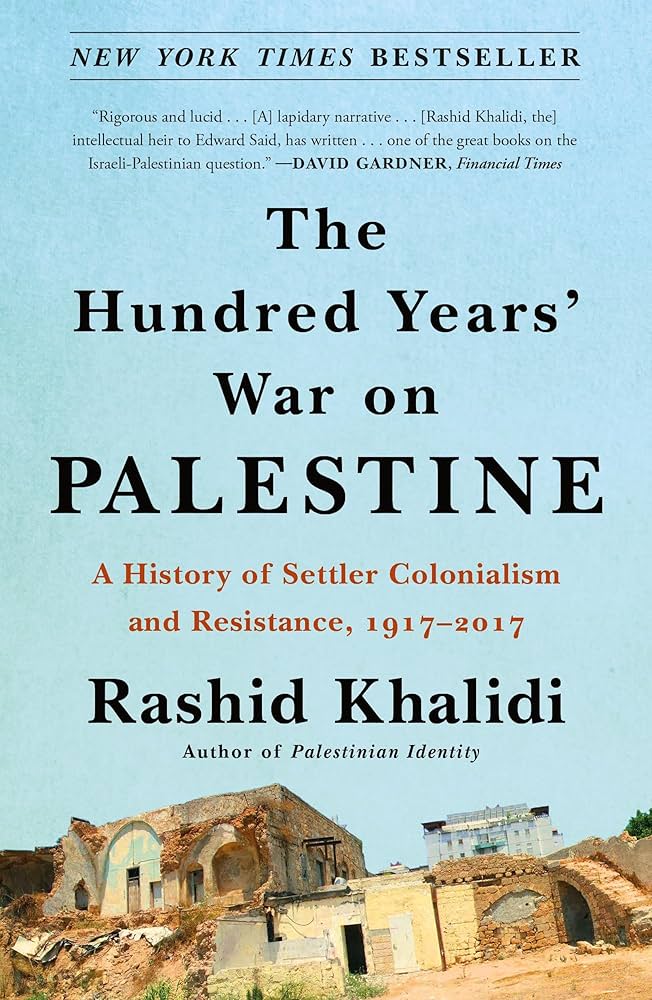
Starting with early Zionist writings, Rashid Khalidi takes the reader step by step through the intricacies of Israel’s founding and expansion – and the parallel displacements of the families which once called the same ground their home (aka, the ‘non-Jewish residents’, to those by whom the label ‘Palestinians’ is taken as an affront). No doubt there are some who will say his history is biased – despite being heavily referenced and filled with quotes from actual participants and documents – but then, what historian’s account is not shaped by their education and values?
The overall impression one gets from reading The Hundred Years War… is of a disorganized and unsophisticated populace whose interests have repeatedly and consistently been subordinated by stronger forces to those of the Jewish persons who chose to emigrate to the region starting in the late 19th century for the purpose of establishing a nation of, by and for Jewish people. It further claims that the colonial powers with the most control in those parts chose to favor the Zionists for a variety of geopolitical reasons, some about the Jewish people, some not, but which they hoped conveniently to sweep under the same geographic carpet.
After recounting events from 1917 to 2017, Khalidi (writing sometime between 2017 and 2020), completed his history on a note of strained optimism. Admitting that the year 2017 “… might seem an opportune moment for Israel and the United States to collude with their autocratic Arab partners to bury the Palestine question, dispose of the Palestinians and declare victory,” he cautioned that “It is not likely to be quite so simple.” In explanation, he offered the possibility that shifting popular opinion around the world combined with a U. S. government tight-focused on Mr. Trumps avowed ‘America First’ reorientation might “allow Palestinians and others to craft a different trajectory than that of oppression of one people by another.” Despite generations of poverty and virtual imprisonment in their ghetto territories, despite Mr. Trump’s obvious sympathies toward Netanyahu and his methods (which are after all, ones Mr. Trump would dearly love to emulate in dealing with any who do not genuflect to him) Khalidi at that time held out a slender hope that the balance of events might shift just enough to allow the non-Jewish inhabitants of the contested lands some form of self-determination and self-rule.
Reading today, we know that the years since 2017 have not been kind to that hope. The bright promise of 2011’s Arab Spring petered out, leaving autocracy the rule and cutthroat capitalism the guiding principle for much of the Middle East. Despite Biden’s election in 2020, progress toward any just solution was impeded by the fact so many interested parties bought the line that Jared Kushner’s so-called Abaham Accords meant peace was fully under way, rather than seeing them for the callous money-for-silence racket they actually represented.
Most tragically, the brutal Hamas attack on Israel beginning October 7, 2023 dashed whatever hopes remained by giving Netanyahu and his conservative buttresses the perfect pretext for what they may have wanted all along – the virtual elimination of a non-Jewish ‘people’ in the Palestinian region, paving the way for total and permanent Israeli control of all the lands once referred to as Palestine. Even avoiding the wilder conspiracy theories,* it is still possible to say that Israel has since taken full advantage of the attack as justification to bury any possible path to Palestinian self-determination. The U. S., far from becoming less of a player, has been drawn by Mr. Trump’s greed and ego into proposing a ‘Peace’ plan which is anything but, consisting of removing the non-Jewish indigenous people while his cronies rebuild their homeland (at significant profit) into a luxury resort wherein, if the original inhabitants are allowed to return at all it will be only to fill dead-end service jobs in the venture-capitalist’s high-dollar playground by the sea.
For over one hundred years, The Hundred Years War on Palestine… shows us, repression has generated pushback, military tactics have generated militant responses and violent repression has been met with more violence. There is, unfortunately, little reason to imagine that cycle will stop now – unless the result of Mr. Trump’s ‘Peace’ plan is that there will simply are no longer any ‘Palestinians’ in Palestine to remember that their ancestors once occupied those lands. In that case, this book may well be crucial in reminding future generations of how they were disappeared, and why, and by whom.
If you like what you read here or at robinandrew.net, please share any posts as widely as possible –and consider subscribing: it’s totally free!
P. S.: E Unum Pluribus is a new novel that considers the enormity of what the U.S.A’s current leadership may cost our nation, and how even tragedy of that magnitude may yet spawn new possibilities for the future. It is currently being serialized and you can be among the first to read its opening pages here by opening the post titled ‘E Unum Pluribus.’
* Among the conspiracy suggestions I’ve read are: Did Israel (and Netanyahu specifically) allow/encourag the Gulf States to provide many millions in funds to Hamas over the years because that would keep the Palestinian Authority, Hamas and other factions at one another’s throats, preventing the PA from unite the populace and so becoming more effective at dealing with Israel? Was it not obvious to Isreal and the U. S that the Abraham Accords, by leaving the Palestinians virtually no peaceful means of advancing their legitimate interests, would result in the most radical among them resorting to non-peaceful means? Did Israeli leadership in fact turn a blind eye to warning signs leading up to the Oct 7 attack because they were willing to risk some losses in order to have a pretext for their desired cleansing and achievement of the greater Zionist vision? And, if none of those claims are true, why has Netanyahu never allowed any substantive inquiry into the intelligence failures surrounding Oct. 7, when his entire administration is predicated on the claim that he and only he can keep Israel safe from exactly that sort of attack?

 RobinAndrew