Attachment and Cost

Reading a novel recently ( Beautiful Ghosts, by Eliot Pattison – an intriguing mix of crime thriller and Taoist reflection on the culture and modern history of Tibet) I came upon a passage from the Tao that immediately made me think of running:

“The stronger the attachments, the greater the cost”

Approaching a run with a specific goal or expectation can help optimize results, whether in training (go long or go fast, intervals or consistency at a specific pace, go all out or baby that latest minor injury…) or just for health and recreation (to explore a new route, join with other runners, tick off a personal first…).  Holding those goals too tightly though, can lead to overdoing it, and that in turn can lead to injury.  Even without injury, failing to achieve a too-closely-held goal can turn an otherwise exhilarating experience discouraging and dispiriting.  Any of which can lead to less running.

Repeated and regular running is the most basic goal of a mid-pack runner, and enjoyment is the best incentive for that.  Enjoyment of the setting, of the human body’s incredible potential, of being part of the quiet family that is all runners, of putting one’s own health and well-being – fro a small period of time – ahead of the multitude of demands  which life can make…

So, set goals and monitor them, but never let them get in the way of all the other blessings of running.

Enjoy yourself!


Complicit?

In a recent tweet about immigration, our President stated that those who do not agree to his preferred measures aimed at controlling illegal immigration become, by their disagreement, complicit in any future murders committed by illegal immigrants.

There are certainly many grounds upon which to disagree with that claim, but an intriguing alternative response might be to take it at face value.  For if the logic is valid – that taking a position on a political issue makes one morally complicit in any negative instances that might possibly occur relative to that position (regardless of the balancing positive effects) – then the following is also and equally true.

All those who advocate for gun ownership, gun rights, in fact the enter Second Amendment debate, are complicit in every murder or wounding committed with a legally-owned firearm.

And yes, Virginia, that is a far larger number, every year, than the number of murders committed by illegal immigrants.

But we will not hear that from our President,


Fair Is Fair

In the news today, US auto sales fell 1.8% in 2017.

So, the next time our current President claims credit for some suggestion of economic growth (such as the rise in the stock market, which is clearly the continuation of a long-term trend that began long before he took office), will he also accept credit for this development, which ended seven years of growth?

Let’s watch and see….

Giving it 110%, or “Have some gravy with them biscuits!”

Long runs can be tough.

Starting out might be the easiest part – you’re fresh and enthusiastic and (hopefully) feeling healthy and fit, but if you’re really going long – whatever that is for you, on any given day – there’s probably also some apprehension about all that time/distance ahead of you. Or downright dread maybe.

The middle part, is definitely tough, when it seems you’ve been running forever and still have forever to go.  Calorie reserves dwindling, pressure points announcing themselves, any lingering weak points of the physiology becoming more and more prominent, this is where runners build character, whether we want it or not.

But then there’s the last portion, when you can smell the barn and see the light… Despite fatigue, aches and pains, this may just be the best part of a long run – cruising to the finish.  Unless…

Unless you’re ramping-up to some long goal or event, following one of those training plans where every week or two (or three for those of us who need a lot of recovery time) you make that weekly long run a little bit longer (10% more than the last one is the oft-spoken rule, so that’s what we’ll refer to).    Adding distance means that just as you are getting to what last time around was the payoff, you have to “go the extra mile,” and that is no small deal, since by definition the lead-up you’re now staggering to complete is 100% of the max you’ve run before in this training cycle.   Aching, sticky with sweat or frozen with cold, stomach grumbling (at best), bowels raising the alarm (definitely not the best scenario) the prospect of going even farther can be pretty daunting, especially if the earlier miles haven’t gone particularly well.  Some thoughts that have helped this follower-dog “keep on keepin’ on”:

One:  A lagging pace in that final extra distance doesn’t affect your average pace nearly as much as it might seem.  The reason is basic math – proportions.  Let’s say your pace in the added 10% drops by one minute per mile.  Since you’ve already run 10 times as far, the impact on average pace will be 60 seconds divided by 11, or less than 6 seconds – a rounding error for those of us in the middle of the pack.  Even if the pace lags more than that, if you’ve given it your best for the bulk of the  distance, that added 10% is all about the doing, you don’t need to ace it.

Two: When temptation rears its ugly head, suggesting you call it a day and do that long-run-plus in a couple of days, or next week, (or any other time but right now, which is what I’m really thinking, right about then), it may help to remind yourself what it took to get to where you even have the choice whether or not to do that 10%.  If you bag it today, you’ll have to run the whole 100% again, just to be where you can make this decision.  That’s right folks, you can end the pain and suffering here and now, but then you’ll have to go through it all again just to get back where you are today.

And Three: if you can just make it through that extra 10%, what a sense of satisfaction you’ll have!  Whereas,if not, you’ll have done somewhere up to 90.9% of the work (that’s 100% out of 110%) for none of the payoff.  Talk about a rip-off!

Biscuits-and-gravy comes to mind – that 100% you’ve already run is like the biscuits – hearty and nutritious, but by themselves more than a little dry and grainy.  The added 10% is the gravy, the part your mouth has been watering for, and that will make all the rest go down smooth and easy.  If you’ve gotten anywhere near it, push on through and make the miles.


In most areas of life, “giving it 110%” is a cliché – and worse, one that flies in the face of logic and mathematics.  In running though, it can be very real, and all the literature seems to agree it has big benefits. So make a training plan and ratchet up the distance, and when you find yourself on the cusp of calling it off, remember: that extra 10% is what makes the meal worth savoring.

Long runs?  Yummie!

(Easy enough to say when I’m sitting at this keyboard…)
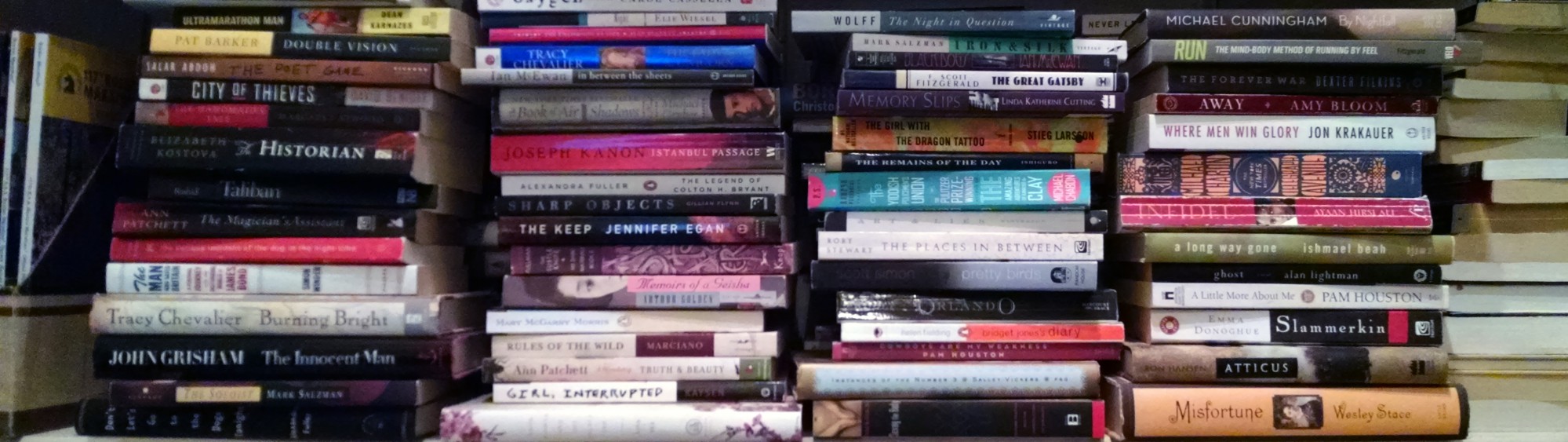
 

Scribbling the Cat, Alexandra Fuller

This author continues to impress both for the  boldness of the people about whom she writes, and for the conscience with which she records and expresses lives lived on the edge of what most mainstream readers and writers would consider to be the modern world.  From her own raggedly individualistic and idiosyncratic family to the Wyoming roughnecks of The Legend of Coulter H. Bryant, to this tale of an African ex-soldier on the cusp of regret and despair, she reminds that civilization is neither uniformly progressed nor equitably shared.  Along the way we are amused, thrilled, at times appalled and always captivated by the variety and beauty of lives lived less carefully than our grade-school teachers taught us we should do.

As in her two family memoirs, Africa is a central character here, her raw beauty, blood-smeared history and sometimes-fatally-high demands treated with love and respect.  One is left with a great desire to see  the place for oneself – note ‘see’ rather than ‘experience;’  Fuller is all too successful at exposing the faults and folly of those who hope to observe this land casually or in safety, and the risks one must accept in order to even begin to get to know this continent or its people.

There is, in this travelogue of a road trip (an expanded meaning for that expression, to be sure!) with the soldier identified as ‘K’ more than a little revelation of the author as well. Clearly Fuller was struggling to understand and accept her then-current existence as a married mother in safe, comfortable Wyoming.  As with Hemingway and so many others, the total immersion and sensory overload of life in the midst of conflict or on the edge of subsistence appears to beckon and fulfill in ways the workaday cannot.   It is no surprise then, to find in a Wikipedia search that another of Fuller’s volumes, Leaving Before the Rains Come, chronicles the disintegration of her marriage some time after the journey described in ‘Scribbling…’ (That title, by the way, is one of the multitude of euphemisms K and his fellow combatants use for the act of killing.)

A book to keep on the shelf, and an author to pursue.  Expect I’ll soon be reading the remaining 2 of her six volumes to date.

Out and Back and Out and Back

Most runs fall (though usually not literally) into one of a few categories – out and back, loop, point to point, or laps. A recent pace run has given me reason to appreciate a variation I’d never considered – the repeated out and back.

Back-story: I set out this past Saturday on a mid-length run, aiming to sustain a particular pace (faster than any of my recent long runs, but not as fast as shorter ones), but quickly began to fear the packed snow and ice on local streets was a recipe for injury.  Deciding to stop and consider my options, I actually did fall  down – thanks to a hidden patch of glare ice,  and so packed it in right there and headed to a Rec. Center treadmill to finish an abbreviated workout.

On Sunday, still hungry for real miles, I drove some distance to where the lower elevation meant a paved trail would be clear and safe. I planned to run 5 miles out before turning around, but nearing 2 1/2, began to suspect the treadmill intervals might have taken too much out of my legs to keep the targeted pace that long.  Plus I had no idea how far downhill I’d go on the rest of the out bound leg and have to climb back up later. The prospect of finding myself five miles downhill from my car, with worn out legs, did not seem fun, or even very wise.

It was then that Plan B occurred to me: how about turning back at 2 1/2 miles, and pushing hard back to the car at 5?   That’d give a better shot at maintaining goal-pace, limit downhill to what I’d already seen (not much to that point), and still leave the option of heading back out for more. Done deal!

The first discovery was the added optimism I felt turning around at 2.5, as if I’d already achieved something.  Next was the realization that since I’d just covered them in the other direction, I had a clear idea what each of the next 2.5 would bring, and the confidence to attack them more aggressively.  Approaching the 5 mile mark, it was surprisingly comfortable to push the pedal down and hit my goal pace with a ten-second margin, the satisfaction of which was more than enough incentive to head back out again (after a short breather).

Not surprisingly, the next 2.5 began a bit tough, but well-before the turn-around the ol’ legs had cleared themselves of exhaust gases and seemed eager to revisit the same stretches they had just ‘conquered.’   Plus I could tell myself I’d already succeeded for 5 miles, so had a lot more reason to believe I could do the same distance again.

End of story: after initially wondering if my intended run was possible, it turned out to be very much do-able and fun; not only able to beat goal pace for the first half, I managed to come within just a few seconds of it over the entire distance.  Plus I can now compare splits on the two halves and see clearly what role fatigue played on identical terrain, something you don’t get ever get on a loop, point-to-point or single out-and-back (where covering grades in reverse prevents any direct comparison).

Out and back, out and back – it’s really another way of saying you can run laps on any route, it doesn’t have to be a track or even a loop.  That turns out to be a great way to break up a long effort (see Divide and Conquer, 10/22/17) and also to hedge your bets if the weather is iffy, the terrain unknown or your own readiness in question.

Who would’a thunk?  Not this mid-packer, at least.


Life After Life – Kate Atkinson

A great fan of Kate Atkinson’s fiction, I put off trying this volume because its blurb sounded rather a domestic-family-history sort of thing, not my favorite subject matter.  The first few chapters did little to dispel that, but the super-hooky opening scene had already fulfilled its function and I kept on, to find about 10% of the way in that the story suddenly became more intriguing when Ursula died and her life began again, the first of many such re-sets.

Between those jumps, the narrative superficially resembles a classic British novel of woman’s place and yearnings, but as subsequent incarnations multiply with varying consistency, both character and reader become conscious of something more; the insidious impact which even a small amount of future-sight might have on one’s actions, reactions and dreams.  By the end of this substantial tale (a long-ish read in the beginning and end, though the middle portions hold the attention very well and overall one is sad to leave its world), both are armed with enough information to anticipate and dread events in roughly equal measure.

Testament to the effectiveness with which Atkinson parcels out information to the reader and her character, is that we discover and wonder at her situation in much the same way she does.  This manipulative skill was already apparent in her earlier Case Histories, but is here even more integral to the ideas being explored and the craft being applied.

Another point of appreciation is the degree to which Ursula’s life and tale are not ruled by romance.  Yes there are scenes of her first encounters with boys (informed by her lack of intimate education, these feel both historically accurate and quite amusing) and later affairs, but this is no Bronte or Austin creation, desperately seeking the right man to validate and support her. What really guides Ursula is the desire to craft a unique place and impact in the world that reflects her personality and abilities – a compass too often granted to male protagonists and not their female counterparts.

As always, it is conclusion that makes a story truly successful or not. Here the most dramatic act is unsettled – we are not allowed to see how it plays out – except that once we think a bit, we do know, both by our own experience outside the novel and by the coda-like scenes which follow it.  As much as we enjoy the return of one of her favorite relatives, he would not have been missing in the first place if her plan had succeeded as intended, so…

All in all, a thoroughly enjoyable and deeply satisfying work, reflecting and engendering serious thought about family, literature, destiny, philosophy and the very nature of existence.   Oh, and much less ponderous than that last makes it sound…

Worthy of a re-read, though unlike Ursula I do not find my time multiplying endlessly. And besides, there is a subsequent volume, A God in Ruins, picking up on another character from Ursula’s lives.

So much to look forward to!


The Long and the Short of It

Most runners start out relatively short – with short distances, that is.  Whether as track athletes steered by coaches to an event which best suits them (100m, 200, 400, 800, 1600…), or recreational/fitness runners who choose a mile, 5K or at most a 10k for their first official  target.  Only after substantial experience with those more modest distances do they build up to hours-long efforts in half-marathons, marathons, or ultras – if ever.

As it happens, my first-ever organized running event was a half-marathon (or ‘hemithon’, if you’ve read an earlier post on giving this distance its due) which I entered with an over-ambitious buddy who’d started training and wanted company in his challenge.  It also doesn’t hurt that I live in a small town many miles from larger communities – it’s difficult to justify driving several hundred miles and spending one or two nights in a motel for any event that will last less than a couple of hours.  Whatever the factors, I tend to focus on events of 13.2 miles or more, and maybe not to fully value their more compact alternatives.

This year’s though, a local Turkey Trot 5K provided a good reminder of something to love about shorter events: the high ratio of Start/Finish time to cruising time.

It’s no secret, after all, that the start of a race is very exciting. The crush of bodies before the tape, the inspiring music, the cocky buddy-chatter with whoever winds up at your elbows.  The possibility of a new experience, a new PR, or just another notch in the old shoes…  Enough excitement and joy that many of us have to consciously avoid going out too fast and hurting later performance.

And the finish has an appeal all its own: that competitive burst as the line approaches (if there’s still that much gas in the old tank…), the imminent relief of ceasing to run (without guilt!), the after-race beverages – whether water, electrolyte or brewed…  The celebratory connecting with friends and co-runners.

In contrast, the mid-part of any event tends to be considerably less intense.  Unless you suffer a cramp or collision, or make a wrong turn and have to find your way back to the course, it’s mostly steady-state pacing and self-control (and how many people find self-control exciting?  not a lot of hands shooting up there…).  No wonder so many distance runners strike up conversations with strangers, or plug-in to music, podcasts or talk radio (well, maybe not that last one, we want to spend our energy running, not raging).

What struck me this turkey day is that the start line time and energy of a 5K can be just as great as that of a marathon.  In fact, it’s actually more related the size of the field than the length of the course.  The Bolder Boulder is a 10K,  for example, but with a field of nearly 50,000 it boasts remote parking, city-wide shuttle buses and a plethora of waves and corrals, meaning one may leave the house three or more hours before toing the line – plenty of fantasy time for any of us feel like an athlete in the Olympic Village.

And the emotional weight of a finish is really determined by one’s strategy and approach.  Sure, if you start accelerating at mile 23 of a marathon, that’s 3 miles of buildup and anticipation: hopefully enough foreplay for a satisfying release after the line is crossed.  But heck, you can get the same duration in a 5K; just start anticipating the finish at .1 mile in – right after you’ve forced your pace down from that initial foolish start-sprint.

The point is, these precious moments are just as accessible and meaningful no matter the length of the event!  We can have as many minutes of juicy start and finish experience in a 5K as in an Ultra, if we just remember to focus and enjoy them.

Long, short or in between, every organized event is a chance to experience excitement, anticipation and release.  What’s not to love about that!


He Said What?

Following the Sutherland Springs shootings, our President opined that, if two townspeople had not pulled out their own guns and shot the perpetrator, he would have “.. had hundreds more dead…”

Considering what this deranged shooter was able to do inside that crowded church (horrible, terrible, indefensible, but not “hundreds”), or what the Las Vegas shooter did with an enormous crowed, time and multiple pseudo-automatic weapons (again, horrible, terrible, indefensible, but not “hundreds”), it is simply not credible that the TX shooter could have killed “hundreds” while speeding away with police in pursuit.

Once again, our President cannot help himself exaggerating to the point of obvious falsehood.   We deserve better.

Founding Brothers – The Revolutionary Generation, Joseph J. Ellis

A thoroughly engaging recap of several first-string players’ roles in our nation’s early innings.  Structured around six key incidents (The Duel, The Dinner, The Silence, The Farewell, The Collaborators and the Friendship) this relatively slim volume provides a compelling picture of the interpersonal conflicts among what we today recall so monolithically as our Founding Fathers.  Profoundly divided and conflicted, as Ellis dramatically illustrates by starting out with The Duel between Hamilton and Burr and elucidating it’s root causes, it is their very differences that gave us a system which has managed to accommodate our nation’s more profound conflicts for longer than any other republic ever has.

This is neither puff piece nor hatchet job; Ellis admits flaws in even his favorites (Washington foremost, with Adams as runner-up) and virtues in those he has pegged down (Jefferson, Franklin).  Only Aaron Burr is completely dissed, as selfishly opportunistic and without values (a modern parallel comes to mind…).  The penultimate impression is as the author clearly intends: gratitude that these men (and one woman, Abigail Adams, presented as wise, tolerant and far more worldly than members of her sex were given credit for in that time) happened along at such a moment.

Clearly they alone did not create the historic circumstances for independence, many others contributed to both causes and effects, but these eight (Hamilton, Burr, Jefferson, the two Adams’s, Madison, Franklin and Washington) played crucial roles.  Over 200 years later, still we live in their shadow and their debt.

A book well-deserving of its Pulitzer.