Tag Archives: Boston Marathon

Compress That, Buddy!

In a recent on-line article about compression gear, the author cited a bunch of studies on elite runners and concluded– wait for it… that there was no conclusion. No scientific consensus on whether compression has benefits or not.   Well, this never-been-elite-and-never-gonna-be is ready to disagree!

Back in 2013 I had pretty much ignored the ads for compression clothing, figuring they were just another sexy way for manufacturers to part runners from their money. It seemed obvious to my innocent mind that having to stretch that heavy fabric every time my legs bent or straightened would bleed-off precious energy which was better applied between my feet and the ground.

But…I was also on the verge of quitting marathons. Not because my times weren’t progressing (they were, though only very gradually and not consistently), but because running 26.2 just felt plain wrong. Despite having followed a ramp-up training plan to build strength and endurance, every marathon left me feeling more mangled than majestic. Gutting out those final miles on legs that refused to respond, then staggering around for several days like a stiff-legged zombie, I figured I was simply not cut out for it. Until the horrific Boston bombings happened; after which my entire cardiovascular system wanted desperately to line up in Hopkinton the next year and join the hordes of other runners and spectators to show the world that those two impotent losers had not accomplished a damned thing.

Knowing I’d need all the help I could get, I scrunched up my tight little fists and sprung for a pair of CW-X ¾ length compression tights, after which – drum roll please….

What I did not experience was any sensation of resistance or wasting energy. My mental image now is that, just as much as your motion in one part of a stride stretches the fabric, the springy stuff acts to snap your leg back in the other, so fifty-fifty.

What I did experience was a big difference in how my legs felt in the later stages of long runs. Where before the heavy muscles around the thighs had been flapping and flopping like to tear themselves from the bones, now they were solidly in place, and because of that they maintained more strength longer. Day-after was the real kicker though, with noticeably-less leg fatigue and stiffness after running in compression than without.

Third conclusion? A couple of months after getting those tights, I wore them for an official marathon – and PR’d by over 15 minutes! I’m not saying that was all the compression tights (it was a downhill course, after all), but could I have kept up that pace in the last 6.2 if my legs were feeling flayed from the bones like I’d learned to expect? Not on your Lycra.

Since then I’ve worn compression tights for pretty much every event over half marathon distance. (But not for training; training is about applying stress to induce growth, so I save the stress-reducing super-gear for actual events.)

Thus sayeth the Follow-dog: get yourself a pair and see how they work for you. I’m already sold.

P. S. – Compression socks? Haven’t tried ‘em for running (I’m hooked on wool socks by Darn-Tough or Smartwool) but do use them after a big effort, for comfort and quicker recovery. Compression sleeves? Sleeves are a great layering option for warmth in marginal weather, have never tried compression up there. Compression shirts? Not with my mid-section, thank you very much!

The Measure of a Run

In 2014, Meb Keflezighi won the Boston Marathon, the first American man to do so in 31 years.  Millions watched intently, thrilled and awed by his victory. His winning time? in 2:08:37.

In 2011, Ryan Hall ran the same course in 2:04:58, the fastest marathon ever run by an American, anywhere.  But Ryan Hall didn’t win; he didn’t even get to stand on the podium, because three men ran even faster that year. So his run, nearly four minutes faster than Meb’s, didn’t bring anything like the acclaim – or rewards – of that performance.

Is beating every other runner who shows up for a particular event on a particular day the best measure of a runner’s performance – or is hitting a particular time the more absolute and lasting achievement?

On one hand, winning seems dubious when the time required to do so can vary so much from year to year…

On the other, there was reportedly a tailwind in 2011, which may have boosted the entire field’s times – though how much that affected them is undetermined; and undeterminable. Swinging the pendulum in the opposite direction, 2015’s winning time was 2:09:17, widely thought to be attributable, at least in part, to headwinds; but again, how much so is impossible to determine.  Consider that Robert Kiprono Cherulyot had won – and set a new course record – in 2010, but if his 2:05:52 had occurred one year later, it would only have been good for – fifth!

Clearly, actual time isn’t the absolute objective criterion it seems to be, either.

And is an individual’s performance really due solely to their efforts, or do drafting, switching leads and the emotions of the chase contribute – how much did the pacing of others play into those astounding 2011 times?   Speaking of intangibles, seven of the 2014 men’s field had previously run a 2:05:30 or better somewhere.  How readily do we conclude that it was only Meb’s personal commitment to making a statement after the tragedy of 2013 which set him at the head of such a phenomenal group – or were their efforts moderated, as some have claimed, by Hall himself, lulling them into a relaxed pace until Keflezghi had opened a gap which was to prove unbridgeable? (Apparently the same factors that can skew finishing time can affect placement as well – and make my brain start to hurt…)

When confusion reigns supreme, seek refuge in the simple: and one simply indisputable truth – especially for an MPR – is that both Meb’s and Ryan’s performances are spectacular, inspiring, and borderline incredible.  When your own marathon times hover around 4 hrs. (or five, or…), it is almost beyond belief that someone out there can do it in just over two – and those who can do so seem so superhuman, it makes little sense to differentiate between one or the other.

Another thing we can be sure of, is that neither of these runners –  among the very best in the world – really knows before a given event what they will achieve.  They may run a new PR and win – or run an even greater PR, and not win. Someone else may not run their fastest race – and still win. Or not.  All they or any of us can really count on is the satisfaction that comes from knowing you did your best; for that day, for those conditions, for all the factors that play into what seems like the simplest of sports (run from here to there, as fast as you can) but is in reality, fraught with complexities.

Doing your best is the most reliable measure of achievement, whether you’re an MPR or an elite champion: another way in which there’s not as much difference between us as one might first suppose!


(By the way, why is the US running conversation so focused on ‘American’ runners.  Lelisa Desisa won the event in 2013 and 2015;, where were the magazine covers, cable TV profiles, and full-page sponsor-ads for him?  Or for Geoffrey Mutai, leader of that blistering pack in 2011, with a 2:03:02 that still stands today as the course record? And we cannot go without mentioning Dennis Kimetto, whose 2:02:57 in Berlin 2014 is the fastest marathon to date; anywhere, in any field.

And why is this post only about the men?

More to come.)

Run-up to Boston – Part 7 – Turning On To Boylston

Hypothesis: for an MPR, running Boston is not about the finishing-time, but the experience, and when one takes that view, perhaps the ultimate moment is not crossing the big yellow line (yes, it really is big enough to see on Google Earth); the real climax is when you round the corner from Hereford St. onto Boylston and see that last .2 (it’s actually .36, but who’s counting?) stretching out, straight and simple and piece-of-cake, lined with roaring humanity, to the banners and bridge that will mean it’s over; and realize you wish this run could last forever.

775770_1384_0028

And so:

To the 27,000 who came from around the country and around the world to run…

( you saw them sprinkled around airports, train stations and highway rest stops across the country Friday, Saturday and Sunday, proudly displaying runner-shirts or jackets from years past, a pop-up community coalescing more and more, the closer each one came to the epicenter of its strange ambition…)

To the family and friends who humor and support them in their obsession…

To the organizers (the Boston Athletic Association, and its many generous sponsors), who put this enormous celebration together so seamlessly and well…

To the police, military, EMTs, firefighters and nobody-but-them-knows-who-all, who did so much to keep all of us safe, with as little visibility or inconvenience as they possibly could,

To the photographers, who captured moments and memories of what can otherwise seem an ephemeral experience…

To the volunteers, smiling with astonishing good cheer through –

  • Seemingly-endless lines of registrants to be checked-in, bags and shirts to be handed-out
  • Ushering dazed and hapless crowds around the expo
  • Dishing out tons of pre-race past in the bowels of City Hall
  • Preparing a safe and un-miss-able course from rural woodlands to city center
  • Accepting drop bags and shepherding thousands of manic, jittery would-be-racehorses onto busses in the early morning hours
  • Handing out coffee, water and smiles under drizzly tents in the runner’s village (even when we couldn’t figure out which side of the tables was for servers, and which for servees…)
  • Dispensing hydration, energy, first aid and encouragement every mile along the route
  • Draping medals over sweaty necks, thermal ponchos over about-to-become-hypothermic shoulders and handing out still more hydration, calories, first aid and encouragement after the line
  • The after-party – which many of us (like this one…) were too full of the experience by then to attend, so we’ll never know what it was like…

And did it all with patience and courtesy and heart-warming generosity…

And most of all, to the crowd, who came out in droves – despite the rain, wind and cold – to once again cheer a bunch of self-absorbed migrant-strangers as we exercised this odd compulsion, disrupting lives and clogging the streets of their cities and towns for hours on end, and made us feel completely and utterly welcome…

To anyone I’ve overlooked (as I’m sure I have, someone)…

There is only one thing to say:

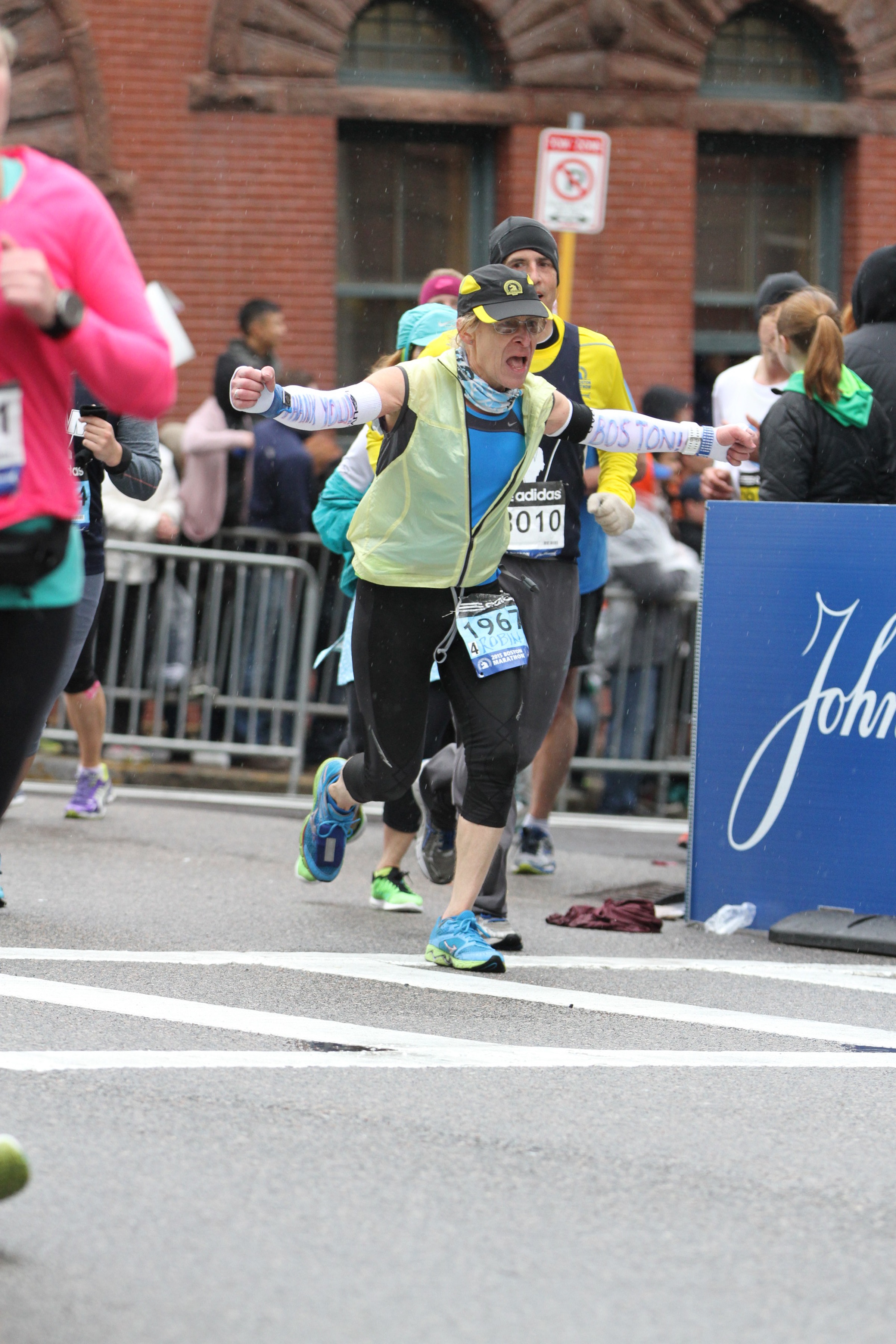
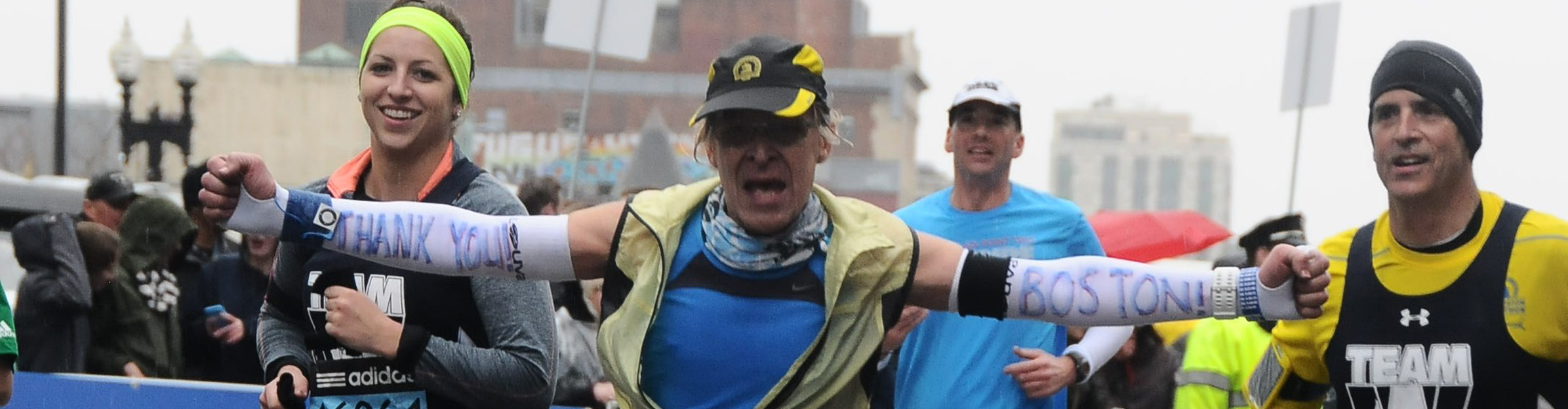
Boylston Corner Tight Crop


One More Time

(I know this is just a tiny echo from a much, much larger and more-profound story, but it’s my echo, and after trying many times, this is the best way I’ve come up with to tell it.)  

ONE MORE TIME

You wake up early to run a big-city marathon –

Early enough to pick up your phone in the darkened hotel room and check the weather, then shave and sunscreen before putting on the clothes laid out the night before –  Smear your toes with Body-glide to fend-off blisters, before pulling on socks and the shoes that have been broken in just right. Early enough to gather up extra warm layers and hat and gloves for the trip to the start, and energy-gels and water bottle and music player; to touch your wife’s sleeping shoulder so you don’t wake her, and whisper ‘Goodbye,’ before stepping out into the silent and deserted hallway, shutting the door as quietly as you can.

Familiar tasks, that you’ve done before, – not because you’re some kind of natural-born athlete, or an athlete at all.  No, you actually got into it because you were turning fifty and your 12-year old towered over you and your business had slowed to a crawl after 911 even as your country was sliding downhill into war and it all made you desperate for something – anything – that felt like moving forward.  The first marathon hurt like hell, but the atmosphere was electric, the energy and optimism of all those vibrant persons, and that part clicked, so that you wanted to try it one more time, to see if you could do better.  And when you actually did worse, that drew you in to do it one more time, and then one more.

And every time, there came a point somewhere along the distance that it seemed it would never end, where you told yourself ‘this is ridiculous, I’m not made for this, I will never ever do this again.’  With the result that, when you happened on a chance to run here – in the big-time – you said, yeah, that’ll be a good way to end it all. One more time, and then it’s over: you don’t ever have to do that to yourself again.

Which is what you’re thinking out on the street and in the coffee shop, where half the people you see are other runners heading for the subway, which takes you to the park where 20-some-thousand people are converging to board the hundreds of school buses arriving like clockwork and where you find yourself next to two women who are also from Colorado, and as you chat and watch the sun come up along the highway, you all know this is going to be a great day.  Filing through security; milling about a high school campus that’s been organized like a military marshaling yard, you feel the excitement, see the smiles and anticipation on thousands of faces. The armed soldiers on the school roof seem like overkill, as do the sniffer dogs being handled through the crowd. A couple hours of shivering and finally the sun is starting to warm the treetops as your wave – the last and slowest wave that is – make their way through the usually-sleepy side streets to jam up behind the tape.  Music is playing and everything is under control as your group reaches the line, then a gun goes off and you’re running again, along with several guys doing the distance in combat boots, fatigues and field packs; six kids in hamburger suits, and twenty-six-thousand of your closest strangers.

Along the way you stop a couple of times to take photos of the hoard – never brought your phone on a run before, but since this is the last one, and since it is the big time, it seemed like a good idea, and it lets you catch a photo of the sign for Framingham – where your father returned again and again for surgery after the war, which connects in your mind with the uniformed servicemen and women controlling traffic at many of the cross-streets.  There are a hundred little things like that to see and remember, but mostly it’s the continuous cheering crowd lining both sides of the route, with their signs and high-fives and kids reaching out for hand-slaps as you pass by, that make it feel like coming home, generating warmth not just from the rising sun or the sweat, but from the good will pouring out all around you.

Around 22 miles you look for Jennifer, on the corner the two of you picked out with Google Earth, and there she is, camera pointed. A quick hug, a hearty kiss, wisecracks from the people standing beside her, and you’re off again knowing now the goal is to spend these last few miles burning up whatever strength is left, to get the most out of this one last time and the pulsing humanity lining both sides of the course, now two and three deep.

The closer you get, the deeper the crowd is, and louder, voices bouncing of tall brick buildings, fueling you to think “it doesn’t get any better than this,” this glorious celebration and welcoming – four-hundred-thousand people, the press predicted – pouring out their goodest-good-vibrations for strangers and family alike, a festival of community as you make the final left onto Boylston and get your first glimpse of the finish three-and–a-half blocks away.  The emotion builds as you push still harder, breathing locomotive-loud with every footfall, heart beating like it wants out of your chest and your only goal is to drain out as much of yourself as you can, to be spent and exhausted at the end of this road, and then in an instant you’re across the line, legs stuttering to a stagger.  Someone hands a bottle of water as you try to stay upright and get some air into your lungs, then, another volunteer puts a plastic cape around your shoulders as she tells you to keep moving. Farther down the block, they hand you a medal to drape around your neck, and despite the fact that every limb is screaming with pain you begin to really feel the glow of triumph and self-satisfaction, to realize what a great day this is – one of the best days of your life – when  POOMF


Not Blam! or Bang! or any other comic-book-speech-bubble-sound, Not thunder or earthquake or ground moving beneath your feet, or even very loud, really.  Just ‘POOMF’, but a sound so out of place you know in an instant what it is, and when you turn you see down the block the back-side of the finish line arch, with dozens of people strung-out between here and there and every one of them turning just as you are, to stare at the column of white smoke rising from where, two minutes before, you passed the shoulder-crammed crowd of spectators.

‘Maybe a gas line burst,’ someone says hopefully, and you say no, that wasn’t a gas line, because you know – but of course you’re wrong: it wasn’t a vest and it wasn’t a belt. It was a backpack-filled-with-pressure-cooker-filled-with-fireworks-nails-and-ball-bearings.

Which is also not a gas line.

‘Where’s Kathy?’ one runner cries out – or maybe it’s ‘Mary’ or ‘Judy;’ the name doesn’t mean anything to you but the point is crystal clear.   ‘She was behind me,’ answers another, and whether one of them says ‘Oh my god,’ or you just think it, the meaning is the same.  In your head you do the quick math – Jennifer was at least three miles back of the line; however long it took you to run that, it’ll take her a lot longer to walk it, so there’s no way – unless she hopped a  bus or took the tube…. You pull out the phone – which you never take on runs but you did today because it was going to be the last one – and text Jennifer, just the letters: “I M O K R U”’, but the first time you check for a response the networks have gone down and it will be hours before you receive or send another message.

There are no sirens yet, just a murmuring stream of runners, and the race workers urging you all to keep moving, their voices calm and gentle as if nothing at all has really happened.

You start walking again, dazed and confused, body starting to chill though you don’t quite notice it yet.  You’re farther down the block and it all seems kid of distant and unreal until – POOMF –a second time, and this is when it hits home; in this moment everything else about this day seems small and silly and pointless as you seek out the nearest stable object and grab-on tight with both hands, the words clearly verbalized whether the syllables come out of your lips or not – “people are dying, right over there” – while your entire body starts to vibrate and the tears come, the first time.

By now the sirens have started, distant and inconsequential at first, like they could be any city street any time of the day or night, except they continue and multiply as you heed the volunteers’ instructions to keep moving away under a darkening sky, sun hidden now, the wind picking up; reminders of the morning’s cold; or the cold of midnight; the cold of things that end forever.

As cold as you soon become, focus is impossible; it’s half an hour before you remember the long-sleeved shirts tied round your waist miles ago, and fumble to get them on, though they do not help at all as you arrive at the lamppost you and Jennifer had scouted for a rendezvous, to find her nowhere in sight.

It’s an hour from the moment – an hour of no cell service and no word from Jennifer, who you’re so sure was far from the scene, and yet so not-sure at all – an hour of listening to people trying to figure out what’s happening, the news so far all cryptic, half-conjecture – before she appears out of the chaos to find you shivering and blue-lipped, arms-wrapping and feet stomping to try to get warm, and seeing her face and feeling her hug is about as welcome as anything has ever been.

It’s maybe two days later, that someone asks – do you want to come back?

“One more time,” you were thinking, waking up in that darkness. “One last time and you’ll never need to put yourself thru that again,” but now the answer comes in a heartbeat: “absolutely”.  To hear that crowd, to run that last hundred yards past where it all went down?  To stab a middle-finger in the eyes of the impotent losers who did this to all those beautiful smiling spectators? Damn right you’re coming back.

It’s maybe a month after the day that you realize you were wrong – about everything else being small and silly and pointless. When yet-another person asks you what it was like and you realize you don’t want to talk about the tragedy, because that gives the idiot bastards too much credit. What you want to remember and to tell about is the crowd that day, the outpouring of support and encouragement and what certainly felt like a kind of love.  About how it was really those spectators and volunteers who were targeted, who paid the most in blood and sorrow, who deserve to be remembered; and they who make you want so badly to do it all again.

Which is why, six weeks after the day, you run again in another town, and find something has changed; despite it being as hard as ever, there’s a sense that this is now something you do.  It has become a part of you, though underneath the handshakes and smiles of the finish line you feel the emotion bubbling up from the deepest places inside, and sneak off into a nearby alley to huddle in a doorway as the tears return; not for the last time.

At  five months, you apply to go back, only to learn that so many people want to run that first-year-after – so many people want to thumb their noses at the fiends and all their like – that you don’t quite make the cut-off.

And so you suck it up and train harder and run more, and now – two years and five days after that moment,– you get to go back and do it again. Travel those same roads and tour those towns and campuses; turn that same final corner feeling the warmth of that mass of humanity and shout ‘THANK YOU’’ and ‘BACK-AT-YA’ to them, for being there, year after year – though no one ever gets a medal for spectating or for volunteering. To honor and to thank them for coming out again to welcome thousands of strangers into their city –

ONE MORE TIME.
Run-up to Boston – Part 5 – That Crowd!

I’d read about it before my first trip to Boston, but nothing in print prepares one for the reality, which includes:

Homeowners and compatriots hooting and encouraging from their front lawns as you leave the holding area at a Hopkinton school yard to walk the half-mile or so to the actual starting corrals.

Friends and family six-deep and more at the start, snapping shots of loved ones as they finally find enough open pavement to break into a run, bursting with energy pent-up thru several hours of waiting, queuing and standing shoulder-to-shoulder.

Barely as much as twenty feet of unoccupied curb on either side for the entire distance.  (Except one thinly-wooded stretch early-on, where lots of male runners were stopping relieve themselves, barely off the route and not at all concealed – come on guys!)

Service-women and -men in uniform controlling traffic at many of the side street intersections along the way; a great honor to be so cared-for by you.

The colleges: yes, there are hundreds of college students in Wellesley and Boston College, generously offering the kind of hysterical enthusiasm that comes from being cooped up on small campuses with large expectations.  Much appreciated!

Signs – some clearly aimed at a particular runner, but tons offering non-specific encouragement, with the result that even an out-of-towner feels like they are running thru family and friends the whole time, making this feel like a home-town event, no matter where one hails from.

The volume!  You want to plug-in for extra encouragement thru the late-teen miles? Fugeddabout it!  Not only is it impossible to hear over the crowd without cranking-up to a head-splitting level; it quickly becomes clear that not even Born To Be Wild is as effective a spur as all those voices and faces!  Plug-out and observe; this is priceless

Crescendo – by mile 22 or so, the bigger buildings are closing-in, the crowds even thicker and the volume just continues to grow, equally-heartening whether you are struggling to hang on or ready to start squandering some hard-won hoarded reserve for a strong finish.

Rounding the turn onto Herford street it seems like it can’t get any better (visions of Olympic rings and Super Bowl trophies may come to mind, as you picture your own private ‘Miracle on Ice’), until that final left onto Boylston kicks you in the shorts even more.  How can you not give your all to these people who fill the sidewalks, standing in the cold, or rain, or baking sun, beaming their own personal energy and emotions out to supplement whatever you have left?

Which brings up a somber thought: none of the reporting I’ve seen about the tragedy of 2013 has sufficiently emphasized that the bombs were placed not on the course, but in the midst of the spectators at the finish.  The majority of those injured that day – and all of those killed – were not runners at all, but people who had come to cheer them on. People who would get no medals that day, would have no finishing-time to put in their logbooks; who were only there to encourage others.

And the next year, the crowd was bigger than ever!

Running a marathon is in many ways a selfish pursuit; spectating at one is just the opposite; an act of generosity and even love.

SO THANK YOU BOSTON CROWD, YOU ARE WINNERS, EVERY ONE! 

Run-up to Boston – Part 3

So, OK – you’ve made your BQ, sent in your registration, received the very nice notice they send out and posted it somewhere you cannot possibly miss seeing upon waking up every day. Now what?

First of all, it’s a wait. With registrations confirmed in September or early October and the run in mid-late-April, that’s up to seven months to anticipate. Seven months is 28 weeks give or take, and there are plenty of 20- or 16-wk. marathon training plans out there, so lots of latitude building your own schedule to arrive fully-prepared.  Set a plan and follow it; ‘nuff said.

Second – Boston is a big city, but close-in, affordable (everything is relative) accommodations fill-up early for race weekend, so find a place to stay as soon as you’re confirmed.  The event website has great info on travel arrangements and my experience is they are decent deals, so check them out and get something booked soon.

Plan other activities.  The race is held on Patriot’s Day, for goodness sake, and Beantown (beware, no one from or in Boston ever calls it that) has tons of U.S. history.  Touring the Old North Church or Paul Revere’s house takes on extra meaning when you’re in town to participate in one of its best-known events, and you’re sure to see other runners (recognizable by their jackets, shirts, caps etc. from the current or past years). For one or two days before and after the running it feels like the entire town is dedicated to marathoners, so plan time to soak it up – this weekend is a good as it gets for the sweat-soaked, black-toenailed crowd (and unless you tell them, no one knows or cares where in the pack you will start or finish).

Shop the gear – maybe I’m a dork, but it really fuels me to have a cap or shirt even before getting to the expo, plus it helps us loonies recognize one another.  Beware though, I’ve found the official Addidas shirts and shorts are proportioned for storks, giraffes, super-models and stick figures.  If you’re the least bit teapot-shaped (‘short and stout’) like me, they may not work all that well…

Tell people!  Many MPRs are kinda shy about their achievements – I mean we are the folks who bust our butts, consume our mornings, evenings, lunch breaks and weekends, spend our money and baffle our families – knowing full-well we will never actually win a race… But even most total-non-runners are aware that Boston is special, so drop a (brief) clue in conversation, and enjoy the reaction.  You’ve earned it!

More to come…