Finish Line Etiquette – Part 2

A few years ago I had a difficult run – colder weather than expected and headwinds that seemed to come from whatever direction the course was headed, no matter how many ways it turned. After battling intermittent showers and my own head-trips, I finally reached the home-stretch, laser-focused on one last chance to feel good about my morning by finishing strong, and found myself pulling-up on another runner who didn’t seem to have much ‘oomph’ left. Inflatable arch in sight, I huffed and puffed and managed to pass the guy with less than a hundred feet to go, feeling really proud of myself. It was only later, when the results came out, that I discovered the gent was over twenty years my senior! He’d been ahead of me for 26 miles, and if he took any notice at all of me passing, it could only have detracted from what was a far more impressive performance than mine. Suddenly that last-minute pass didn’t feel so glorious.

Since then I’ve become a lot more conscious about who is around me in that last hundred yards or so.

It’s one thing to challenge yourself to catch some person up-ahead in the middle of the race – that’s a great way to keep up the concentration and intensity, and for all you know, she or he might find it a useful spur to try to keep ahead of you.   I know I’ve felt that way – the “I’ll be darned if she’s going to pass me going up this hill…” kind of thing. At its best this turns into a team effort – two runners drawing each other on so that both excel. With a few friendly words tossed back and forth along the way, I’ve had this lead to a new friendship in the cool-down pen – exchanging names and histories, and even sweat-soaked hugs. (Nothing better than those slippy-soggy, salt-crusted, post-race hugs….well maybe a few things).

Nor am I saying a finish line push is never justified. If there’s a chance to catch some big young fella’ you’ve been playing leapfrog with all the way – and he’s still fighting as well – that’s part of the game. But if I find myself approaching the finish line neck-and-neck with a 14 year old kid (yup, it’s happened) or if it feels like one more hard push with two strides to go might allow me to pass another runner who’s clearly run out of gas, my rule now is to back off and seek satisfaction in clock-time and how I executed my game plan.

Running in the middle of the pack is about how you run, not dodging your “would’a, could’a, should’a’s” at somebody else’s expense. The best events are run against the clock, not the other MPRs around you.

Salomon XT Wings Pack

When I started doing longer training runs I worked my way thru a couple of different hydration belts. Still use them sometimes too, but when the going keeps on coming, I find my insides seem to swell up, and a belt that’s tight enough not to bounce around or fall down can be more than uncomfortable – it can be downright nauseating.

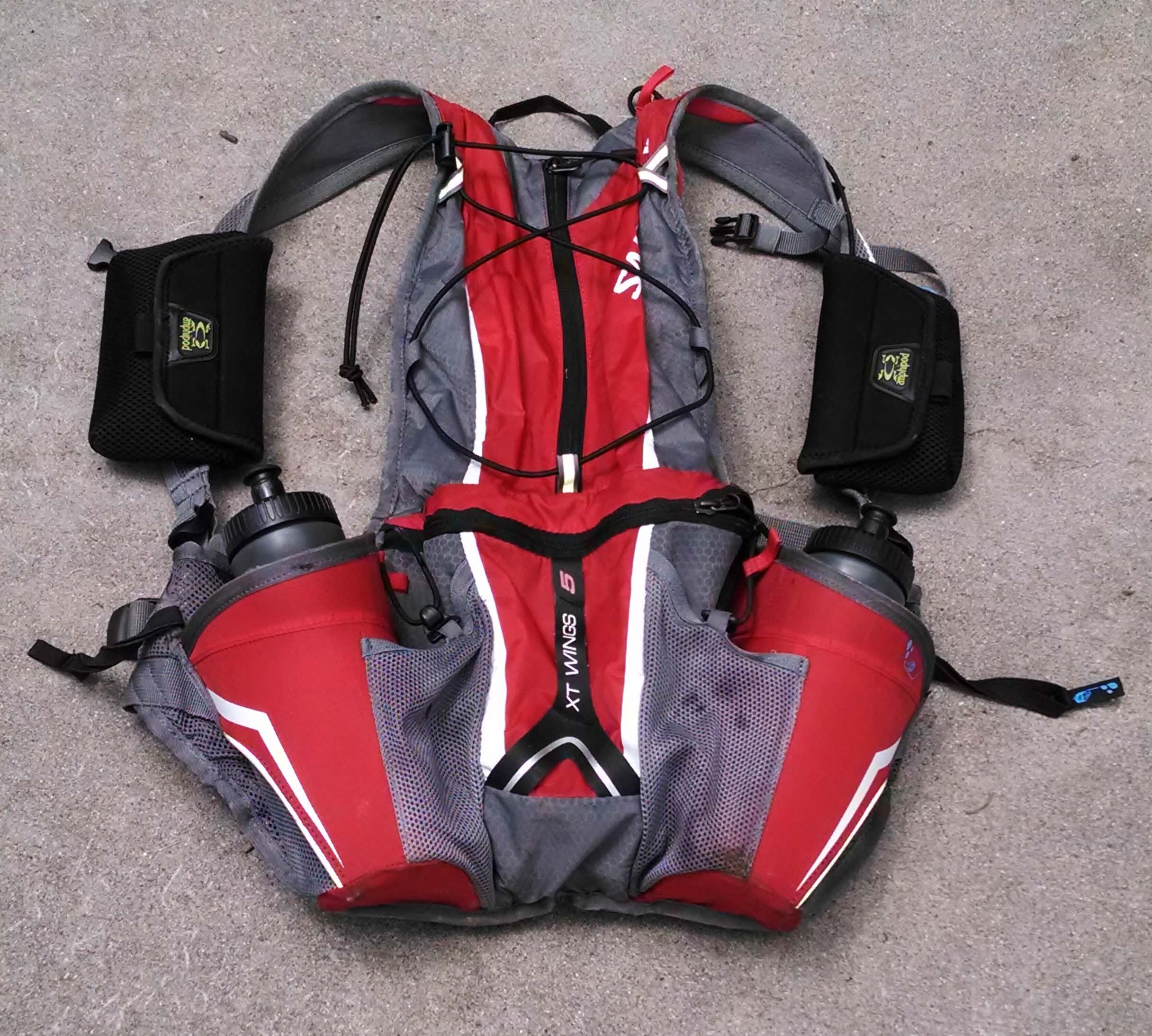
For long unsupported runs (especially on trails, or remote country roads), nothing beats a running-specific backpack.   Just large enough for hydration, fuel and an emergency layer; cut to allow full motion; a good pack can extend your comfortable range, all by itself.

Salomon XT Wings crop

Most that I see in stores or catalogs use an internal bladder, but I love this model from Salomon because it carries two separate bottles right outside, where you can conveniently grab and replace them without breaking stride (it also accommodates a bladder, but I’ve never bothered). I prefer the bottles because I can fill one with electrolyte drink, and the other with plain water (especially necessary to wash down gooey jells and snacks, and much better for pouring over the old scalp than energy drinks…).

On trail runs, one of those bottles is a Katadyn, (see separate ‘Things That Work’ posting) that filters water from any source, another reason I prefer bottles over a bladder. And on a recent ‘minimally-supported’ event (aid stations three to seven miles apart; too far for me to go dry in between) it was a lot quicker to refill my bottles from their jugs than a bladder would have been.

My only gripes (and they’re small ones):  this pack does not quite adjust down to my torso (I’m just shy of  5’-4” on a good day) and there are supposed to be snap-in holders available to carry a gel flask on the front of each shoulder strap, but I’ve never been able to find them for purchase.  As you can see, I ended up jury-rigging two Amphipod Velcro pockets to do the job (sort of), but I’d still love to get the proper accessories (any Salomon reps. out there reading this?).

Other than that though, I’m sold on this pack which has a couple hundred miles on it  by now, and I expect will have a lot more before I bother looking at any other.

Finish Line Etiquette – Part 1

If you’re a Mid-Pack Runner, then by definition there are folks finishing after you, some of whom may be radiant with achievement, some of whom are likely to be struggling for all they’re worth to achieve their goal.

Now I don’t want to take anything away from front runners – those Dionysian souls whose ability to take-in and process oxygen makes the rest of us look like we’re sucking atmosphere through a sippy-straw, but a part of me says if it takes a person more than twice as long to complete the course as the leaders took, then that person has probably worked way more than twice as hard.

Unfortunately though – and especially in small local events – by the time these dedicated souls come around the last turn, there may not be many spectators to greet them, and that’s a shame.

My suggestion is, after you’ve finished your own mid-pack run and taken a few minutes to catch your breath and grab a drink of water (and maybe free those tired toes from their running-shoe-captivity), consider spending some time standing ahead of the ‘Finish’ line, clapping and cheering for those who come in behind you. You don’t need to think up anything brilliant to say – most runners will be so focused on toughing out those last few strides that all they’ll register is the general hubbub – just make some noise with your hands and your voice, or by banging on something handy, and trust that they’ll appreciate it.

I’ve done this many times, and find it can be downright humbling to realize just how hard some runners push themselves, in full knowledge that they are finishing toward the end of the pack. Spend a few minutes shouting “Way to go runner!” or something equally banal, and chances are good you’ll find yourself gaining enthusiasm for your next Mid-Pack Run.

Katadyn Filter Bottle

Long trail runs demand plenty of hydration – but who wants to lug a ton of water up a mountain?

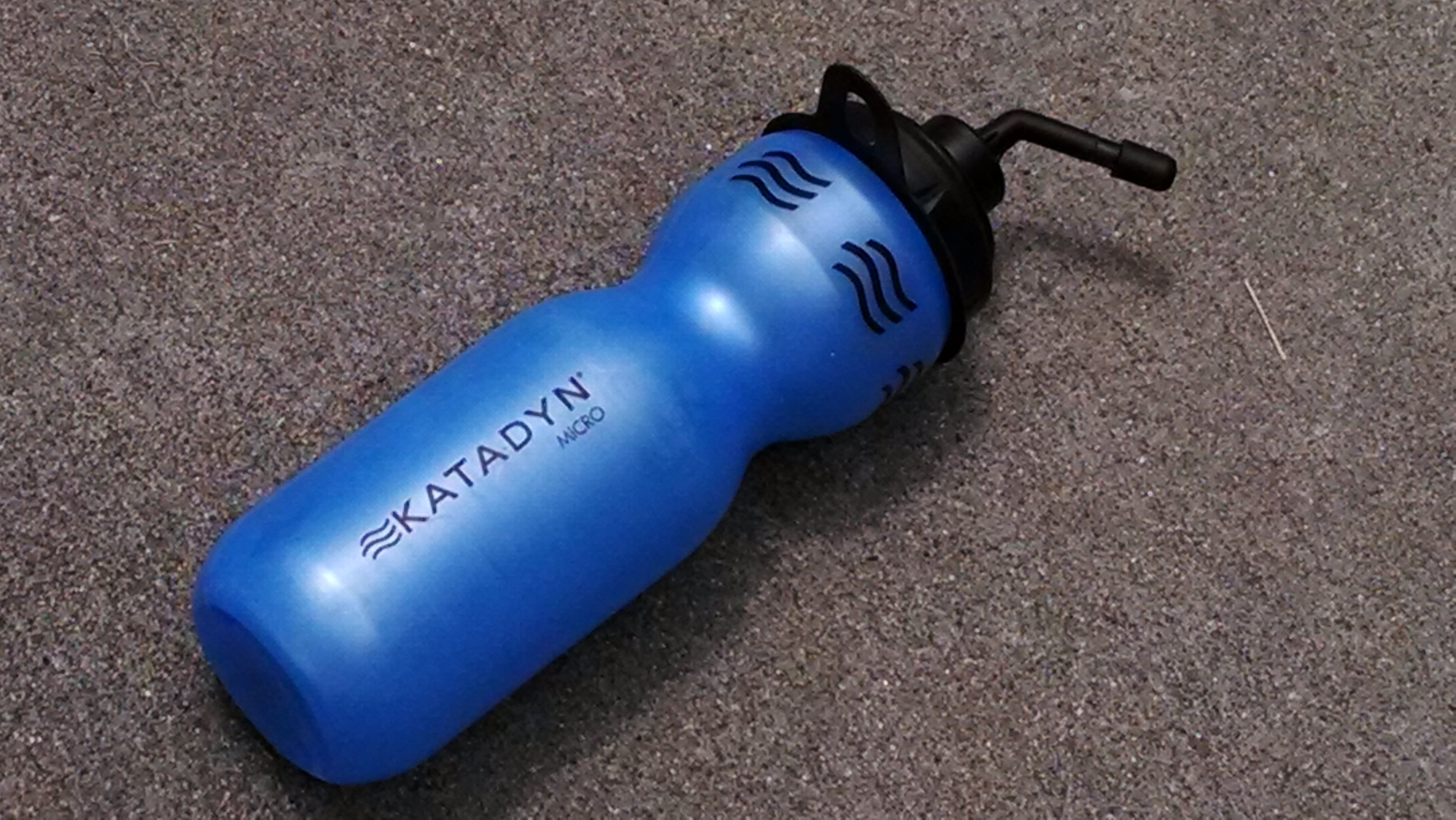
One answer that works for me is to carry two bottles, both filled before I start. One is a standard water bottle, the other is a Katadyn bottle with built-in filter. I drink from that one first, and whenever I pass a creek or pond, unscrew the cap and pull it off, bringing the filter with it. Dunk the bottle far enough to fill it to the line, screw in the filter and cap, and I’m re-supplied in seconds. According to its website, Katadyn is the only EPA approved filter-in-a-bottle, and it removes viruses, bacteria, cysts and chemicals. I’ve been doing this for several years, drinking from streams and lakes in mountains, desert and ranchland (un-cooked cows are not hygienic…) and never a trace of any untoward reaction.

That other bottle of tap water from home? I keep it in reserve, in case I empty the filter bottle before finding a new source. Doesn’t happen very often, but it’s reassuring to always have a full bottle available, even when you’re miles and hours away from the trailhead.

Another bonus – if you refill from a cold mountain stream, you get to drink refreshingly cold water. Try that with a bladder that’s been on your back for twelve miles in the sunshine!

My Katadyn (pictured)

Katadyn

is an older model; check out the website for the latest:

http://www.katadyn.com/usen/katadyn-products/products/katadynshopconnect/katadyn-water-filters-ultralight-series-products/katadyn-mybottle-purifier-blue-splash-1/


Ease-in the Clutch

Ever forged your way up a hill early in a run, only to find, when you come upon another hill later, that your legs feel leaden and unresponsive? I certainly have, in fact it has always seemed to me that there was only so much climbing in my legs, and once it was used up, it was gone for several days. Now, I’m not so convinced.

Preparing for a rather intimidating trail event that that includes several large climbs spaced out over the total distance, I set the goal one morning of running up the largest of the climbs twice in a row – with even a distant thought I might be able to tough-out three laps. (Masochism runs in the family…)

The first time up was just as I expected with a fresh start; hard work, but steady, and I crested the ridge in decent (for me) time. On the way down I reveled in gravity’s assist while reminding myself not to overdo it – I’ve learned the hard way that even on a steep downhill, too fast a pace can take it out of you, and I had another lap planned.

Once at the bottom I turned right around and headed back up, but this time, because I’d set such a stiff goal – two laps on a hill I’d always considered an achievement to do once – I set out pretty slowly, telling myself it would be enough just to keep a running stride, regardless of the pace. Enlisting the music in my headphones to drown out the cries of my leaden legs, I settled in to daydreaming, but here’s the thing – when I glanced down at my GPS a good while later, I was surprised to find myself not that far off the pace of my first lap, and feeling almost as strong!

Which made me wonder: maybe that dreaded dead-leg syndrome was not so much about the exhaustion of particular muscles, as it was about the shock to the entire system when different muscles were enlisted in different ways to transition from downhill (or flat) to climbing once again. Between my low expectations and the distraction of music coming from my Shuffle, I’d managed to coast thru that transition and only gradually drift back up to the cadence, stride and level of effort that my conditioning caused to feel natural.

Now, I’m not saying it was painless getting up that hill again, and yes, my time was a bit slower than the first lap, but I made it feeling surprisingly strong, and headed back down with newfound optimism. Enough so that there was no doubt about trying for lap three, on which I made a point of starting out super-slow, and only building the pace as my legs felt capable, which they did after a few minutes of perfunctory complaining. Cruising down after cresting that ridge three times felt great, and I found myself looking forward to the upcoming event more than ever before.

From now on, my goal when approaching yet another hill will be to ease-in the clutch as slowly as possible, allowing the wise physiology of the body plenty of time to drop into a different gear before asking it to do its best.

Where Men Win Glory, Jon Krakauer

Journalism at its best, as Krakauer rescues a worthy role model from the politically-motivated banality to which the mass media reduced him. His telling makes one feel the loss of Pat Tillman – and the Defense Department’s subsequent cover-up of the fact it was friendly-fire that killed him – as a visceral, personal tragedy. His extensive attributions and quotations of the perpetrators’ self-justifications convincingly assure that this is not a hatchet job. What it is, is one more example of the random wastage of a nation’s greatest resource, with no point or benefit in the instance, whatever one’s opinion of the validity of the cause which has been proclaimed.

Especially poignant is Krakauer’s treatment of the moment of Tillman’s death – a passage which cannot be read without pausing for tears and an acknowledgment of the ubiquity of death and injustice. Equally moving is the plight of Marie Tillman, Pat’s widow, who seems condemned to live on, knowing how unlikely it is she can ever match the heights of love and joy she shared with Pat.

Painfully-effective storytelling, and a service to both the protagonists and the wider community.

The Warm-up Factor

Ever lace up your shoes and head out the door, only to have that the first mile blow you away with how easy and natural it feels, then look down to find a fabulously fast time on your watch at the end of it?

Neither have I.

In fact, I usually feel like the first part of every run is a total slog, calling into question whether I have any business being out there; if I shouldn’t just pack it in and head for the couch. Other runners I’ve talked to say the same thing.

Run with a GPS though, set to show current pace, and you may be able to watch what’s happening. Going out strong, that first mile pace is likely a full minute (or two) slower than your brain says it ‘should be.’ Get distracted by the traffic, the scenery, music or thoughts, and the next mile comes up faster, with the same perceived effort, and the next one may be quicker still.

More than reading any articles or books, observing those times has proven to me that there really is such a thing as warming-up – that first few minutes (or at my age, fifteen!) when the body is shifting gears, re-allocating resources and getting its bio-chemical support systems up to full operation. Getting on a treadmill with a heart rate monitor tells a similar story – for the first few minutes my heart rate seems way higher than it should be, even at a moderate pace, then gradually settles down. Halfway thru the workout, I find myself running a faster pace at a lower heart rate – and with less perceived effort.

Recognizing this can play into strategy for events. For short distances, make sure you are thoroughly warmed-up before the start. That’ll make every measured mile count in your favor, and since it’s a short event, you don’t have to worry about your warm-up draining energy reserves enough that it might hurt overall performance.

For a longer event, where stamina is the key and a slow start can get evened out over many miles, you may choose only a minimal warm-up, and let the rest happen in the first part of the event, conserving your body’s reserves for the long haul. That’s especially true in mass starts, where you’re going to be held back by the crowd anyway, so you may as well let that initial ‘Times Square Shuffle’ be your intro.

Any way you play it though, recognizing the Warm-up Factor can help reduce that ‘what was I thinking?!?’ reflex to a minimum.

Is this a pain, or what?

A very important person in my life likes to say, “if it hurts… don’t do it!”

As a runner I respond, “well, yeah, but…”

Truth is, if you’re at all interested in running, you’ve probably heard or read comments like “running to your full potential requires a high tolerance for pain…,” and even those of us in the middle of the pack – who may not be hell-bent on pushing our limits – have to expect some level of unpleasant sensations. Heat and sweat, hunger and thirst, sore tired muscles, rubbing and blistering, they all come with the territory, but are they really ‘pain’?

My battered old paperback Webster’s defines ‘pain’ as “physical or mental suffering…” and I’ll admit that sounds a lot like how running sometimes feels. Fortunately, the good Dr. Daniel W. goes on to say “… caused by injury, disease, grief, anxiety, etc.,”   Now we’re talking! ‘Pain’ is that category of suffering which is caused by some sort of negative influence; ergo – I love using that word; it sounds like the name of the robot dog in some sci-fi carton series, doesn’t it? – ergo: the category of suffering caused by something which is not negative or destructive, is not ‘pain.’ (It’s just ‘suffering,’ as if that is any better, right?)

Well, actually, this MPR does find it is better, especially if you take it one step further and consider that suffering is not all that different from ‘being uncomfortable.’ If I am suffering because I’m pursuing something I love and enjoy (even if I enjoy it most when I finally stop, having achieved my goal for the day…), then I’m not in pain, I’m just uncomfortable, and you don’t have to be a Navy Seal to know that life isn’t supposed to always be ‘comfortable.”   (You just have to have a few Scottish-Presbyterian ancestors – or Eastern-European, or African-American, Jewish, Korean, or any other nationality or ethnicity that had to work and struggle for survival or to establish themselves in a new strange land – which is all of them).

So when the going gets tough and the right side of your brain says “I’m in pain,” use the left side to drill down thru the sensations and figure out just what is causing them. If you can tell that something is doing damage, will potentially cause you not to be able to run tomorrow or the next day, then by all means, pull over and take care of yourself. But if the answer is no, I’m not doing damage, I’m just sore – or tired or hot or hungry or (fill in the blank) – put it in the box labeled ‘uncomfortable,’ do what you can to get more comfortable (take a drink, eat a gel, vary your stride, strip off layer…) and get on with the laudable objective of proving yourself ‘Too Stubborn To Stop.’

Why Not To Be Lead Dog

If you read this blog, you’ll know by now that I have never actually led a running event, but I have run some very small events, and one of those taught me a lesson about being ‘leader of the pack.’

The Grand Valley Marathon (Palisade, Colorado, is wonderful, but tiny. In fact, one year I ran it, there were a total of twenty-seven finishers. Even considering there were a few more folks who DNF’d, spreading that few people across 26.2 miles means a lot of empty course and so, for several miles of this out-and-back, I got to experience a bit of what a Lead Dog must feel – nothing but open course from my nose to the finish line – and I have to admit I was enjoying the fantasy.

My big lesson came at mile 23 though, when the road we’d been following forever (at least it seemed like forever at that point) reached an intersection and for the life of me I could neither find a race sign nor remember with any certainty which way we’d entered this same intersection twenty miles before. Fortunately (I thought) the road heading off to the left rose up onto a bridge across the Colorado River, giving me a clue: starting about mile 2, we had followed the river’s bank for a mile or more, so I picked up my stride and headed down the road that seemed destined to hug the river, only to find myself, several minutes later, in a neighborhood I was sure I had never seen before.

You can guess the rest – I’d picked the wrong road, and by the time I was certain of that, I’d gone half a mile off course. And by the time I’d stood around being angry with myself, despaired at what this would do to my hoped-for finishing time, actually quit and started to walk back to my car before my left brain finally convinced my exhausted right brain that the morning would be better spent if I finished disappointingly-late than not at all – and made my way back to the intersection, where I immediately observed another runner not making the same mistake – I’d eaten up a good fifteen minutes. All because I’d been out there with no one ahead of me!

Not getting lost – one more way in which the view can be just grand, when you’re not Lead Dog!

GPS Will Free You

One of the things I love about running is it simplicity – no deraileurs to adjust, no flats to repair by the side of the road in a chill drizzle – and the freedom to go nearly anywhere – pavement or trails, rural or urban, crowded sidewalk or lonesome nowhere. So it may not be surprising that I put off for a long time any thought of using a GPS. From the early handhelds to the initial wristwatch styles – comically oversized even on a big man’s wrist, which I do not have – they seemed like one more way to make our sport expensive, complicated and regimented.

At the same time, I accepted without thinking that I must limit serious training runs to half a dozen routes around home which I had been able to drive or measure on a topo map, so that I knew the distance accurately and could compute my time and pace. Runs in unfamiliar locations, while fun and rewarding, were pretty much just for maintenance, since I had no way of knowing how far I’d gone. Yeah, you can use Google Earth and map a route and get a distance, but it’s pretty cumbersome and not all that accurate unless you zoom way in to follow each twist and turn, not likely when you land in a new city and want to explore its neighborhoods and parks while maintaining the build-up to that next event.

Which is why I did eventually succumb, and discovered that running with a GPS actually grants me the freedom to run anywhere, and still keep track of it.

Not only can I go out to explore a new city, but even here at home, I no longer have to stick to established routes. Want to detour and add a hill?  No problem. Want to detour and avoid a hill? No problem. Feel like exploring that neighborhood I’ve run past a score of times but never ventured into? No Problem!

With GPS you can wander to your heart’s content and not only know how far you’ve gone today, but store that info away as a possible objective for the future. Where previously I’d felt limited to a few pre-measured routes, now every road, path or trail is a potential training route.

Just goes to show, you can teach an old dog a new trick, it just takes a little longer – and GPS will be happy to tell you just how long.