Category Archives: Books Worth Keeping

Plenty of books are worth reading once.
These selections are good enough that they deserve shelf space; to be remembered and referred to, and to cherish the prospect of one day experiencing them again.

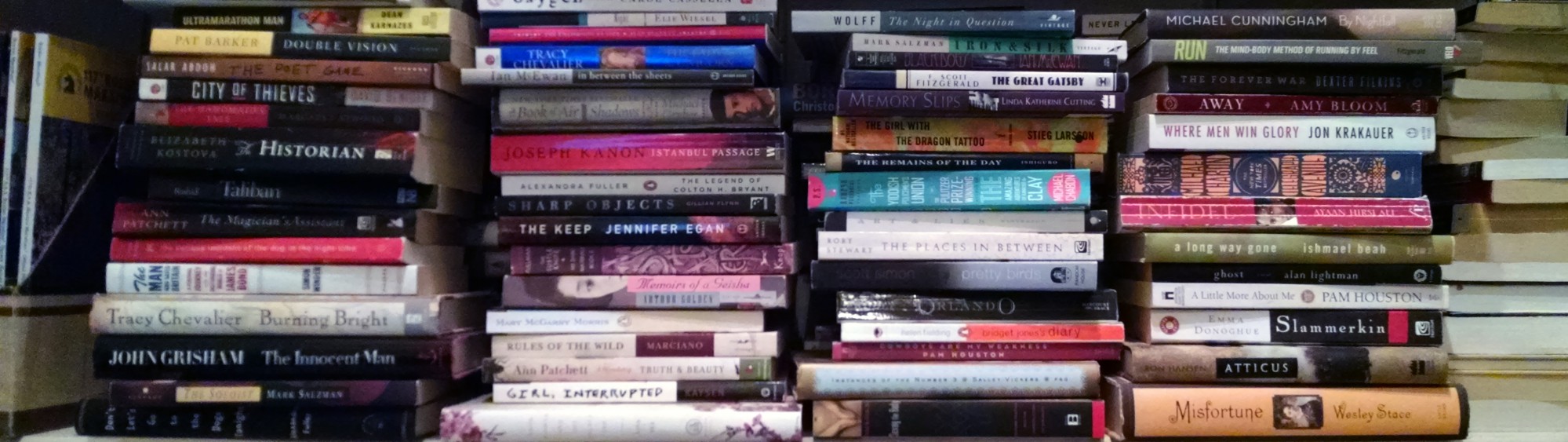
Where Men Win Glory, Jon Krakauer

Journalism at its best, as Krakauer rescues a worthy role model from the politically-motivated banality to which the mass media reduced him. His telling makes one feel the loss of Pat Tillman – and the Defense Department’s subsequent cover-up of the fact it was friendly-fire that killed him – as a visceral, personal tragedy. His extensive attributions and quotations of the perpetrators’ self-justifications convincingly assure that this is not a hatchet job. What it is, is one more example of the random wastage of a nation’s greatest resource, with no point or benefit in the instance, whatever one’s opinion of the validity of the cause which has been proclaimed.

Especially poignant is Krakauer’s treatment of the moment of Tillman’s death – a passage which cannot be read without pausing for tears and an acknowledgment of the ubiquity of death and injustice. Equally moving is the plight of Marie Tillman, Pat’s widow, who seems condemned to live on, knowing how unlikely it is she can ever match the heights of love and joy she shared with Pat.

Painfully-effective storytelling, and a service to both the protagonists and the wider community.

Any Human Heart, William Boyd

What a Find!

I picked this up at the informal lending-library outside a local liquor store, just on the strength of the back-cover blurb, and it turns out to be one of my most satisfying reads in years. A sort of super-literate anglophile Forrest Gump, this is neither more nor less than the story of one life, well-lived and equally well-told.

While the central conceit – a bundling up of episodes & intermittent journals – at first sounds limiting, it actually frees the author to tell only the parts of Logan Mountstuart’s life he chooses, and to insert ‘editorial’ exposition where needed to bridge the gaps of time or detail. At the same time, the first person voice of a protagonist who is credibly both educated and introspective gives access to thoughts and emotions without seeming fake or forced. The upshot is that this reader experienced Logan’s ups and downs quite personally, especially the decades-later mourning of his second wife and daughter, random victims of the London Blitz.

In my book, Boyd is a writer to seek out, up there with Ann Patchett and Michael Cunningham – smart, generous, entertaining and meaningful.


Again, this is a find.

West With the Night, Beryl Markham

It is delightful to read of a woman having such adventures in the early 20 th century without apparent trace of gender resistance or romantic overlay.  Perhaps it is the wildness of Africa that allows this, or perhaps self-editing, but either way, Beryl Markham’s memoir  furnishes a shining example of the non-universality of our commonly held stereotypes.

As a writer, Markham tends to the florid, as is typical of her era.  Still, she can kindle excitement at a chase, and when it comes to her own actions, she leans to dryness and understatement.  One actually wonders if a biographer might expose even more drama in this material than does the subject herself.  The Africa of which she tells has plenty of inequality, though the racism which underlies it seems, in what is perhaps a Colonialist’s view, genteel and respectful.  Of course there is plenty of exploitation going on beyond the horizon, setting the stage for later, less sanguine, interactions.

An enjoyable and eye-opening artifact of time and place, as well as a glimpse of an admirably independent spirit.

A Yellow Raft in Blue Water, Michael Dorris

A work which grows, as one progresses through it, from anecdote, to story, to fable.  Dorris effectively manipulates the reader by telling first the tale of the youngest of three women – Rayona – inviting us to form opinions (or judgments, given the poor nature of some of her choices) of her character and actions.  He then proceeds to tell first her mother’s – and then her mother’s – stories, overlapping, braiding and, in the process, shattering our neat conceptions about what is good or bad, and who is right or wrong, victim or abuser.

Dorris’ prose is generally straightforward, allowing objects, events and his characters’ thoughts to tell the story.  Only occasionally does it rise to more florid description, but it is the detail and personalities which make the story seem so real, the women totally convincing even when their actions are not ones with which many readers may sympathize.  That, and the author’s even-handed telling, which seems to reflect the moral conviction with which his bio suggests he lived his too-short life.

A work which has its own objectives, neither the quick entertainment of the popular novel, nor the showy intellectualism of the academic, but an honest desire to tell of people too easily forgotten, and thru them reveal a bit of basic human truth.