Author Archives: robinandrew0804

Unknown's avatar

About robinandrew0804

Robin Andrew is my pen name; I’m a runner, a writer, and a parent, from a small town in central Colorado. As a youngster, my biggest athletic aspiration was to not be the last person picked when teams were chosen for games. Since taking up running for stress relief (right about the time our kids entered their teen years - go figure) and fun, I’ve run fifteen marathons and dozens of other events, on both pavement and trails. This site is my way of sharing the joy and sense of accomplishment I’ve found in simply putting feet into motion, plus a few other bits and pieces of what I find interesting and worth caring about.

The Art of Running in the Rain (or ‘Whatever can go wrong, will go wrong, partie deux’)

April being the month of showers, an event back in 2018 comes to mind, where weather was forecast to be in the low to mid 30’s F, with steady heavy rain and serious gusting winds.  At mid-pack pace, I’d be out there for a good four hours, so this was definitely gonna be a gear-critical day.

Figuring the regular ¾-length compression tights would leave too much flesh exposed, I opted instead for a full length pair I’d brought along for casual wear. Fast forward to a couple of miles out in the rain and their stylish light-weight fabric started sagging and bagging. Couple more miles and the butt-covering portion had sopped up enough water to become a noticeable dead weight hanging noticeably below where it was supposed to fit.

Given that weather forecast, gloves were definitely in order, and figuring plain fleece would absorb too much moisture, I’d opted for a pair of thinner gloves with a wind-stopping nylon-hood sort of feature that could be pulled over the fingers to approximate the warmth of mittens. That nifty nylon hood kept the wet out for, oh, a good 30 seconds or more, after which the stretch material beneath it became thoroughly soaked and lost whatever insulating properties it might ever have.  Which meant my fingers were too stiff and bulky to retrieve a gel from a pocket without removing a glove, which I promptly did, only to realize those gloves had actually been keeping my hand considerably less-frozen than hanging them out naked in the downpour. Seconds later came the further realization that thanks to the glove’s soggy stretch- fabric, it took a full stop and an eternity of pushing, pulling ,shoving and tugging to get the sticky shrunken mass back onto my hand.

Thus was the rest of the run spent alternately struggling to pull up my tights and begging spectators to put my gel flasks back in their belt-holders for me after fueling – which ended up occurring about a quarter as often as necessary, thanks to the frozen claws.

The lesson learned is an old one – never try anything for the first time during a run that counts. The big event should be the big event, not a Myth-Busters experiment, so test out all gear beforehand, under the most realistic conditions possible (in this case, I suppose I should have stood under a gushing hose in a walk–in cooler for an hour or so, but even I’m not that sick).

So, what does work in the rain? First off, a cap with a long, stiff brim, especially if like me, you need to wear glasses. Head tipped forward, brim pulled down low, I swear I never saw anything on that April day that was more than about 8’ in front of my toes, but my glasses stayed clear (which is a good thing ‘cause there’s no way I’d’ve been able to wipe them off in the downpour).

Another sure thing – wool socks. Wet or dry, they keep the piggies warm (and fight blisters to boot).

And finally – forget the waterproof jacket!  My two cents is, if you’re running, you’re gonna get wet from the inside anyway, so anything with enough water-repellency to keep the cold water outside and the warm moisture inside is good enough. What really matters are pit-zips! That nifty little invention lets you vent heat and moisture where they build up the most, while keeping the actual vent openings about as well hidden from vertical precipitation as anatomical geometry will allow. Pit zips be the bomb; jackets without them are the pits!

Avoid hypothermia, keep your hands useable and your vision clear, your head down and your feet moving till you get to that bundle of warm, dry gear you’ve stashed at the finish.  Sometimes that’s the best we can do, but it’s still called…running!

Is Running Relevant?

Amid the tragedy of a pandemic and its terrible economic fallout, it seems almost irresponsible to be writing about running. Whether you call it a hobby, a sport or an obsession, aren’t there more important things to have on the mind right now than going out for a run?

Of course there are, but the world is not an either/or kind of place. For all but the most deeply central (health care workers, first responders, home care workers and others; thank you one and all!) it’s possible to give adequate attention to the crises and still carve out a little time for other things as well.

Plus: our limited, tentative, developing knowledge of Covid 19 suggests that it, like so many diseases, hits hardest those who are already unwell. And while some folks cannot avoid the conditions that put them at risk, there are many who have the potential to improve their health and so become less vulnerable. Regular exercise is a strong component of getting and staying healthy, which in turn allows help to be focused on those who need it the most.

If that is not enough justification to keep the conversation going, here’s another twist. Before running yesterday I was studying a problem on which my architect colleagues had asked for help. Looking at the drawings and questions I could readily see the challenges, but the solutions I was thinking of were predictable, and not really an improvement. A little later though, chugging up a steep grade with the sweat pouring out of every pore and the sound of my own breathing drowning out the playlist in my ears, something else popped into the old noggin. ‘Change this wood frame to steel, hide the frame up on top of the panels, assemble it on the shop floor and use the exposed spots of the steel frame to attach suspending rods, and bingo, Bob’s your uncle!’

Now I was a student once (a long time ago, in a galaxy far, far away…), and I know that ideas which look great in the dim din of a tavern or the heated atmosphere of an all-night buzz-session are rarely as attractive in the light of day, but over the years I’ve found that mid-run ideas have a much higher survival rate. This particular endorphin-powered light bulb was just as illuminating when I got back to my desk and drew it up, and when I talked it over with a colleague via Zoom, as it had been when it mushroomed up out of a 5-step running cadence. So….

  • a moderate fitness habit can help you stay healthy and less vulnerable to even a predator like Covid 19.
  • It can also help to keep the bad events in perspective, strengthen the spirit and allow optimism to thrive – a healthy mind is a more-effective mind.
  • Repetitive motion activities can free creative regions of the brain to do their best work, which can result in useful ideas, in whatever field one endeavors.
  • Running is one of the simplest, most accessible (we’re talking moderation after all, not Olympic Trials) ways to achieve all those benefits.
  • It’s good for you, it’s not bad for the environment, and it might just lead to a good idea every now and then.

Conclusion?  Even today, running is worth thinking about, talking about and doing.

Go for it!

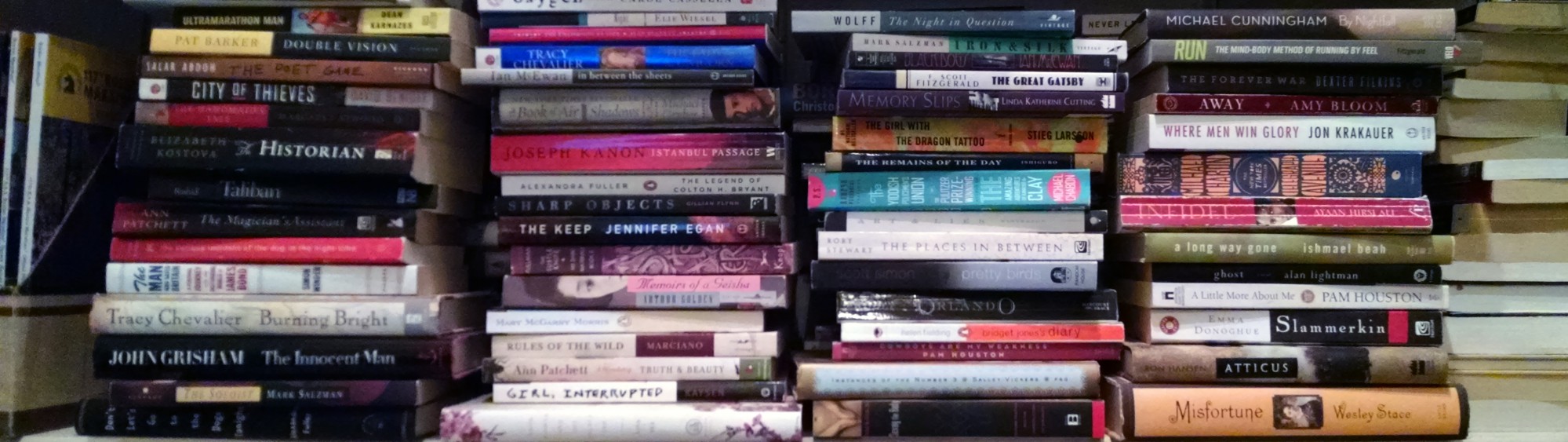
A Single Thread, Tracy Chevalier

As a ‘surplus’ woman in an England still reeling fourteen years after the 1918 end of The Great War in which two-million young men of her generation were wiped away, Violet Speedwell struggles to find any trace of meaning or purpose in her life. Brother, fiancé and father all dead, mother an intolerably-abusive emotional wreck and her opportunities deeply constrained by gender, custom and the dearth of even marginally-desirable suitors, her only sense of achievement comes from having moved-out to a boarding house room in the next city and managing to live on her own, though that living is marginal at best. Desperate nostalgia for the warmth of child-time church visits (one possible interpretation of the novel’s title) leads her to discover ‘the Broderers,’ a group of women engaged in embroidering new soft goods for Winchester Cathedral. It is that encounter which allows her to forge some tenuous personal connections and so drives this totally-engaging and moving tale.

This is necessarily a narrow tale, as Violet’s life is limited by circumstance and prejudices, yet the author uncovers sensuality in a hungry woman’s reactions to food and drink, entrepreneurialism in others’ efforts to survive when their jobs are lost to bigotry, and even a range of sexuality. The illicit love of two women is treated with empathy and honor, making clear that it is love for its own sake (‘their own sakes’?) not just a make-do for the lack of eligible men, as some of their compatriots rationalize it. Violet’s own romance, a sparse affair with a married man devoted to caring for a wife tormented by the wartime death of their only son, is doomed in most senses, yet still nurtures them both in important respects, even before it produces the slender thread of permanent connection that restores meaning to each of them and to the novel’s title.

Along the way we learn about embroidery bell-ringing and church customs, and are reminded of how material our modern lives have become as we see Violet live with barely more than a suitcase-full of possessions. We also discover real artistic ambition and achievement in women (the actual historical figure of  Miss Louisa Pesel, in particular) whom we might otherwise dismiss as slaves to convention, decoration and rote following of recipe.

More than any of Chevalier’s earlier novels, this one opened my eyes to what she is really doing, correcting the lack of female figures in familiar moments of cultural history by novelizing them through a female point of view. From the tapestries of the Lady and the Unicorn, to the paintings of Vermeer in Girl with a Pearl Earring, the writings of Wm. Blake in Burning Bright and the discoveries of Darwin and early fossil hunters in Remarkable Creatures, Chevalier illustrates that women were present and integral to the work for which men have been so lauded. Not only that, but those women’s contributions were made under duress and restrictions far greater than the men ever faced.

Each volume entertains and enlightens at the same time they serve, both singly and as a body, that very worthwhile social purpose. Brava, Ms. Chevalier, brava.

Boudica, Vanessa Collingridge

Subtitled ‘The Life and Times of Britain’s Legendary Warrior Queen,’ this hefty volume turns its narrative outward from the individual to her context, becoming in effect a survey of the entire history of Britain as a nation and a people, lensed around the largely-mythical warrior queen. While at times that feels digressive or indulgent, in the end it provided this Yankee with plenty of useful insight into how a group of disparate warring tribes evolved into a world power and an important culture.

Collingridge writes somewhat as one would expect of a television presenter, lots of grand characterizations mixed with occasional insertions of her first person (‘I was nearing the end of my search for the legend’ sort of stuff) but has clearly done a great deal of research, with frequent source citations and an impressive bibliography. The sense is of an author eager to demonstrate she has qualifications above and beyond her popular success and it mostly works, despite some unfortunate lapses in editing and copy-proofing.

The first 150 pages or so hardly deals with the title character, but gives instead an overview of Rome’s imperial grasping toward, and eventual invasions of, the British Isles. The depth of that background at first seems odd, but then makes sense as it places the eventual tribal rebellion in a proper context. More than that, it makes abundantly clear that there was no ‘Britain’ or ‘England’ until the Romans conceptualized it as a way to refer to the region they claimed to have conquered. Once Boudica (or Boudicca, or Bodicea; the variations due to different hearings, translations and monkish typographical errors) herself comes on the stage, we realize that almost nothing is factually known about her; whatever spelling one uses, she is largely the fabrication of other authors down the ages, starting with the writings of her Roman opponents, Caesar (the single contemporary), Tacitus (writing decades after) and Dio (another hundred years removed). Their meager and un-confirmable portraits, which Collingridge points out are most-certainly biased by their politics, have then been repeated, massaged and embellished over the ages. Several middle chapters then recount the rebellious Queen’s battles and eventual demise, a tale which is surprisingly brief, even fluffed out with plenty of speculative recreation and embellishment. The third and concluding part of the volume is again more substantial, as it depicts the morphing of Boudica’s story and image to serve the changing needs of the British people and politics at various stages of their history through nearly two thousand years to the present (Boudica and Princess Diana making a particularly interesting pairing).

Along the way one learns that Druids are not originally Welsh or even British, but of continental origin, as is the term Celtic and even the La Tene art style which we today refer to as ‘Celtic design.’ Nor are present day Druids in any real way connected to the historic ones – so little is known about what the original Druids actually believed or did, that any modern versions are really just fabrications by poets and others from the Romantic period onward. How New Age-y! On the related subject of archaeology, Collingridge voices appreciation for the findings of ‘metal detectorists’ who scour the countryside in search of finds. In the end though, the reader’s dawning realization that not one of the objects found to date can actually be tied to Boudica herself only emphasizes that all talk about her is speculation, at best, or fiction, at worst.

A rewarding read (with some judicious skimming now and then, when the pedantry gets excessive), Boudica ultimately affords enough detail and insights to be well worth the journey.

Running Both is Funnest

After writing last time about slow running for those just getting into the habit, I was interested to see a recent column, The Art of the Easy Shuffle, by David Roche. For those who do not know Roche, you should check out his work in the print or on-line editions of Trail Runner magazine, where he combines knowledgeable analysis of the most-current medical studies with his real-world experience coaching athletes of all levels. You can also find his coaching service, Some Work, All Play at https://swaprunning.com/.

Anyway, in that recent column, Roche was recommending that experienced runners incorporate a significant amount of slow running in their training plans. Even for the most hard-core, Roche pointed out, slow running is a way to build total volume (geek speak for ‘miles per week’) with less risk of damage to the body. Aerobic fitness (the body’s ability to draw oxygen out of the atmosphere and get it to the muscles to fuel their work) is another proven benefit, with studies showing that the maximum potential to increase that fitness comes from lots of aerobic exercise (at or below the level sustainable for an hour or more, i.e., low to moderate effort) not from the more intense anaerobic exercise (output above that level, i.e, running hard, and thus fast).

Great technical knowledge and great for the hard core, but a recent run reminded me of an altogether simpler reason for running slow – it can make you hungry to run fast again!

Pounding out a 10-mile mid-week run was decently satisfying, and there was plenty to pay attention to – checking the heart rate to make sure it was still averaging below 140, self-correcting stride to avoid heel strike, pulling the head back to keep eyes up and neck tall, taking time to see the sights – but as the GPS read off eight miles and then approached nine, it felt a bit like medicine to be choked down. What a relief then, to crank the dial up a couple of notches at the start of that final mile, a little more when GPs showed just a half to go, and all the way to 11 (for all you Spinal Tap fans out there) for the final quarter. Yeah! – that felt great, and because the first 90% of the run had been moderate, it felt downright easy. There was no pain, no worry about damage, and very little fatigue. Best of both worlds, you might call it.


So; try slowing down for a good part of your regular running (maybe as much as 60 of weekly ‘volume’). But if you’re feeling well and healthy when you get to the final ten percent of a run, allow yourself the pleasure of really blasting it. Feel the air moving past you faster and faster, experience the world narrowing down to just you and the pavement (or dirt if you’re that kind of bear). Maybe get your body forward a bit; more on the toes, less on the heels. Consciously lengthen each stride at the same time you push-off harder to fit more strides into each minute. You’re well-warmed up by now, all systems operating at capacity, so put everything you’ve got onto the ground as you approach the day’s target distance – whatever that is for you – and remind yourself of the simple joy of being alive and active in the physical world.

Running slow is fun, running fast is funner. Running both is funnest.

See you out there – from a safe distance!

Neverwhere, Neil Gaiman

Gaiman certainly has a knack for taking fantasy in titillating new directions. Mixing legend with pop culture, bridging generations and phases of life, his is an impressive improvisational-seeming voice; loose and loud and reasonably sound in its coherence and payoff.

Richard Mayhew, protagonist this time around, is a decent mensch, a modern everyman who seems just as lost in his own world as he will become lost in the underworld he discovers as a result of one decent – and so, uncharacteristic – act. Such a mensch, in fact, that his survival and eventual semi-triumph are a bit implausible, though satisfying nonetheless. The characters who surround him are pleasingly off –beat and appealing and their adventures offer enough cliff-hanging to keep one deeply involved.

Underneath it all, there glimmer a few bits of insight into human frailty, relationships and the failings of society. Just enough to ground this fantasy in reality and assuage the guilt of reading such fluff.

Yes, a pleasure all the way. Well done, Mr. Gaiman, well done.

Slowing Down – Whether We Like It or Not

In this time of Covid, some of us are finding our lives slowed down, with work hours curtailed, trips cancelled, commutes compressed from hours to seconds (for those lucky enough to be able to work from home).  Seems like there may be a few folks out there using some of that time to start – or get back to – a running habit, which is a great way to ameliorate the stress and stasis of their situations. For those folks, the Follow Dog has one suggestion above all – Slow Down!

“Wait a minute; running means going fast doesn’t it – I mean, isn’t that the difference between running and walking?” – Nyet! We say; a big, fat, ‘nyet’ to that!

The difference between walking and running is the stride – in walking one foot touches down before the other lifts off, so at least one foot is always in contact with the ground and bearing weight. In running, on the other hand (well, we’re not actually running on our hands, that’s another activity altogether), one foot pushes off before the other touches down, so there’s a moment in every stride when the runner is totally airborne. This can lead to speed, of course, but not always. What it does always do is require more and different muscle activity than walking, which requires – and therefore can build – greater strength and cardio-pulmonary capacity. It can also burn off tons of nervous energy, break our brains free from worries, help us to relax, sleep better and thus to be more effective at all the other things we do during our days, which is the best reason possible to get lace up those sneakers.

An earlier post (Slow and Steady, 9/4/14) talked more about this, and recommended beginning runners go as slow as possible for as long as possible, then build from there. That approach is even more valid right now: we do not need any more frustration than we already have, thank you very much!

So if you’ve got time on your hands (no, I’m not going there a second time), maybe try running, and if at first it doesn’t seem to work for you, try slowing down till you find a pace that fits. When life gives us lemons….

P. S. – The ‘oh yeah’ part: as some of our lives are slowing down, for others (health care workers, first responders, parents of young children), life has just gotten way more intense than ever. If you’re one of them, THANK YOU . For those of us who are not, let’s look for ways to help. And in the meantime, observing local restrictions and keeping a generous distance apart while exercising will ensure we’re not unnecessarily adding to their workload; it’s the least we can do.

Astrophysics for People in a Hurry, Neil deGrasse Tyson

‘For people in a hurry,’ in the sense that it this is a tiny volume, pocket sized with barely 200 pages and not small type; and also in the sense that a universe of complex ideas are treated briefly and with concision. Perfect for those who want a general sense of what terms like multi-verse, dark energy and Boolean Algebra mean, without the years of schooling and boggled-brains it would take to really ‘know’ this stuff.

For those folks (of which I count myself one), Tyson does a great job, leading us in somewhat random-feeling steps from the relatively-intuitive astronomic understandings that give us a map of the nearby (solar system, asteroids) to the tougher concepts that make up our current best understanding what the entire universe consists of, how it was formed and how it behaves, at levels from the molecular to the quantum. Along the way he delivers plenty of staggering numbers such as:

the portion of all matter/energy which is visible vs that which is totally invisible except through its effects – that being ‘dark matter’ and ‘dark energy’ accounting, for if memory serves, some two thirds of all there is!

The number of molecules in a single cup of water – which is greater than the total number of cups of water in all the oceans of earth!

The number of bacteria in one inch of a human colon – which is greater than the number of all the humans who have lived through all time!

And many, many, more

Of particular appeal are passages recounting a few great miss-understandings which even great minds have labored under, and how those very mistakes eventually led them and others to new discoveries, an essential part of the scientific method which is sometimes lost in the shouting matches of reactionary culture wars.


Once all that knowledge has been disseminated, a final summation touts the intellectual and moral benefits of these concepts being understood widely, partly to cultivate the skills of thought that will lead to success in other pursuits, but more importantly  to instill the awe, wonder and humility that enable us to better appreciate and manage our environment and culture. Some of that falls flat, as when he suggests the absence of atmosphere in space means we should not engage in ‘flag-waving’ about space exploration – a very tenuous stretch of analogy. For the most part though, Tyson is an inspiring democratizer.

All in all, a worthy volume to read, and perhaps a good tool to raise the level of conversation at cocktail parties and Covid-lock-down video calls. Thanks NdGT!

(which now that I’ve typed it out, looks like an algebraic designation of some great import…if I assign the value of G as 27 to tenth power, and T as the length of time since the big bang, and d as the cosmic constant, can I solve for the value of N?  Hope your not holding your breath!)

An Off Day, A Day Off

Yesterday’s run started OK – legs tired and stiff, but I expect that for the first two miles anymore, given age, and the extra miles I’ve been putting in since work was curtailed by the Covid-19 situation. (I’m not discounting the social distancing we’re all following right now, by the way, but I’m fortunate to be able to run on streets and paths where keeping mucho-distance from others is really easy, and fresh air and sunshine are pretty integral to keeping healthy and strong, if you ask this dog). Mile three was back to normal but it was downhill (the wrong kind of downhill) from there, a struggle to complete even slow mileage as the ol’ gas tank was clearly on empty.

Turns out there is only so much work my body can take, so this morning I settled for a walk around a nearby lake amidst a wet late-season snowfall. Stepping off the path I so regularly run, I wandered to the water’s edge, where slush dripping from tree branches pock-pocked rhythmically on the water and geese eyed me with suspicion. Moving slowly and stopping frequently I could scan the sandy bottom, where crawfish shells rested and a golf ball hid from the clubs of any locals intent on practicing their swing.

Farther along I walked a sandy stretch I’m used to seeing filled with toddling toddlers in the summer, now silent and smooth except for the toothy imprints of my trail shoes. A smattering of saplings which have sprung up from the muddy margins displayed their graceful curves against a misty distance, and even the nearby highway noise seemed muted by the density of moisture-laden air.

Heading back to the house ready for some coffee and warmth, I felt a great appreciation for the change of pace, the sights and sounds and smells. Not better than another run, not worse; just different. And different is good, in almost all things.

“Infinite variety, infinite combinations.” Those Vulcans are no dummies.

Owsley and Me, Rhoney Gissen Stanley with Tom Davis

Propelled by the excitement of the times and place – mid to late 1960’s San Francisco, this memoir of life in the Grateful dead family is a quick and fascinating read. Like more than a few other members of that scene, Rhoney Gissen came from wealth and dysfunction, and found in the hippie movement a refuge from the former, but not necessarily the latter. Her relationship with August Owsley Stanley III, better known as ‘The Bear,’ and later just Owsley Stanley, was very different from that with her parents, but no more healthy. It is a credit to Rhoney’s character that she not only survived, but overcame that treatment, to raise an apparently healthy and productive son (with the charmingly period-appropriate name of Starfinder Stanley.

Besides affording an entertaining travelogue, and a devastating portrait of the rampant misogyny of the movement (including the Dead, contrary to their counter-cultural reputation), this is Owsley’s story; the self-driven and self-centered genius who simultaneously revolutionized the recreational drug industry and the state of sound-system art while rubbing elbows and other body parts with a who’s who of psychedelic rock celebrities. Hendrix, Joplin, Jefferson Airplane, Joan Baez, Elvin Bishop, the Stones and the Beatles all make appearances, as do Bill Graham, Melvin Belli and many more. Seeing them from inside the movement puts lots of new spin on peace, love and freedom (which seems a better way to complete the trio than ‘happiness,’ given the bad trips, legal troubles, poverty and heartbreak we see).  The detailed accounts of Stanley’s LSD manufacturing are perhaps the most eye-opening part of the book; to paraphrase our current mad-scientist genius, “who would have guessed it was that complicated?”

Fluidly written by Davis, a comedian best known for being half of Franken and Davis (along with fellow SNL writer – later turned politician – Al Franken), the adventure is mostly cheerful and melodic, even when not harmonious. Owsley’s drug business appears to have thrown off enough cash to keep him and his followers in crash pads and the rest of their practicalities were handled with the frugality of artists, trusting to fortune. Brushes with the law are treated as inconveniences, until Stanley serves several years and abruptly shows how much aging he has accumulated. His last years feel bittersweet, as they must have been after such a brightly blazing youth.

A useful antidote to blissful images of the Summer of Love et al, but not one that justifies totally discounting them, just adds another unique perspective.